Balance-Sheet Entries Can Constitute Valid Acknowledgement Of Debt: Supreme Court Restores CIRP Application Before NCLT
The Court found that accompanying notes did not negate the acknowledgement reflected in three consecutive balance sheets. Having decided limitation on that basis, it did not examine whether the one-time settlement proposals also acknowledged the debt.
The Supreme Court has held that entries in a company’s balance sheets can constitute valid acknowledgement of debt under Section 18 of the Limitation Act, 1963.
The Apex Court held that an asset reconstruction company’s Section 7 application under the Insolvency and Bankruptcy Code, 2016, claiming ₹21.61 crore was within limitation, set aside the NCLAT’s contrary ruling and remitted only the question of default to the NCLT.
The Court was hearing a civil appeal against a National Company Law Appellate Tribunal judgment that had reversed the National Company Law Tribunal, Kolkata Bench, and dismissed the financial creditor’s Section 7 application as time-barred. The NCLT had treated a balance-sheet entry as acknowledgement of the debt and admitted the application.
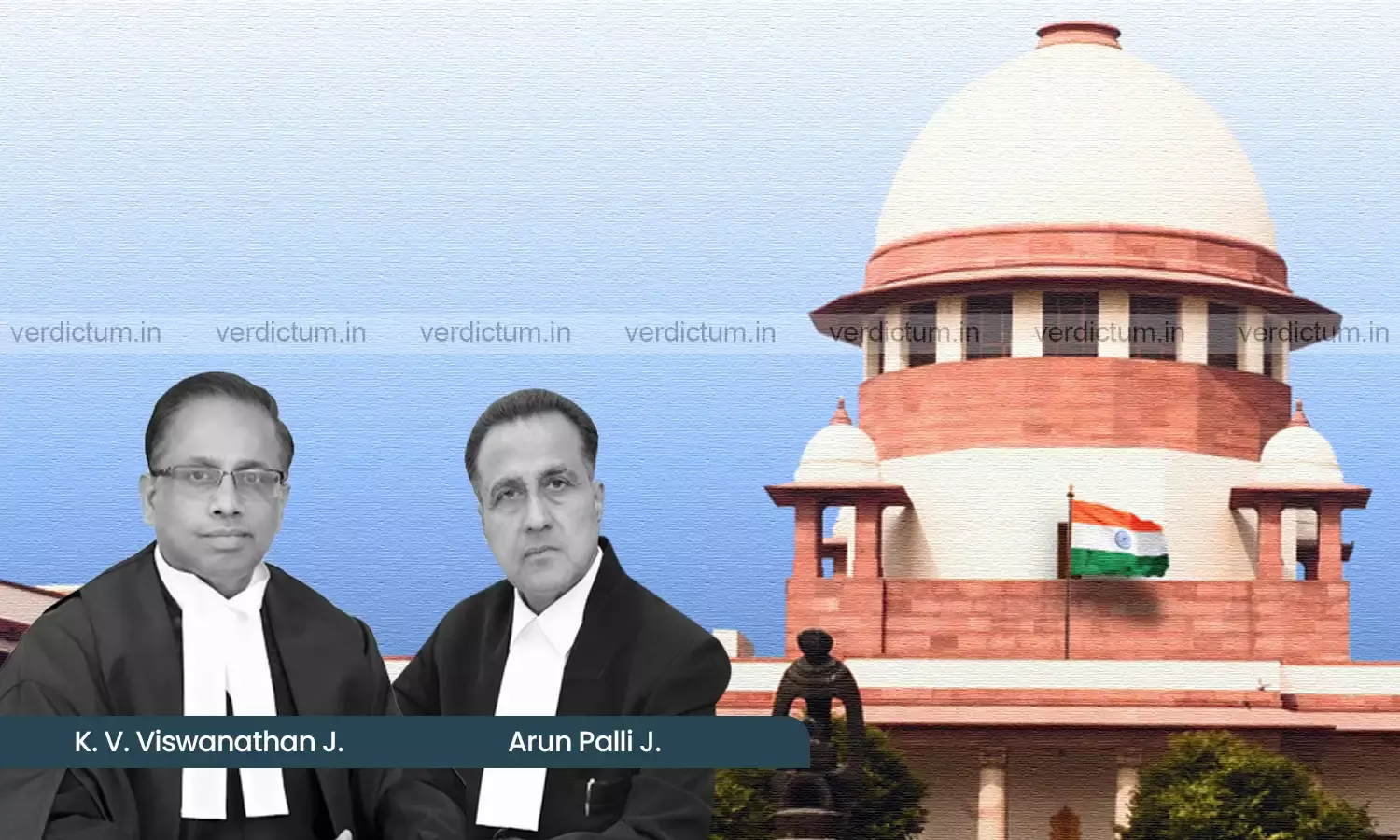
A Bench of Justice K.V. Viswanathan and Justice Arun Palli, referring to IL & FS Financial Services Limited v. Adhunik Meghalaya Steels Private Limited (2026), reproduced the Supreme Court’s observation: “It was not disputed before us that entries in balance sheets could constitute a valid acknowledgement and in fact it could not have been disputed, in view of the categoric pronouncement of this Court in Asset Reconstruction Co. (India) Ltd. v. Bishal Jaiswal, (2021) 6 SCC 366.”
Applying the principle to the appeal, the Bench held: “We are satisfied that there is a clear acknowledgement of liability in terms of long-term borrowings in the balance sheets for the Financial Years 2015-16, 2016-17 and 2017-18.”
Advocate Vatsala Kak appeared for the appellant company. Advocate Shivam Singh appeared for the first respondent.
Background
A bank sanctioned a loan facility of ₹12.26 crore to the corporate debtor. After the account was classified as a non-performing asset, the bank assigned the debt and its underlying rights to the appellant asset reconstruction company.
The corporate debtor’s balance sheets for three successive financial years reflected long-term borrowings. The appellant contended that those entries and separate one-time settlement proposals acknowledged a subsisting debt and extended the limitation period. It subsequently filed an application under Section 7 of the Insolvency and Bankruptcy Code claiming an outstanding debt of ₹21.61 crore.
The NCLT held that the appellant was a financial creditor and that acknowledgment in the corporate debtor’s balance sheet brought the application within limitation. It accordingly admitted the application. On appeal, the NCLAT held that the financial statements contained no valid acknowledgment and dismissed the application as time-barred.
Before the Supreme Court, the appellant relied on the balance sheets and the settlement proposals. The first respondent argued that the notes accompanying the balance sheets stated that no bank confirmation had been received and that no default was continuing. He also contended that one balance sheet had not been produced before the tribunals and that the settlement proposals had not formed the basis of the original application.
Court’s Observations
Balance Sheets May Acknowledge Debt Under Section 18
The Court examined Section 18 of the Limitation Act, under which a written and signed acknowledgment made before expiry of the prescribed period starts a fresh limitation period. It referred to Asset Reconstruction Company (India) Limited v. Bishal Jaiswal (2021), Dena Bank v. C. Shivakumar Reddy (2021), Vidyasagar Prasad v. UCO Bank (2024) and IL & FS Financial Services Limited v. Adhunik Meghalaya Steels Private Limited (2026).
The Court explained that whether a particular balance-sheet entry amounts to acknowledgment depends on the document’s tenor, context and surrounding circumstances. The statutory requirement therefore had to be applied to the documents and facts of the particular case.
Quoting Dena Bank, the Court stated: “Section 18 of the Limitation Act cannot also be construed with pedantic rigidity in relation to proceedings under the IBC. This Court sees no reason why an offer of one-time settlement of a live claim, made within the period of limitation, should not also be construed as an acknowledgment to attract Section 18 of the Limitation Act.”
Three Balance Sheets Acknowledged The Liability
The Court examined the corporate debtor’s balance sheets for the three financial years and found that they consistently reflected long-term bank borrowings. It rejected the objection that one of the balance sheets had not been produced before the tribunals because the first respondent did not dispute that it was the correct document, while the other two were admittedly on the record.
The Court also rejected reliance on the accompanying notes. One note stated that no default was continuing, while another acknowledged that the account had earlier been declared a non-performing asset because of defaults and that recovery proceedings were pending before the Debts Recovery Tribunal.
The Court observed: “The Notes relied upon also do not carry the case of the Respondent any further insofar as the acknowledgement of liability is concerned. In fact, there is a contradiction in the Notes.”
On that basis, the Court concluded that the balance sheets acknowledged a subsisting liability and that the NCLAT had misread both the entries and their accompanying notes.
Application Was Timely; Default Alone Remitted
The Court held that the acknowledgment reflected in the three balance sheets kept the Section 7 application within limitation. It accordingly set aside the NCLAT judgment.
The first respondent had not argued before the NCLT that no default existed even if the debt was within limitation. Since the contention was advanced before the Supreme Court, the Court granted him one opportunity, on the special facts of the case, to place that plea before the NCLT.
The Court clarified: “In any event, by this judgment, we are only holding that the application is within time. As to whether as on the date of the application under Section 7, there was any default, is a matter which can be decided once the matter is remitted.”
It further held that all other issues, including limitation, stood concluded. Since the balance-sheet acknowledgments were sufficient to decide limitation, the Court did not examine the one-time settlement proposals.
Conclusion
The Supreme Court allowed the appeal and set aside the NCLAT judgment dismissing the Section 7 application as time-barred. It remitted the matter to the NCLT to consider only the first respondent’s plea concerning the occurrence of default under Section 7(5) of the Insolvency and Bankruptcy Code. All other issues, including limitation, were concluded, and the Court made no order as to costs.
Cause Title: UV Asset Reconstruction Company Limited v. Gautam Sinha and Others (Neutral Citation: 2026 INSC 1263)
Appearances
Appellant: Advocates Sumesh Dhawan, Mahesh Agarwal, Ankur Saigal, Vatsala Kak, Nishant Rao, Geetika Sharma and Sagar Thakkar; Advocate E.C. Agrawala (AOR)
Respondents: Advocates Shivam Singh, Murari Kumar, Animesh Kumar and Dhananjaya Kumar Tyagi; Advocate Smarhar Singh (AOR); Advocate Vaibhav Manu Srivastava (AOR)