

Challenge To Answer Key Can Be Entertained Only Where Error Is Glaring And Apparent Without Inferential Reasoning: Supreme Court
The Apex Court clarified that mere doubt must favour the examining body, while an offending question may be excluded where it is shown to be incorrect or to admit more than one correct answer.
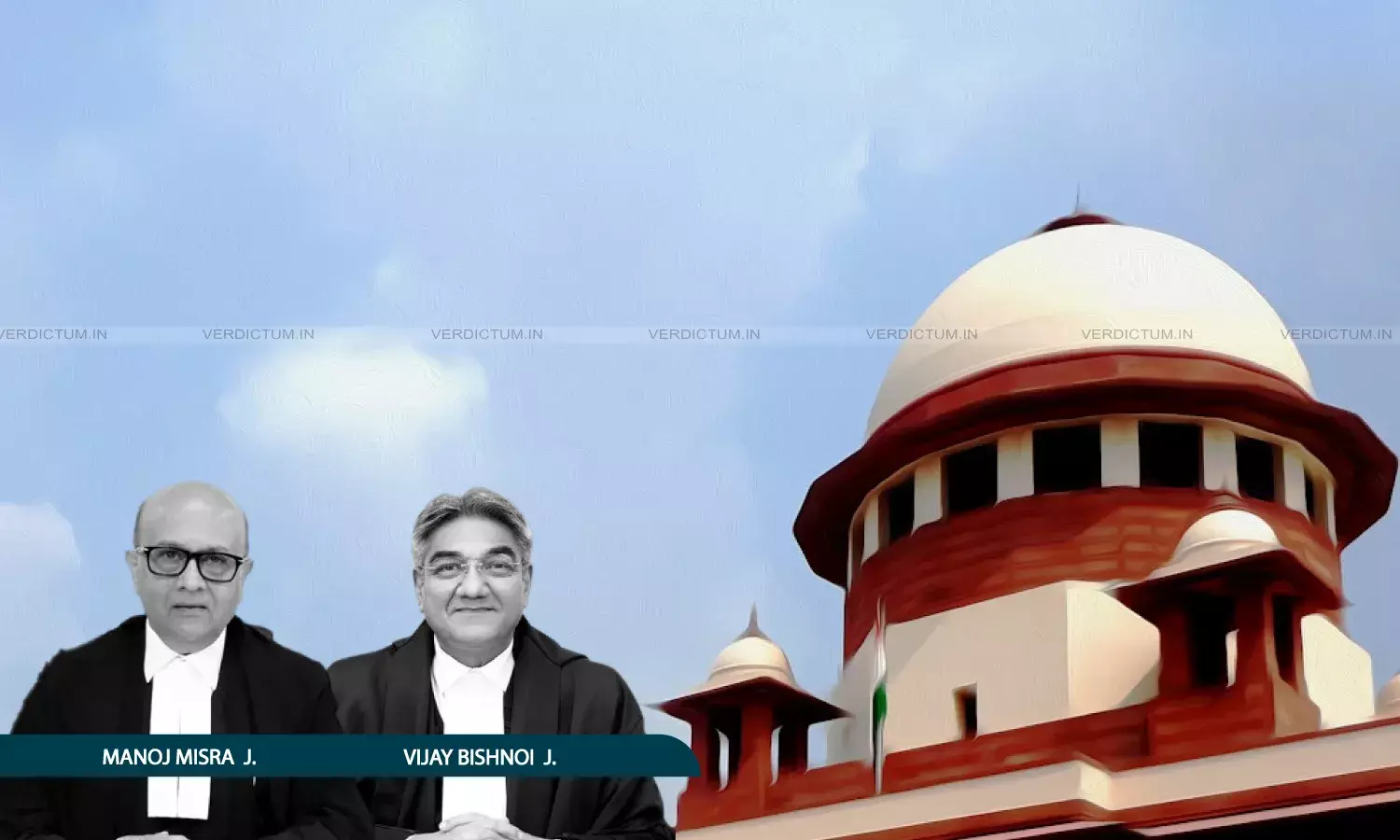
Justice Manoj Misra, Justice Vijay Bishnoi, Supreme Court
The Supreme Court has held that a challenge to an answer key can be entertained only where the alleged error is so glaring and apparent that it can be demonstrated without any inferential reasoning.
The Court set aside an Allahabad High Court judgment which had awarded an additional mark to a candidate and dismissed his writ petition.
The Court was hearing an appeal by the Uttar Pradesh Subordinate Service Selection Commission against a review judgment of the Allahabad High Court which held that the candidate’s answer to a Village Development Officer recruitment examination question was correct and directed consequential declaration of his result, recommendation and appointment.
A Bench of Justice Manoj Misra and Justice Vijay Bishnoi observed: “… a challenge to the correctness of answer key must be entertained only where the mistake is so glaring and apparent that no inferential process or reasoning is required to show that the mistake exists. Besides, while considering a challenge to the correctness of a question or an answer, the court must bear in mind that there is a presumption about the correctness of the question/ answer, and the onus is on the candidate to demonstrate that it is incorrect.”
Senior Advocate P.S. Patwalia appeared for the Commission, while Senior Advocate Sudhir Kumar Saxena appeared for the respondents.
Background
The Commission conducted a written examination for recruitment to Village Development Officer posts and published a provisional answer key. After considering objections, it issued a revised answer key and declared the result.
The disputed question required candidates to identify the incorrectly matched pair from Baburnama–Babur, Shahjahannama–Mohammad Tahir, Humayunnama–Humayun and Tuzuk-e-Jahangiri–Jahangir. The Commission treated the second pair as the correct option, while the candidate selected the third on the ground that Humayunnama was authored by Gulbadan Begum and not Humayun.
A Single Judge dismissed the candidate’s writ petition on the ground of laches while relying on U.P. Public Service Commission v. Rahul Singh (2018). The Division Bench initially dismissed his appeal but subsequently allowed his review petition after considering an expert report which stated that the third option would be correct if the pairs were examined by authorship, while the second would be correct if they were examined according to the person described in each work.
The High Court awarded the candidate one mark, directed the Commission to declare his result and make the corresponding recommendation, and directed the State Government to issue an appointment.
The Commission contended that the expert report did not declare its answer incorrect and that the question did not prescribe authorship as the basis for identifying the unmatched pair. The respondents argued that the question appeared in the General Knowledge portion of the examination and should therefore have been understood as testing knowledge of authorship. They relied on Siddhi Sandeep Ladda v. Consortium of National Law Universities (2025) to contend that courts could interfere where academic decisions adversely affected candidates.
Court’s Observations
Referring to Ran Vijay Singh v. State of Uttar Pradesh (2018), the Court reiterated that re-evaluation may be permitted only in rare or exceptional cases where a material error is demonstrated without inferential reasoning or rationalisation. Courts should not themselves scrutinise answer sheets as academic matters are ordinarily best left to experts.
The Court also referred to U.P. Public Service Commission v. Rahul Singh (2018), which placed the burden upon the candidate to establish not merely that the answer key was incorrect, but that the error was glaring and apparent.
The Court held: “Further, in the event of a mere doubt about the correctness of the question or the answer, the benefit should go to the examining body and not to the candidate. However, where it is demonstrated that the question itself is incorrect, or there could be two correct answers to the question when only one is to be chosen from the options provided, the Court may interfere and order exclusion of the suspect or offending question from evaluation.”
It added that where only one answer is correct but the examining body has selected a different option, the Court may direct the award of marks for the correct answer and revision of the result. Courts must also be strict while condoning delay and may reject a challenge where the prescribed objection procedure was not followed.
The Court found that the question did not specify the principle according to which the pairs were to be assessed. The Commission had applied a commonsense approach by matching each work with the person about whom it was written.
The Court observed: “At this stage, it would be pertinent to note that the concerned question did not spell out the parameter/ principle basis which the incorrect pair had to be selected from the available options. Absent any parameter/ principle for pairing, a commonsense approach of pairing the book with the subject i.e., the person about whom the book was, is what has been adopted by the Commission in selecting the answer. Such an approach cannot by any stretch of imagination be considered arbitrary or irrational. Therefore, in the context of the question concerned, option ‘B’ is one answer which cannot be called patently erroneous.”
The Court held that the candidate had inferred that authorship was the governing parameter despite there being nothing in the question to support that assumption. It characterised this as an assumptive mistake attributable to the candidate rather than to the question or the examining body.
The Court found that the expert report relied upon by the High Court was equivocal. While it supported the candidate’s answer if authorship was treated as the basis of pairing, it supported the Commission’s answer if the books were matched with their subjects.
The Court remarked: “The Expert Report relied upon by the High Court is not categorical in saying that Option ‘C’ is the only correct answer. What it says is that if one adopts the logic of authorship of the scripture, option ‘C’ would be the correct answer i.e., pairing based on authorship; and if logic adopted is subject-wise i.e., on whom the book is written, option ‘B’ would be the right answer. Thus, the Expert Report does not say that option ‘B’, chosen by the Commission, is an incorrect answer.”
The Court consequently held that neither the disputed question nor the answer selected by the Commission suffered from a glaring or apparent error.
Rejecting the contention that authorship should have been inferred because the question appeared in the General Knowledge portion, the Court held that a question must be understood as it stands and not according to how a candidate or court believes it ought to have been framed.
The Court underscored: “Misreading a question, or reading something into a question, often results in a wrong answer. Very often questions are framed to confuse a candidate so that only an alert mind picks up the requisite nuances of a question for rendering a proper answer. The examinee / candidate cannot say that the question ought to have been drafted like this or that. Therefore, while considering whether the question or answer is correct, the Court must only consider whether the question or answer as it stands is correct or not and not what it ought to have been.”
Since the Commission’s answer was neither patently erroneous nor irrational, the Court held that the question and answer were not amenable to judicial review. It found that the High Court had exceeded its jurisdiction by interfering with the answer key, particularly while exercising review jurisdiction.
Conclusion
The Supreme Court allowed the Commission’s appeal, set aside the Allahabad High Court’s review judgment and dismissed the candidate’s writ petition. All pending applications were also disposed of.
Cause Title: Uttar Pradesh Subordinate Service Selection Commission v. Ashok Yadav & Others (Neutral Citation: 2026 INSC 991)
Appearances
Appellant: Senior Advocate P.S. Patwalia; AOR Talha Abdul Rahman; Advocates Sudhanshu Tewari, Deveshi Chand, Faizan Ahmed and Vibha Swaminathan
Respondents: Senior Advocate Sudhir Kumar Saxena; AORs Umesh Dubey, Namit Saxena and Shashank Singh; Advocates Himanshu Raghave, Aviral Saxena, Harsh Srivastava, Abhinav Sharma, Shivansh Rajput, Fardeen Khan, Raman Chugh, M.R. Shamshad, Sanjay Kumar, Arijit Sarkar, Prapti Shrivastava, Sweety Gautam and Varun Singh
