Supreme Court Upholds Quashing Of UP Housing Board’s ₹388 Crore Demand From Developer For Substituted Land
The Court expressed no opinion on the Special Investigation Team report concerning alleged collusion and left the authorities free to act in accordance with law.
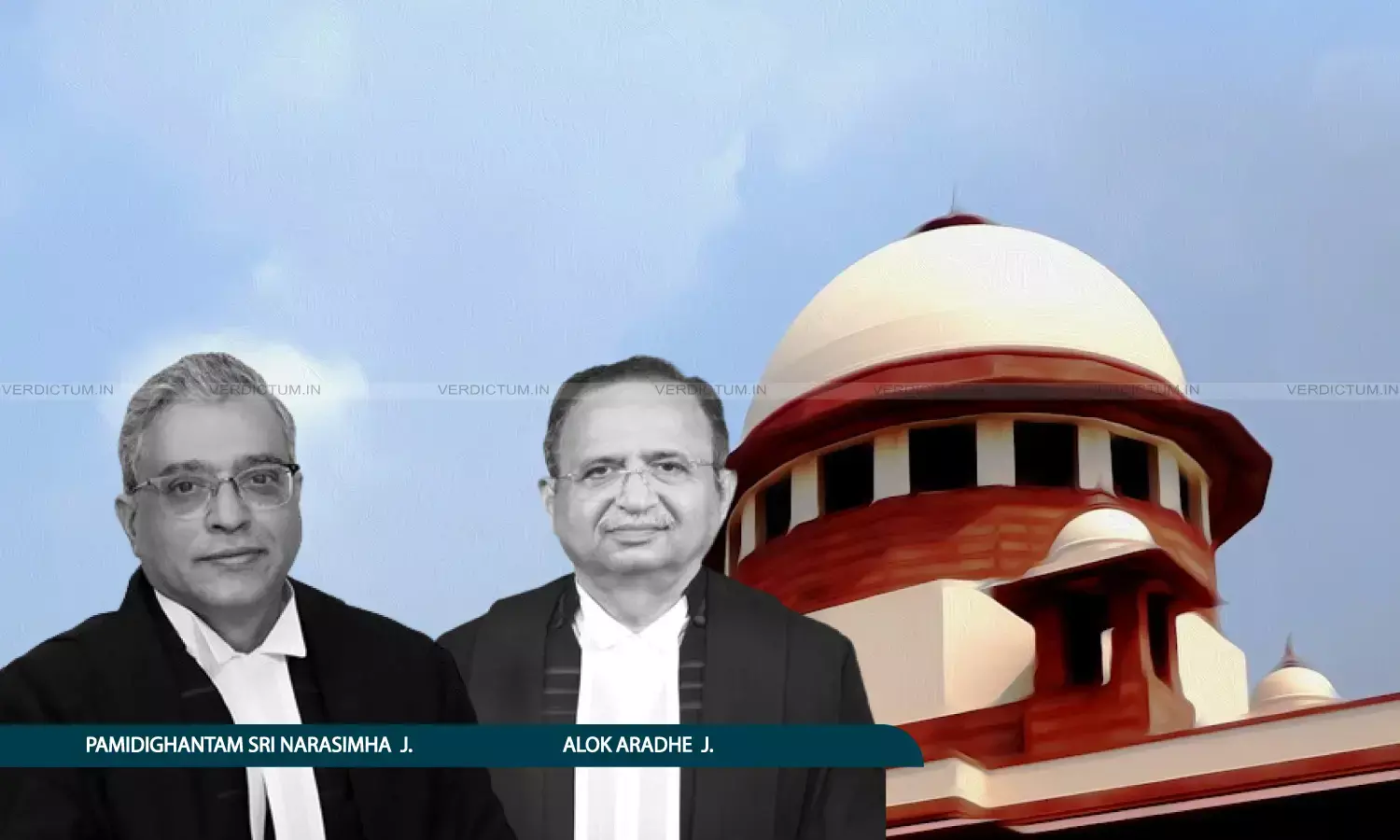
Justice Pamidighantam Sri Narasimha and Justice Alok Aradhe, Supreme Court
The Supreme Court has upheld the Allahabad High Court’s decision quashing the Uttar Pradesh Avas Evam Vikas Parishad’s demand for ₹388 crore from a developer for substituted land allotted under an exchange deed.
The Court held that the Housing Board, having retained and developed the more valuable acquired land without paying compensation, could not demand a further price for the replacement parcel.
The Court was hearing civil appeals filed by the State of Uttar Pradesh and the Housing Board against a High Court judgment that had partly allowed the developer’s writ petitions. The High Court had set aside two conditions imposed by the Chief Secretary, including the direction to charge the current bulk-sale rate, quashed the consequential demand notice and ordered reconsideration of the allotment of 450 flats reserved for economically weaker sections and low-income groups.
A Bench of Justice Pamidighantam Sri Narasimha and Justice Alok Aradhe observed: “The Housing Board has thus retained and developed the acquired land, which is of greater value than the land it gave in exchange, without paying any compensation to the predecessors-in-interest. It cannot, in these circumstances, demand a further price from the first respondent for the substituted land. Under these circumstances, the decision of the High Court in setting aside condition (ii) need not be interfered with.”
Attorney General R. Venkataramani and Additional Solicitor General Aishwarya Bhati appeared for the State; Senior Counsel P.N. Misra represented the Housing Board; and Advocate Veenu Singhal appeared for the first respondent.
Background
The Housing Board acquired 12.047 acres belonging to the developer’s predecessors-in-interest for its Vasundhara Scheme. A compromise recorded by the Supreme Court provided for adjustment of the acquired land within the scheme, subject to a water-purification use restriction, without either party paying value or compensation.
Under a 2004 exchange deed, the Housing Board allotted two parcels that had already been resumed for a bird sanctuary and were recorded as a lake and barren land. The predecessors-in-interest later transferred their interest, including the right to receive replacement land or compensation, to the developer.
Following further litigation, the Housing Board provided another parcel under the Siddharth Vihar Scheme. After the State granted its no-objection and the developer paid ₹32.45 crore in conversion charges, a 2016 exchange deed described the replacement parcel as residential freehold land and permitted residential construction. The developer constructed 2,476 general houses and 450 reserved-category houses, creating third-party rights through sales.
The Chief Secretary later directed allotment at the current bulk-sale rate, prompting the ₹388 crore demand. The High Court set aside that condition, a separate direction reimposing the earlier use restriction and the demand notice. It also ordered reconsideration of the application concerning the 450 reserved-category flats.
The appellants contended that the earlier use restrictions bound the replacement property and relied on a Special Investigation Team report alleging collusion. The developer relied on the Board’s retention of the more valuable Vasundhara land, the absence of compensation and the conversion charges already paid.
Court’s Observations
Use Restriction Applied Only To Acquired Land
At the outset, the Court said that the appeals raised no question of law and required a review of the facts to test the High Court’s conclusions. It then read the compromise as linking the water-purification restriction to the original acquired land and its adjustment within the Vasundhara Scheme, rather than every parcel that might later be allotted in exchange.
The Bench observed: “The compromise does not attach a perpetual restriction to whatever land the Housing Board might eventually give in exchange.”
The compromise also recorded that neither party would pay value or compensation during the exchange.
Housing Board’s Unlawful Allotment Caused 2004 Exchange To Fail
The Court held that the Housing Board was required to provide an unencumbered alternative parcel. Instead, it allotted land that had already been resumed for a bird sanctuary and whose revenue descriptions disclosed its character.
It said: “Clearly, no due diligence was exercised by the Housing Board while making the alternative allotment, and the predecessors-in-interest of the first respondent, for no fault of theirs, could not take possession of the said land due to the unlawful allotment made by the Housing Board.”
The 2004 deed consequently failed, and its use restriction could not bind the later allotment. The High Court was therefore justified in setting aside its reimposition.
Sale Deed Assigned Right To Replacement Land
The Court rejected the challenge to the transfer, holding that the alternative land represented the predecessors’ acquired property and could be transferred by its title-holder.
Examining the sale deed, the Bench found: “A bare perusal of the sale deed between the predecessors-in-interest and the first respondent indicates that there was not only an effective transfer of the allotted land but also an assignment of the right to receive any other land given by the Housing Board in lieu of the above land.”
2016 Exchange Deed Was A Fresh Instrument
The 2016 deed concerned a different plot in a different scheme, was executed with the State’s no-objection and permitted residential construction on a freehold plot.
The Bench said: “Notably, clause 13 imports only the stipulation that no value or consideration is payable from this Court’s order dated 20.03.1995. The parties thus chose which terms of the compromise would govern the substituted land.”
No Opinion Expressed On SIT Report
The appellants relied on the Special Investigation Team’s finding of omissions by a senior housing official, while the developer challenged the inquiry and report.
The Court clarified: “We express no opinion either on the report or its implications. We keep it open to enable the authority to act in accordance with law.”
No Basis For Further Price Demand
The Court considered the deed’s no-consideration term, the conversion charges already paid, the disparity in circle rates and the Housing Board’s creation of third-party rights over the acquired land.
The judgment recorded: “The Explanatory Note of the 228th Board Meeting, in turn, record that the Vasundhara Scheme is older and fully developed, and that its circle rate is considerably higher than that of the Siddharth Vihar Scheme.”
These circumstances left no ground for demanding a further ₹388 crore for the replacement land.
Conclusion
The Supreme Court dismissed the State and Housing Board’s appeals and upheld the setting aside of the two conditions imposed by the Chief Secretary and the consequential demand notice.
It extended by three months from the date of its judgment the period granted to the State for allotment of the 450 flats for economically weaker sections and low-income groups.
The parties were directed to bear their own costs, and pending applications were disposed of. The Court’s decision did not prevent the competent authority from acting on the Special Investigation Team report in accordance with law.
Cause Title: Uttar Pradesh Avas Evam Vikas Parishad & Another v. M/s Gaursons India Pvt. Ltd. & Others (Neutral Citation: 2026 INSC 1233)
Appearances
Appellants: R. Venkataramani, Attorney General; Aishwarya Bhati, Additional Solicitor General; P.N. Misra, Senior Counsel
Respondents: Veenu Singhal, Advocate