

Breaking: Conversion Alone Doesn't Confer Membership In Backward Class Muslim Communities: Apex Court Upholds HC Striking Down Order On Reservation Benefits For Religious Converts
The Court held that former caste or community status cannot automatically be transposed into the Muslim backward class category, nor can a private religious body conclusively determine statutory entitlement.

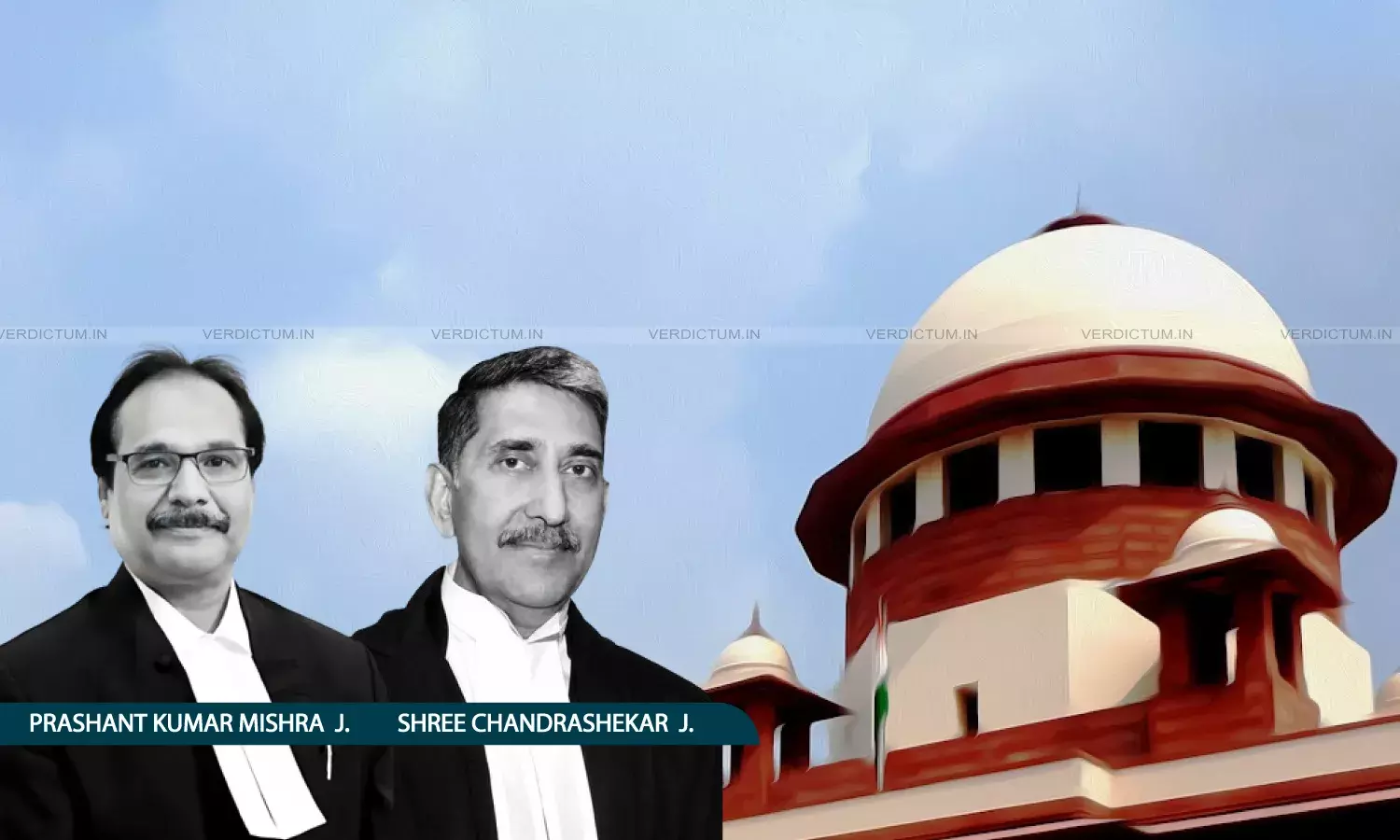
Justice Prashant Kumar Mishra, Justice Shree Chandrashekhar, Supreme Court
The Supreme Court has affirmed a Madras High Court judgment invalidating a Tamil Nadu Government Order that allowed individuals converting from backward classes, most backward classes, denotified communities, and scheduled castes to Islam to be issued community certificates as backward class Muslims.
It was held that a pre-conversion caste or community status cannot automatically be transposed upon conversion, and that such an executive order creates an artificial route for reservation benefits without establishing the necessary social and legal links.
The Court had reserved its order at the admission stage on a Special Leave Petition filed by the State of Tamil Nadu, challenging the Madras High Court judgment, which held that converts to Islam cannot claim Backwards Class Status for reservations.
The Bench of Justice Prashant Kumar Mishra and Justice Shree Chandrashekhar held, "We therefore affirm the central conclusion of the High Court, though our reasoning proceeds on the constitutional foundation set out above. A person who converts to Islam does not by that act alone become a member of any one of the seven notified backward class Muslim communities in the state. His former caste or community status cannot automatically be transposed into the Muslim backward class category, nor can a private religious body conclusively determine such statutory entitlement."
"Tested on that standard, we are of the view that the impugned GO cannot be sustained and has been rightly quashed by the High Court. It creates an artificial route by which a person moves from a pre-conversion social or backward social order into a notified Muslim backward class without establishing the necessary social and legal link. Therefore, the declaration made by the High Court that the impugned GO itself unsustainable in law calls for no interference", the Court held.
Senior Advocates Mukul Rohtagi and Siddharth Luthra appeared for the State/Petitioner, while Senior Advocate Gopal Sankaranarayanan appeared for the Respondents.
The Madras High Court held that upon conversion, the person becomes only a Muslim and nothing more. It had struck down a Tamil Nadu Government Order that had allowed converts from Backwards Class, Most Backward Class, Denotified Community and Scheduled Caste backgrounds to be issued community certificates as belonging to one of the seven notified Backwards Class Muslim sects.
The State contended that Government Order (Ms) No. 31—issued on the recommendation of the Tamil Nadu Backwards Classes Commission—merely protects affirmative action benefits so that exercising the fundamental right to freely practice religion under Article 25 does not result in the denial of reservation rights.
The Supreme Court observed, "A person who converts from a Hindu social order to a non-Hindu social order cannot claim affirmative action under Article 16(4) of the Constitution merely on the basis of the social backwardness associated with his pre-conversion status. The backwardness suffered in the antecedent social order cannot by itself be carried forwards so as to confer upon him the status of a backward class in the religion to which he has converted. By virtue of paragraph 3 of the Constitution (Scheduled Castes) Order, a person who professes a religion other than Hinduism, Sikhism or Buddhism cannot be deemed to be a member of a Scheduled Caste. Consequently, upon conversion to a religion not specified therein, such person ceases to possess the Scheduled Caste status attached to his antecedent caste and cannot claim any affirmative action benefit of a backward class under Article 16(4) of the Constitution which is predicated upon membership of a Scheduled Caste."
The original writ petitioner/Respondent, born a Hindu named Paramasivam, converted to Islam in 2015 and changed his name to Sameer Ahamed. He sought a community certificate certifying him as a Muslim Lebbai to avail Backwards Class reservation benefits.
The application was rejected by the Tahsildar, pursuant to which the petitioner then challenged the rejection relying on G.O. (Ms) No. 31 dated March 09, 2024, which the Tamil Nadu Backward Classes Commission had recommended and the State Government had issued, directing that Backward Classes, Most Backward Classes, Denotified Communities and Scheduled Castes converts to Islam be treated as Backward Class Muslims and issued community certificates as belonging to one of the seven notified sects.
The Court added, "Conversion to a non-Hindu social order does not by itself confer membership of any particular notified backward class community. A person's pre-conversion caste or community status cannot, merely by reason of conversion, be transposed into membership of a distinct notified backward class community in the post-conversion social order. The social backwardness which formed the basis of the person's pre-conversion status cannot by itself furnish the legal foundation for conferring upon him membership of a different notified backward class community after conversion."
It was observed that conversely, where a person, after having converted from the Hindu social order to a non-Hindu social order, reconverts to Hindu social order, the question of his entitlement to affirmative action under Article 16(4) cannot be determined merely by reference to his antecedent status. Such entitlement would require an independent fact-specific determination by the competent authority as to whether the original caste or social identity has genuinely revived upon reconversion and whether the person satisfies the applicable constitutional and legal requirements for such affirmative action.
"No statutory benefit, protection, reservation or other entitlement under Article 16(4) of the Constitution, the enjoyment of which is predicated upon a particular Hindu social order, can be claimed or extended merely on the basis of such antecedent membership after the person has converted to Islam, Christianity or any other non-Hindu social order. Such conversion severs the legal foundation of an entitlement which is specifically conditioned upon membership of that Hindu social order", the Court held.
It was added that a community certificate is declaratory of and not and does not create or confer the status which it purports to recognize. Neither the issuance of a community certificate nor an executive instruction can enlarge, modify or dispense with the substantive constitutional and statutory conditions governing membership of the class or entitlement to the benefits attached thereto.
Accordingly, the petition was disposed of.
Cause Title: The Secretary to the Government, Government of Tamil Nadu v. Sameer Ahmed and Ors. [SLP(C) No. 25507/2026]