

“What A Policy Says, It Is”: Supreme Court Grants War Injury Pension For Disability During Operation Rakshak Posting
The Bench held that once an operation is specially notified under Category E(i) of MoD Policy Letter dated January 31, 2001, the benefit applies unless the policy or notification excludes it; directed the Government to state applicability expressly in future notifications.

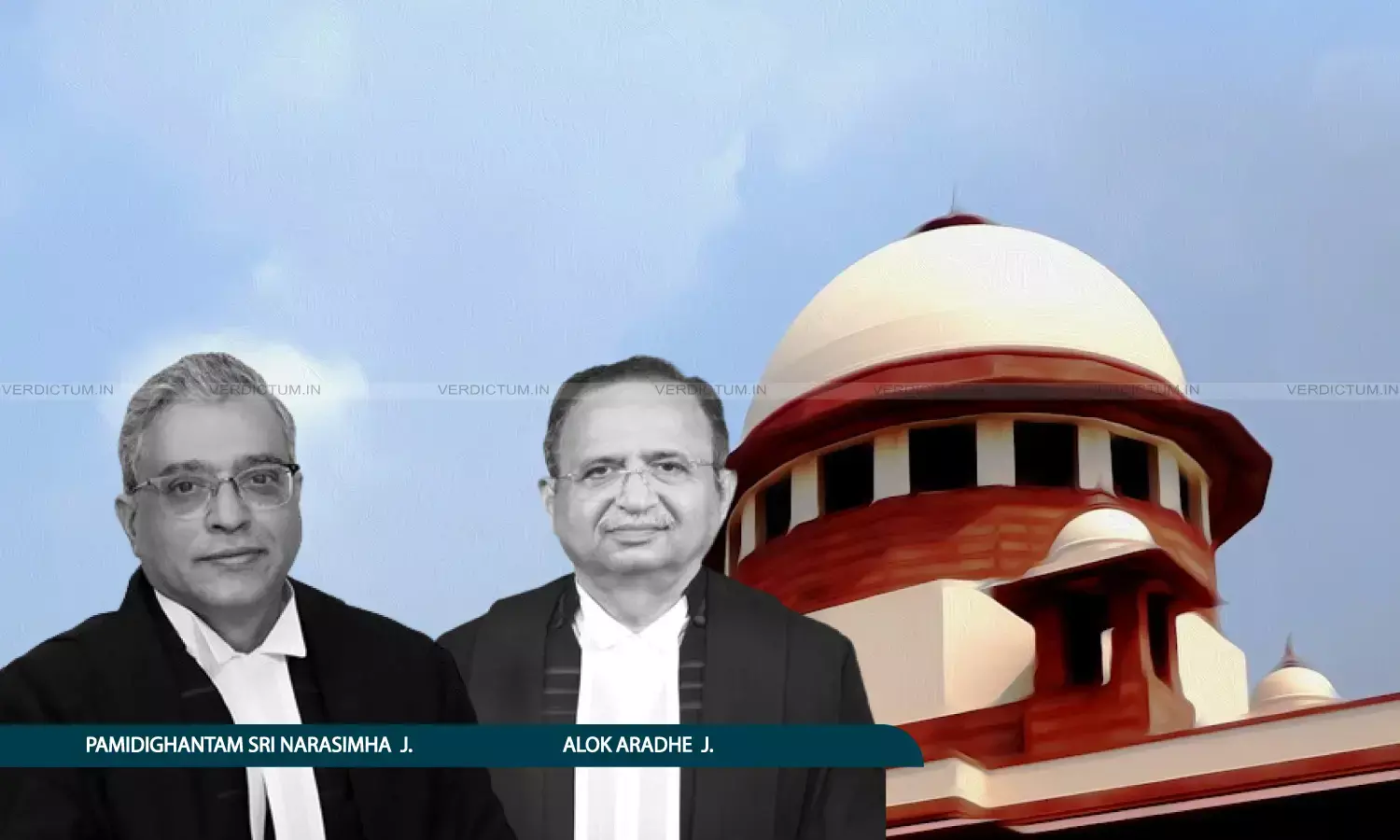
Justice Pamidighantam Sri Narasimha and Justice Alok Aradhe, Supreme Court
The Supreme Court has held that courts will give effect to the plain language of a policy and not to what the policymaker may have imagined it to mean. It ruled that the Ministry of Defence cannot read into its own policy an exclusion that the policy does not contain.
Dismissing the Union of India’s appeal, the Court held that Category E(i), which covers “operations specially notified by the Govt. from time to time”, is enabling in nature. Once an operation is notified, the benefit follows unless the policy or the notification indicates otherwise. The Court added that, in future, the Government must declare in clear terms whether War Injury Pension applies to an operation it notifies.
A Bench of Justice Pamidighantam Sri Narasimha and Justice Alok Aradhe observed, “While interpreting the plain language of the policy, Courts will simply declare, What a policy says, it is and not what is in the imagination of the policymaker”.
Archana Pathak Dave, Additional Solicitor General appeared for the appellants.
“There is no doubt about the fact that the power and jurisdiction to prescribe applicability of a policy to the concerned personnel or the conditions for its applicability are completely within the province of the Defence Administration. However, the policy formulations must clearly articulate their scope, ambit and their application. If an issue relating to applicability of a policy arises for consideration, the primary burden lies on the policymaker to demonstrate the circumstances in which the benefit would accrue or not accrue. Normally, the policymaker’s prescription will not be interfered with, unless the court finds that its approach is beyond the range of reasonable meaning that can be given to the plain language of the policy. If the policymaker interprets its own policy against the plain language or in a manner that could be discriminatory, arbitrary, irrational or goes against the very purpose and object of the policy, the Courts will disregard the interpretation offered by the policymaker”, the Bench had also noted.
The respondent, Narender Kumar, was enrolled in the Indian Army on December 30, 1996. While posted at Kargil from July 13, 2003 to July 6, 2005, he was diagnosed with Rheumatoid Arthritis (Seropositive). He was discharged on January 31, 2013.
The Release Medical Board assessed his disabilities as aggravated by military service at 70 percent, rounded off to 75 percent, and he received Disability Pension. About six years later, he sought War Injury Pension under Part II, Category E(i), Para 4.1 of the Policy Letter, contending that his condition resulted from his posting at Kargil during Operation Rakshak.
The Armed Forces Tribunal allowed his application on April 8, 2024. It held that the entire Jammu and Kashmir area is an operational area. The Punjab and Haryana High Court dismissed the Union’s challenge on August 11, 2025, relying on the Release Medical Board’s opinion that the ailment originated during the Kargil posting. The Union then approached the Supreme Court.
The Union argued that Category E(i) covers only specially notified operations such as Operation Sindoor or Operation Snow Leopard, not ongoing operations like Operation Rakshak. It also argued that the contrary view would render the other clauses of Category E otiose. It further relied on Para 44 of Army Order 01 of 2003, under which Battle Casualty reports are not initiated in such operations.
The Court noted that sub-categories (a) to (h) deal with situations akin to war or extreme violence, while Category E(i) gives the defence administration flexibility. It found nothing in the Policy or in any notification to exclude Operation Rakshak, other than the oral statement of the Additional Solicitor General. It held that the primary burden lies on the policymaker to show when a benefit does or does not accrue. Where the language is unrestrictive, a liberal interpretation is compelling for pensionary benefits.
It declined to rely on Army Order 1 of 2003, observing that it causes more confusion than it clarifies. The Court also criticised the continuing uncertainty about which MoD rules apply and called for comprehensive, clearly identifiable subordinate legislation.
The Court dismissed the appeal and directed that future notifications under Category E(i) must clearly state whether the Para 4.1 benefits apply.
Cause Title: Union of India & Ors. v. Narender Kumar (Neutral Citation: 2026 INSC 1166)
Appearances:
Appellants: Archana Pathak Dave, Additional Solicitor General.