Judicial Member Need Not Chair PMLA Adjudicating Authority But Must Sit On Bench Adjudicating Under Sections 8(2) & 8(3) Of The Act: Supreme Court
The Court further held that a single-Member Bench remains permissible for final adjudication if that Member is the Judicial Member.
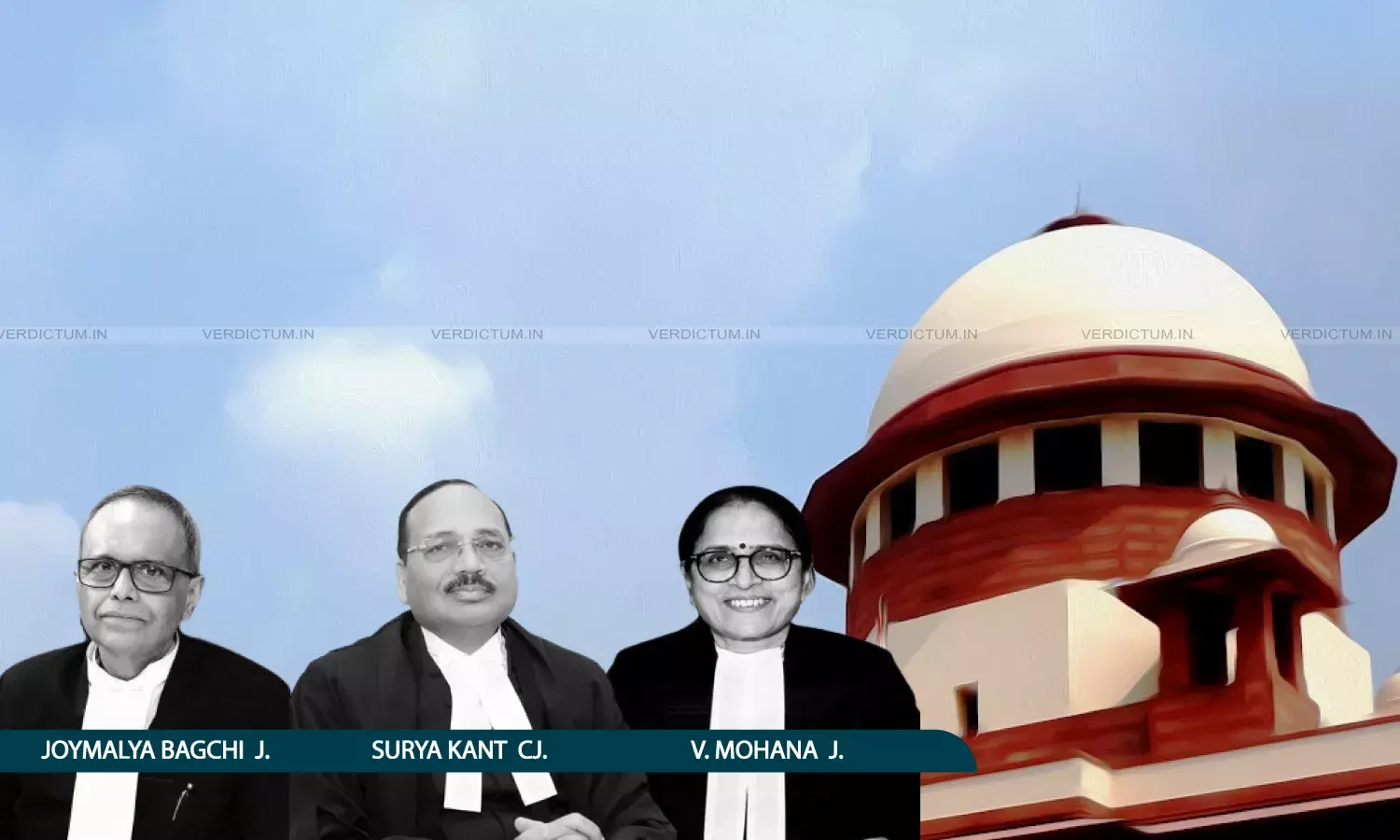
CJI Surya Kant, Justice Joymalya Bagchi, Justice V. Mohana, Supreme Court
The Supreme Court has held that there is no legal requirement for the Judicial Member of the PMLA Adjudicating Authority to be appointed as its Chairperson because the Chairperson's role is administrative.
However, the Apex Court added that a Judicial Member must participate when the Authority hears the parties and finally determines under Sections 8(2) and 8(3) of the PMLA whether property is involved in money laundering.
The Court was hearing a batch of civil and criminal appeals arising from decisions of the Delhi, Calcutta and Telangana High Courts, along with an Article 32 petition, concerning whether the PMLA Adjudicating Authority could discharge its functions through a single Member without a legal background.
The challenges included the validity of Sections 6(5)(b) and 6(7) of the PMLA and show-cause notices issued by single Technical Members.
A Bench of Chief Justice Surya Kant, Justice Joymalya Bagchi and Justice V. Mohana observed: “The application of an independent judicial mind is, in our opinion, adequately ensured by the presence of a Judicial Member in the Bench undertaking adjudication under Sections 8(2) and 8(3) of PMLA. The role of the Chairperson of AA, evidently administrative in nature, does not require similar application of mind by a person from the legal field. There is, thus, no mandate for the Judicial Member of AA to be appointed as its Chairperson.”
Senior Advocates Vikram Chaudhri, Gopal Sankaranarayanan, S. Niranjan Reddy and Siddharth Agarwal, for the appellants and the writ petitioner. Additional Solicitor General Anil Kaushik and Senior Advocate Zoheb Hossain appeared for the Union of India and the Directorate of Enforcement.
Background
The lead matter arose from a money-laundering investigation following the recovery of large quantities of cash and gold during income-tax searches. Treating the related criminal case as the scheduled offence, the Directorate of Enforcement provisionally attached movable properties valued at ₹8.57 crore and filed a complaint before the Adjudicating Authority.
The Authority, then consisting only of a Technical Member officiating as Chairperson, issued a notice under Section 8(1) of the PMLA. The respondent approached the Delhi High Court, challenging the attachment provision and the competence of a single-member Authority without a Judicial Member.
The Delhi High Court upheld the possibility of a sole Member discharging the Authority's functions and held that a Judicial Member was not necessarily required. Connected proceedings before the Calcutta and Telangana High Courts similarly concerned show-cause notices or adjudication by single non-Judicial Members.
The private parties argued before the Supreme Court that the Authority exercised quasi-judicial powers affecting property rights and therefore required a Judicial Member, who should also serve as Chairperson. The Union and the Directorate of Enforcement submitted that Section 6 permitted single-member Benches and did not require either every Bench or the office of Chairperson to be occupied by a Judicial Member.
Court's Observations
Section 6 Permits Single-Member Benches
The Court held that “Bench” did not necessarily signify a plurality of Members. It found that Section 6 contemplated an Adjudicating Authority comprising Judicial, Administrative and Financial Members, but permitted its jurisdiction to be exercised through Benches consisting of one or two Members.
The Court observed: “We, thus, find greater force in the construction advanced by the Union of India, namely, that a Bench may consist of one Member, being either the Chairperson or one of the other Members, or of two Members, being either the Chairperson and one other Member, or the two Members other than the Chairperson.”
It held that the statutory text neither required the Chairperson to be drawn from the legal field nor mandated the Judicial Member's presence on every Bench. Parliament's express insistence elsewhere in the PMLA upon legally qualified heads of adjudicatory bodies showed that its silence concerning the Authority's Chairperson was deliberate.
Judicial Member Required For Final Adjudication
The Court distinguished the Authority's administrative and adjudicatory functions. Receiving and preserving the reasons and material forwarded by Directorate officers was essentially custodial and did not require substantive decision-making. Similarly, issuing a notice under Section 8(1) of the PMLA involved only a prima facie view based on the Directorate's material and did not itself prejudice the noticee.
Final adjudication was different. The Court held that Sections 8(2) and 8(3) required the Authority to hear rival parties, evaluate evidence, apply statutory presumptions and determine whether property was involved in money laundering. Because that determination could result in dispossession pending trial, legal objectivity required a Judicial Member.
The Court consequently directed: “Consequently, we hold that while the issuance of a show-cause notice under Section 8(1) does not require the participation of the Judicial Member of AA, the Bench that undertakes the hearing and final adjudication under Sections 8(2) and 8(3) must necessarily include the Judicial Member.”
The Court clarified that final adjudication need not be conducted by a two-Member Bench. A single-member Bench could decide the matter if the sole Member was the Judicial Member. Determinations concerning encumbrances under Section 9 and the continued retention of property or records under Sections 20(4) and 21(4) were ancillary and had to be placed before the same competent Bench.
Earlier Orders Will Not Be Reopened On Jurisdictional Ground
The Court held that its ruling would not unsettle orders already passed in good faith under the earlier understanding of the statute. Earlier orders made by single non-Judicial Members could still be challenged on their merits through the statutory appellate process, but the judgment itself would not supply a fresh jurisdictional ground.
The Court clarified: “We, therefore, clarify that the law laid down in this judgment shall not furnish a ground to question the jurisdiction of a Bench of the AA in respect of any order passed by it before the date of this judgment.”
For pending proceedings, however, the Chairperson was required to issue an administrative circular ensuring that every Bench passing a final order under Section 8(3) of the PMLA included the Judicial Member.
Union Asked To Consider Multiple Adjudicating Authorities
The Court noted the sharp increase in provisional attachment orders and the statutory requirement to complete adjudication within 180 days. It found that the replacement of the original framework of multiple Authorities with a single Authority had created a case-management bottleneck that risked hurried decisions.
Since the validity of the 2009 amendment creating a single Authority was not under challenge, the Court declined to direct the establishment of additional Authorities under Article 142 of the Constitution. It instead recommended: “That being so, we recommend to the Union of India that it appropriately consider the suitability and desirability of repealing the 2009 Amendment and reverting to the original framework of multiple Adjudicating Authorities and take necessary steps for the same.”
Conclusion
The Court modified the challenged decisions of the Delhi, Calcutta and Telangana High Courts in accordance with its directions and partly allowed the Article 32 petition. All interim relief, including stays of proceedings before the Adjudicating Authority, was vacated. The pending applications and complaints were directed to be decided under the principles laid down in the judgment, and all pending applications before the Supreme Court were disposed of.
Cause Title: Union of India and Others v. J. Sekar, with connected matters (Neutral Citation: 2026 INSC 1277)
Appearances
Petitioners: Senior Advocates Vikram Chaudhri, Gopal Sankaranarayanan, S. Niranjan Reddy and Siddharth Agarwal; Advocates Mahfooz Ahsan Nazki, Jatin Sehgal and Shubhankar Nag
Respondents: Additional Solicitor General Anil Kaushik; Senior Advocate Zoheb Hossain