

Trust Not A Juristic Person; Cannot Be Arrayed As Accused In Criminal Cases: Supreme Court
The Bench quashed prosecution against an educational trust, holding that a trust lacks a separate legal existence to sue or be sued.

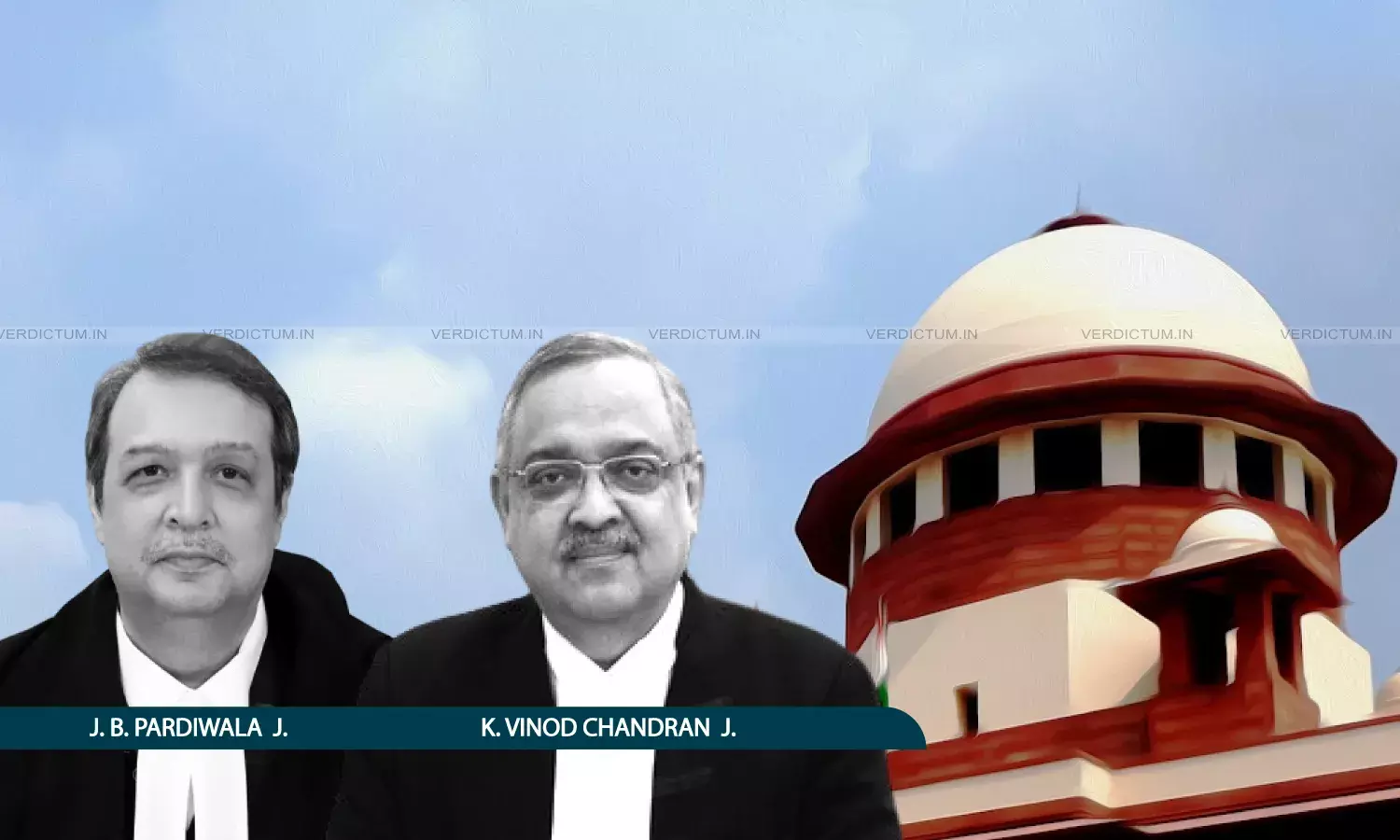
Justice J. B. Pardiwala, Justice K. Vinod Chandran, Supreme Court
The Supreme Court has observed that a Trust is not liable to be arrayed as an accused, it being a concept not capable of being termed as a juristic person.
An appeal was filed being aggrieved by the impugned order passed by the High Court, which refused to interfere with the order of the Sessions Court.
The Bench comprising Justice JB Pardiwala and Justice K Vinod Chandaran held, "We follow the above dictum and hold that the Trust is not liable to be arrayed as an accused, it being a concept not capable of being termed as a juristic person. The allegation of acceptance of money is also by the Trustee who is the second respondent, against whom the prosecution is continuing."
Senior Advocate Nagamuthu appeared for the Appellant, while Additional Solicitor General Kanakamedla Ravindra Kumar appeared for the Respondents
The Appellant was a Trust, and the petitioners before the Special Court and the High Court were the Managing Trustees and the Trust as petitioner Nos.1 and 2. The discharge application was rejected in toto, and the Trust alone has filed an appeal to this Court.
The brief facts of the case were that a company was engaged in collecting investments from various investors/depositors. Eventually, it led to the filing of numerous complaints because their investments had not been refunded. FIRs were registered, and an SIT was constituted. Consequently, the matter was assigned to the CBI.
The Appellant argued that the question of whether a Trust is a juristic person or not was referred to a three- Judge Bench in Administrator Smt. Tara Bai Desai Charitable Opthalmic Trust Hospital Jodhpur v. Managing Director Supreme Elevators India Pvt. Ltd. & Ors., but despite such reference being pending, a co-ordinate Bench has taken a view that a Trust is not a juristic person and cannot sue or be sued, in Sankar Padam Thapa v. Vijaykumar Dineshchandra Agarwal.
The Court noted that in Pratibha Pratisthan v. Manager, Canara Bank, which was in the context of the Consumer Protection Act, 1986; in which it was held that a Trust is not a person and therefore could not be a consumer. Thus, disabling a Trust to raise a consumer dispute.
"Interpreting Section 3 and 13 of the Trusts Act, it was held that a Trust does not have a separate legal existence of its own, making it incapable of suing or being sued, since it is only an obligation annexed to the ownership of the property arising out of a confidence reposed in and accepted by the owner or declared and accepted by him, for the benefit of the another, or of another and the owner. The obligation to maintain or defend suits is placed on the shoulders of a Trustee and not on the Trust itself", it reiterated.
Accordingly, the Court observed that the Trust is not liable to be arrayed as an accused.
Hence, the Appeal was allowed, and the Special Court was directed not to proceed with the case against the Appellant.
Cause Title: Madasa Masih-UI-Uloom Educational and Charitable Trust v. State of Karnataka & Ors. [Crl.A. No. 004363/2026]
Appearances:
Appellant: Senior Advocate Nagamuthu, Advocate on Record Niti Richhariya, Advocate Gotham Polanki
Respondents: Additional Solicitor General Kanakamedla Ravindra Kumar, Advocate on Record Mukesh Kumar Maroria, Advocate on Record S.N. Terdal, Advocate Devraj Bhattacharjee, Advocate Purnendu Bajpai, Advocate Disha Thakkar, Advocate Raman Yadav