

High Court Under Article 226 Cannot Rewrite CrPC: Apex Court Sets Aside Guideline Issued To Examine Sanctioning Authority Before Framing Charge
The Supreme Court was considering the appeals against the dismissal of the Petition seeking the quashing of the sanction under the Prevention of Corruption Act.

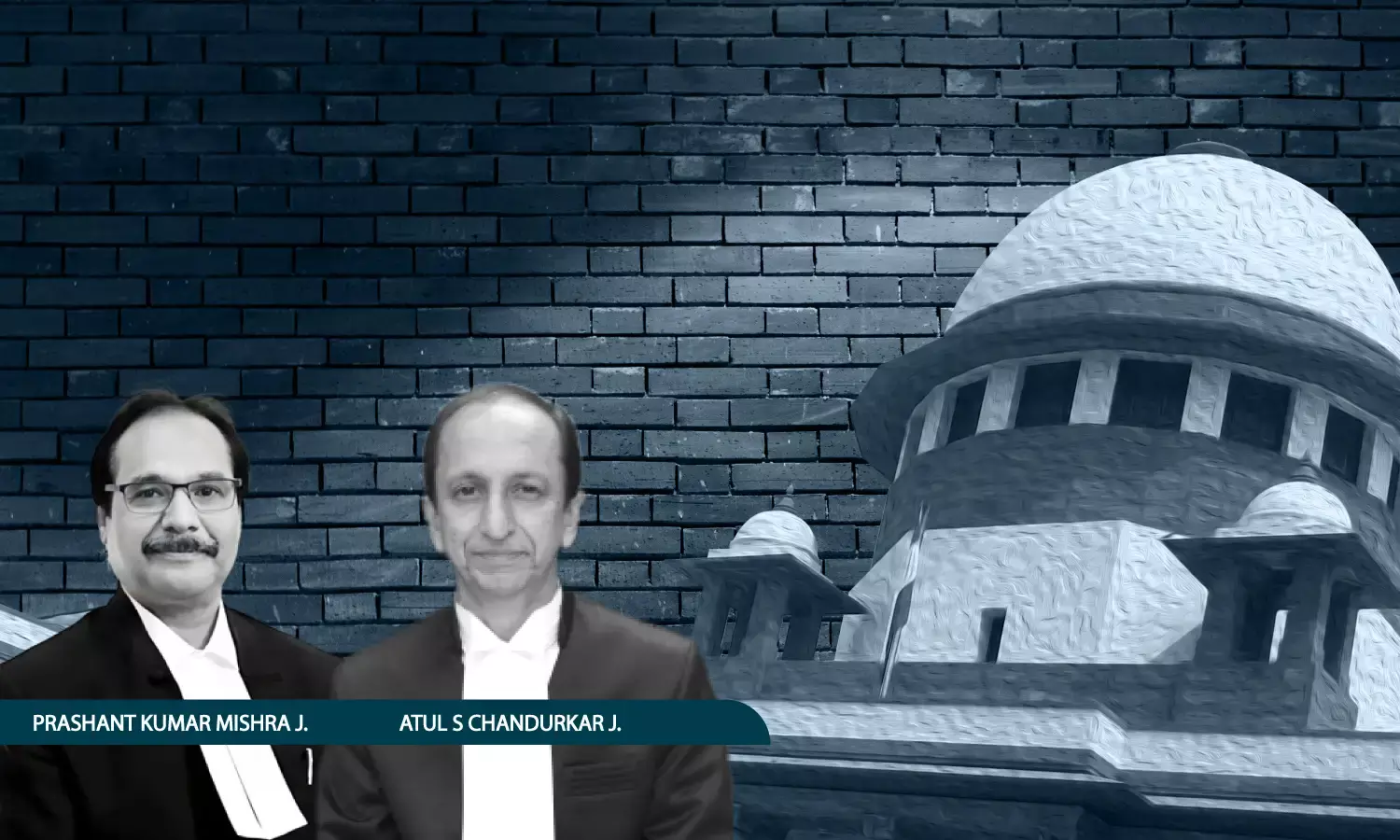
While observing that a new stage for trial cannot be introduced by a judicial fiat and setting aside the directions of the Madhya Pradesh High Court, the Supreme Court has held that the High Court in exercise of its jurisdiction under Article 226 of the Constitution cannot direct all the Sessions Courts/Special Courts under the Prevention of Corruption Act, 1988 (PC Act) to examine the sanctioning authority even before framing of charge or commencement of trial.
The Apex Court was considering the appeals directed against the order dismissing the Writ Petition seeking quashing of the sanction for prosecution granted by the Competent Authority under the Prevention of Corruption Act, 1988, against the first respondent, Ravi Shankar Singh.
The Division Bench of Justice Prashant Kumar Mishra and Justice Atul S. Chandurkar held, “The High Court in exercise of its jurisdiction under Article 226 of the Constitution of India cannot re-write the Cr.PC and direct all the Sessions Courts/Special Courts under the PC Act to examine the sanctioning authority even before framing of charge or commencement of trial.”
AOR Rajeev Singh represented the Appellant, while AOR Amalpushp Shroti represented the Respondent.
Factual Background
The appellant-State was mainly aggrieved by certain directions which the High Court had issued in paragraphs 32 and 33 of the impugned order. Explaining the advantage of recording the evidence of the Sanctioning Authority under Section 311 of the CRPC, before framing of charge, the High Court had enumerated the following guidelines:
- The Trial Court shall examine the sanctioning authority exercising powers under section 311 CRPC before framing a charge, even if there is no challenge to the same by the accused, as the validity of the sanction order can go to the root of the case and can render the very act of taking cognisance itself void ab initio.
- If the trial court finds that the sanction passed in consonance with the provisions of section 19 of the PC Act on both the parameters of competence of the sanctioning authority and application of mind on the part of the sanctioning authority, then the trial court shall proceed to the next stage and decide whether charges should be framed against the accused after hearing the prosecution and the defence.
- If the trial court is of the opinion that the sanction order under section 19 of the PC Act is fundamentally defective on either of the parameters, it shall discharge the accused and return the chargesheet to the investigating agency, which shall be at liberty to file the chargesheet once again after seeking a fresh sanction under section 19 of the PC Act.
- These directions are prospective in nature and shall not affect the proceedings in those cases where the charges have been framed and evidence has commenced before the trial court. It goes without saying that these directions shall have no effect on the inherent powers of the High Court under section 482 CRPC or its powers of revision under section 397 and 401 CRPC.
Arguments
The appellant’s main contention was that the directions and guidelines issued in the aforementioned paragraphs by the High Court would create difficulties in perpetuity affecting all criminal trials not only under the PC Act but also in other serious offences.
Reasoning
Expounding the law as delineated by the Code Of Criminal Procedure (CrPC), the Bench stated that the stage of Section 311 of the Cr.PC occurs under Chapter XXIV regarding general provisions as to inquiries and trials, and these general provisions cannot be read into a step in the conduct of trial to clothe a criminal court with jurisdiction to bypass the procedure provided for the conduct of trial and evolve a new procedure and methodology for conducting trial by examining the sanctioning authority even before framing of charge.
The Bench thus stated, “There is no such procedure provided in the Cr.PC where such step can be made permissible. We are afraid, a new stage for trial cannot be introduced by a judicial fiat. Trial in a criminal case including in offences under the PC Act has to be conducted in the manner provided for in the Cr.PC/ Bharatiya Nagarik Suraksha Sanhita read with the provisions contained in the PC Act.”
Decision
Thus, the Bench concluded the matter by setting aside the guidelines and directions issued by the High Court.
Cause Title: The State of Madhya Pradesh v. Ravi Shankar Singh (Neutral Citation: 2026 INSC 650)
Appearance
Appellant: AOR Rajeev Singh, Advocate Naveen Kumar Singh,
Respondent: AOR Nishant Ramakantrao Katneshwarkar, AOR Amalpushp Shroti, Advocate Naveen Kumar