

Can’t Quash NDPS Case Merely On Ground That Confessional Statement Can’t Be Relied On In Trial: Supreme Court
The Supreme Court was considering an appeal filed by the State challenging the order quashing the proceedings in a case registered under the Narcotic Drugs and Psychotropic Substances Act.

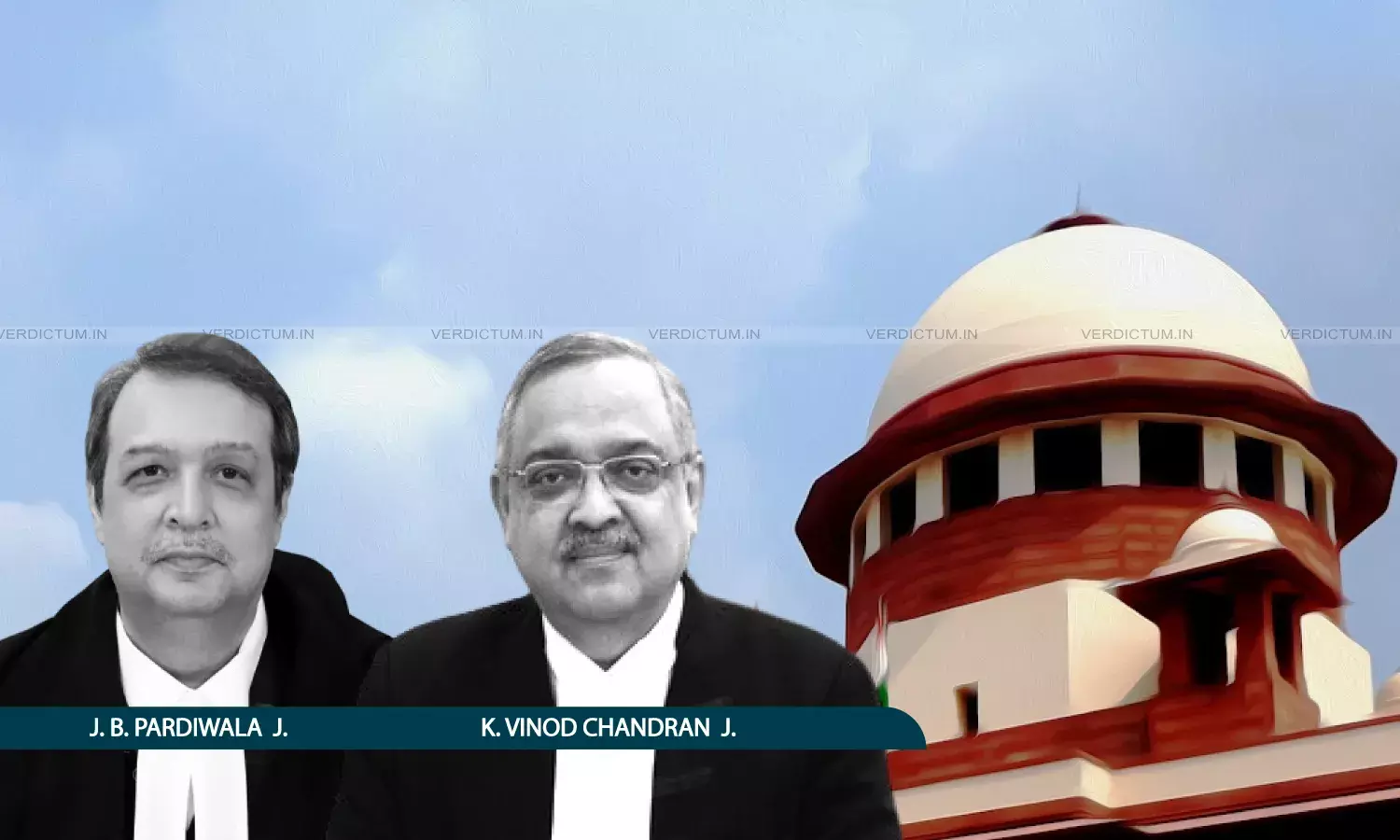
Justice J. B. Pardiwala, Justice K. Vinod Chandran, Supreme Court
While restoring an NDPS case, the Supreme Court has held that the quashing of charges merely on the ground that a confessional statement cannot be relied on in the trial would not be a proper exercise of the inherent powers conferred on the High Court.
The Apex Court was considering an appeal filed by the State challenging the order quashing the proceedings in a case registered under Section 20 (b)(ii) C of the Narcotic Drugs and Psychotropic Substances Act, 1985 (NDPS Act). The appellant was declared an absconder, and a split chargesheet was drawn against him.
The Division Bench of Justice J. B. Pardiwala and Justice K. Vinod Chandran held, “In the First Information Statement (FIS) itself, the name of the person who fled, was recorded, presumably on the others disclosing the same. There is neither a disclosure statement recorded from the co-accused nor a statement recorded under Section 67 of the NDPS Act from the respondent himself; he having evaded arrest. The quashing of charges merely on the ground that a confessional statement cannot be relied on in the trial, would not be a proper exercise of the inherent powers conferred on the High Court. The High Court has not looked into the evidence produced in the case, especially when the trial obviously would have been proceeded with against the co-accused.”
Additional Advocate General Aman Panwar represented the Appellant.
Factual Background
The respondent is an engineering graduate who, after studies, was in the United States of America. The incident occurred when he was a student, and he was arrayed as an accused in an FIR registered at the Lashkar Police Station, Mysuru City. The FIR indicated that, on information received of transportation of Ganja in a car, a police party found three persons standing in a parking area, near the specified car. One of them ran away, and the other two were apprehended. On a search of the car, 32.615 kgs of Ganja was found in 42 bundles, hidden in the dashboard and trunk of the car.
The investigation ensued and culminated in a chargesheet, wherein the respondent was shown as an absconder and the case was split up as against the absconder and the other accused. The respondent was the person who fled from the spot where the seizure was effected. The respondent approached the High Court seeking to quash the criminal case lodged against him. The High Court quashed the proceedings on the sole ground that he was arrayed only on the confessional statement of the other co-accused, who were apprehended on the spot.
Reasoning
On a perusal of the facts of the case, the Bench noticed one person fled from the spot, two others were arrested and were found in conscious possession of the contraband. “In the First Information Statement (FIS) itself, the name of the person who fled, was recorded, presumably on the others disclosing the same. There is neither a disclosure statement recorded from the co-accused nor a statement recorded under Section 67 of the NDPS Act from the respondent himself; he having evaded arrest”, it stated.
The Bench held, “We have no doubt that the confessional statement under Section 67 or a disclosure statement under Section 53A of the NDPS Act, can have no evidentiary value in a trial and it cannot lead to a conviction. Section 53A of the NDPS Act does not enable the disclosure of the co-accused to be placed before Court, especially when he is not examined as a witness or made an approver. The disclosure made by the co-accused who were apprehended at the spot, about the identity and the name of the one who fled, is only a material which the Investigating Officer could use to gather further evidence, which alone could be the basis of a chargesheet or a conviction, in a properly instituted trial.”
The Bench found no whisper as to the chargesheet filed in the case and the culpability found on the respondent (third accused), which, according to the Bench, was premature at the stage of quashing.
Thus, finding the impugned order quashing the criminal proceedings to be improper, the Bench restored the Special Case to the files of the Principal District and Sessions Judge and Special Court, Udupi.
Allowing the appeal, the Bench ordered, “The respondent shall appear before the said Court within a period of two weeks from today, upon which the Court shall allow him to be released on bail on such terms and conditions it deems fit and otherwise, on failure to appear, the Trial Court shall issue steps for his apprehension for production before Court.”
Cause Title: The State of Karnataka v. Sadiq Pasha (Neutral Citation: 2026 INSC 1083)
Appearance
Appellant: Additional Advocate General Aman Panwar, AOR Sanchit Garga, Advocates Shashwat Jaiswal, Bhanu Pratap Singh, Diksha Arora, Manav Kaushik, Aranya Sahay, Rishi Yadav, Nakul Shrivastava