

Choice Influenced By External Factors Is No Longer Voters’ Own: Supreme Court Issues Directions To Curb Use Of Black Money In Elections
The Apex Court directed written reasons for election-related seizures, timelines for investigation, quarterly reports to the Election Commission, High Court approval for withdrawal of cases, and prompt disposal of prosecutions involving candidates and elected representatives.
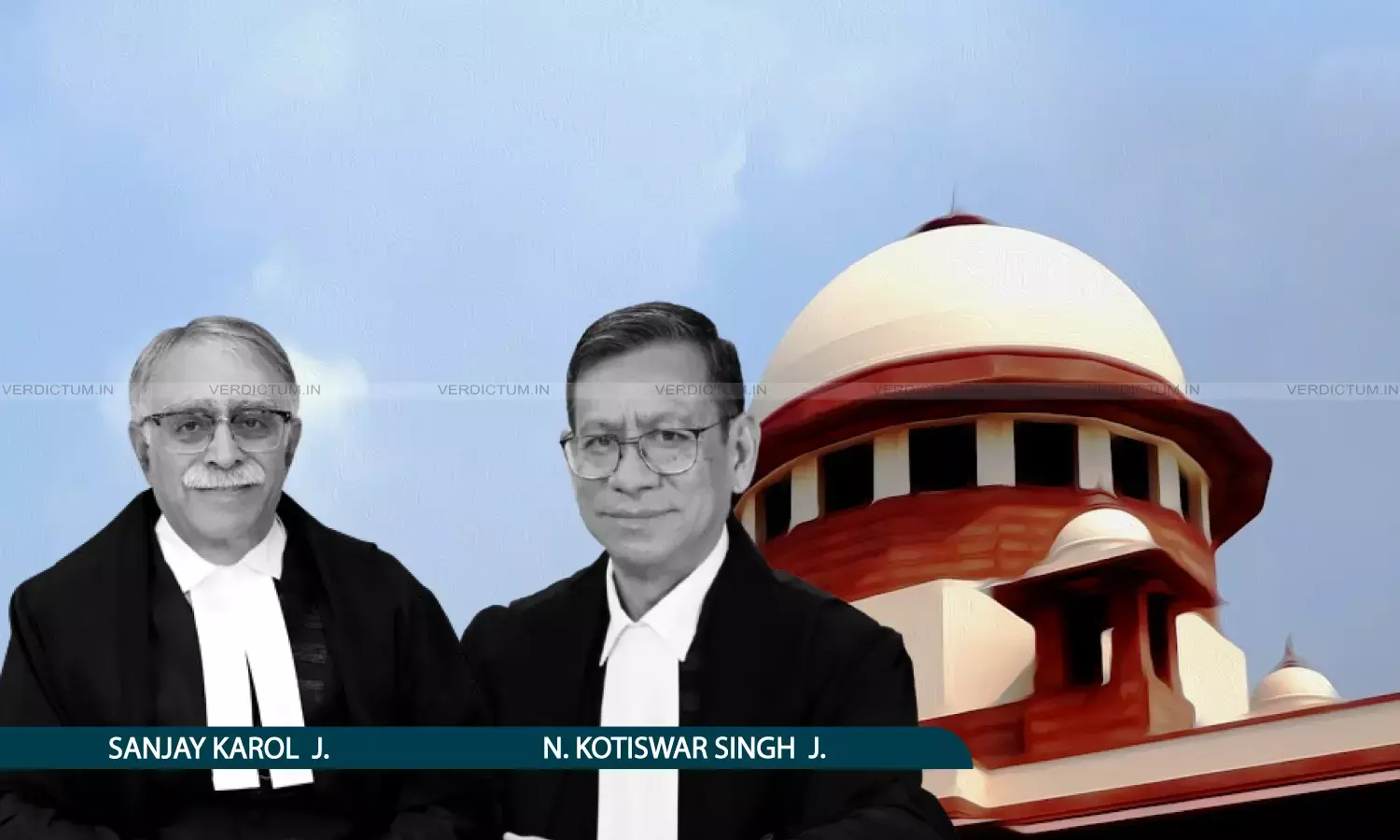
Justice Sanjay Karol, Justice N. Kotiswar Singh, Supreme Court
The Supreme Court has issued directions to protect the integrity of voter choice from being influenced by black money and other inducements in elections, observing that once external factors influence a citizen’s electoral choice, it is no longer truly their own choice.
The Court was hearing an appeal arising from the quashing of an FIR registered after a flying squad raid during the Bellary Lok Sabha bye-election, in which cash and other material were seized on the allegation that the money was intended to be used to bribe voters.
During the proceedings, the Court had called for inputs from the Election Commission of India, Union of India, States and Union Territories on election-related search, seizure, prosecution and withdrawal of cases.
A Bench of Justice Sanjay Karol and Justice Nongmeikapam Kotiswar Singh observed: “For the most part, the citizen is only at the receiving end of this information and campaign across various forms. Their voice is heard only on election day when the result of the votes cast by them is counted and notified. It is their one vote for every person that demonstrates the support expressed for a particular set of policies put forward. If it is that this one chance at expression is itself tainted, it would not be an understatement to say that the very essence of democracy, which is a rule of the people, by the people and for the people, is compromised. To put it simply, the choice exercised by the people once influenced by external factors is no longer a choice of their own. It is somebody else’s choice being thrust upon them.”
Senior Advocate Gaurav Aggarwal and Advocate Dr Swapnil Tripathi were appointed as Amici Curiae to assist the Court.
Background
The case arose from a raid conducted by a flying squad during the Bellary Lok Sabha bye-election. The earlier order reproduced in the judgment records that the raid was based on an anonymous message alleging that the respondent had hoarded counterfeit currency to bribe voters, and that a laptop, cheque books, loose cheque leaves, a pen drive and ₹20,48,355 in cash were seized.
An FIR was registered under Sections 171E and 188 IPC on the allegation that the respondent possessed money to pay voters during the election. The Karnataka High Court quashed the FIR on the ground that the complaint did not state whom the accused intended to bribe or the mode he planned to adopt.
The State of Karnataka approached the Supreme Court. While considering the matter, the Court noted concerns that criminal cases relating to election offences were not being effectively pursued once prosecution was left to State machinery. The Election Commission placed on record its guidelines, SOPs, affidavits and data on election-related seizures, FIRs, investigation, prosecution and pendency.
Court’s Observations
The Court held that elections are the moment when the common person directly impacts governance, and any external influence on that choice affects democracy itself.
The Court observed: “Any external factors that may influence this exercise of choice have the ability to compromise the very essence of democracy, since the choice made by the individual is not free and unencumbered but instead clouded by gratification, monetary or otherwise, or by promises sometimes genuine, other times misleading.”
The Court further held: “Black money in the electoral process i.e. the issue with which we are herein concerned, is one such aspect that compromises democracy, rule of law and the electoral process itself.”
Referring to Article 324 of the Constitution, the Court noted that the Election Commission is vested with superintendence, direction and control over elections.
The Court observed: “It obviously has myriad functions, including maintaining the integrity of the election process and controlling the distribution of inducements like cash, liquor and free food.”
The Court also referred to Union of India v. Assn. for Democratic Reforms (2002), noting that the Election Commission’s jurisdiction is wide enough to include all powers necessary for smooth conduct of elections, subject to valid law made by Parliament or State Legislatures.
The Court traced the recognition of money power in elections through judicial decisions, committees, official reports and policy material, including Kanwar Lal Gupta v. Amar Nath Chawla (1975), the Goswami Committee on Electoral Reforms, the Vohra Committee, Ashok Shankarrao Chavan v. Madhavrao Kinhalkar (2014), the Law Commission’s 255th Report and the Union Budget speech of 2017.
The Court observed: “As demonstrated, this issue has been taken note of consistently by both Judicial and Executive authority.”
It therefore found the suggestion that guidelines should be framed to prevent black money in the electoral process to be “well-founded and justified”.
The Court examined the SOPs for Flying Squads and Static Surveillance Teams, including the requirements of seizure, panchnama, videography, presence of an Executive Magistrate and filing of complaint/FIR within 24 hours.
The Court observed: “All of these aspects taken together, to our mind, revealed a requirement that although the freezing indicates sufficient leeway for subjective satisfaction, the likeliness of the material being used for untoward purposes has to be reduced in writing by the concerned officer, so does the suspicion of commission of crime leading the flying squad to seize articles/cash.”
It added that recording reasons demonstrates why such procedure was resorted to and also addresses the concern that hardship should not be caused to common citizens.
The Court considered the suggestion for real-time tracking of each seizure by Election Commission teams.
The Court observed: “This suggestion appears to be justified. Each seizure will have to be given an identification number through which its stage can be tracked by interested people, medical personnel, activists, etc.”
However, the Court did not direct immediate nationwide implementation, noting that the Election Commission may first bring it out as a private project and then in stages across India, keeping logistical requirements in mind.
The Court accepted the need for timely investigation and prosecution of election-related offences, observing that the “under investigation” tag cannot continue endlessly.
The Court observed: “This becomes all the more important in the context of election-related matters where the public has a right to know, whether of not the candidate of their choice has indulged in corrupt practices or inducements which would be deemed illegal, unethical, unsavory and unacceptable.”
It also noted that candidates who have not indulged in such practices do not deserve to be maligned by prolonged pending investigations.
The Court considered the Election Commission’s concern that State Governments may seek unilateral withdrawal of election-related prosecutions after a change in political dispensation.
The Court observed: “It is not a hidden truth, however, that changes in political dispensation often lead to such decisions being taken. Needless to say, such practice is entirely anti-thetical to the spirit of an unbiased criminal justice system, which is a hallmark of a constitutionally governed republic, specially one like India where the separation of powers is clearly recognized, and as far as possible, enforced.”
Relying on State of Kerala v. K. Ajith (2021) and Ashwini Kumar Upadhyay v. Union of India (2021), the Court held that withdrawal of cases against candidates in a particular election cycle must have the approval of the concerned High Court.
Conclusion
The Supreme Court directed that when cash or other assets are seized, the authority effecting seizure must report it within 24 hours to the District Magistrate, Additional District Magistrate or competent Court, along with written reasons disclosing the prima facie nexus between the seized asset and suspected electoral offence.
It directed investigating officers to make every possible endeavour to complete the investigation within one year from registration of FIR. If the timeline is exceeded, reasons must be recorded and communicated to the Election Commission of India. Quarterly status reports must also be submitted to the Election Commission through the Nodal Officer after approval of the Senior Superintendent of Police or Deputy Commissioner of Police of the concerned district.
The Court directed that where Static Surveillance Teams find money exceeding ₹10 lakh during checks, the information must be forwarded to the Income Tax authorities. It also directed High Courts to consider designating courts, as per their respective procedures, for prompt hearing and disposal of cases against candidates and sitting MPs/MLAs.
The Court held that withdrawal of cases against candidates in a particular election cycle requires approval of the concerned High Court. It further directed concerned courts to make all efforts to take pending election-related cases to their logical conclusion with utmost expedition. Compliance reports are to be filed by the Election Commission of India and the respective State Governments on or before November 18, 2026.
Cause Title: The State of Karnataka & Anr. v. Prathik Parasrampuria (Neutral Citation: 2026 INSC 868)
