“Public Employment Can’t Be An Instrument Of Fraud”: Supreme Court Directs Proceedings Against Constable Who Secured Dual Police Jobs
The Court held that a police constable who allegedly secured appointments in two State police forces under different identities through fabricated credentials could not be permitted to continue in service, observing that such conduct strikes at the very root of public employment and institutional integrity.
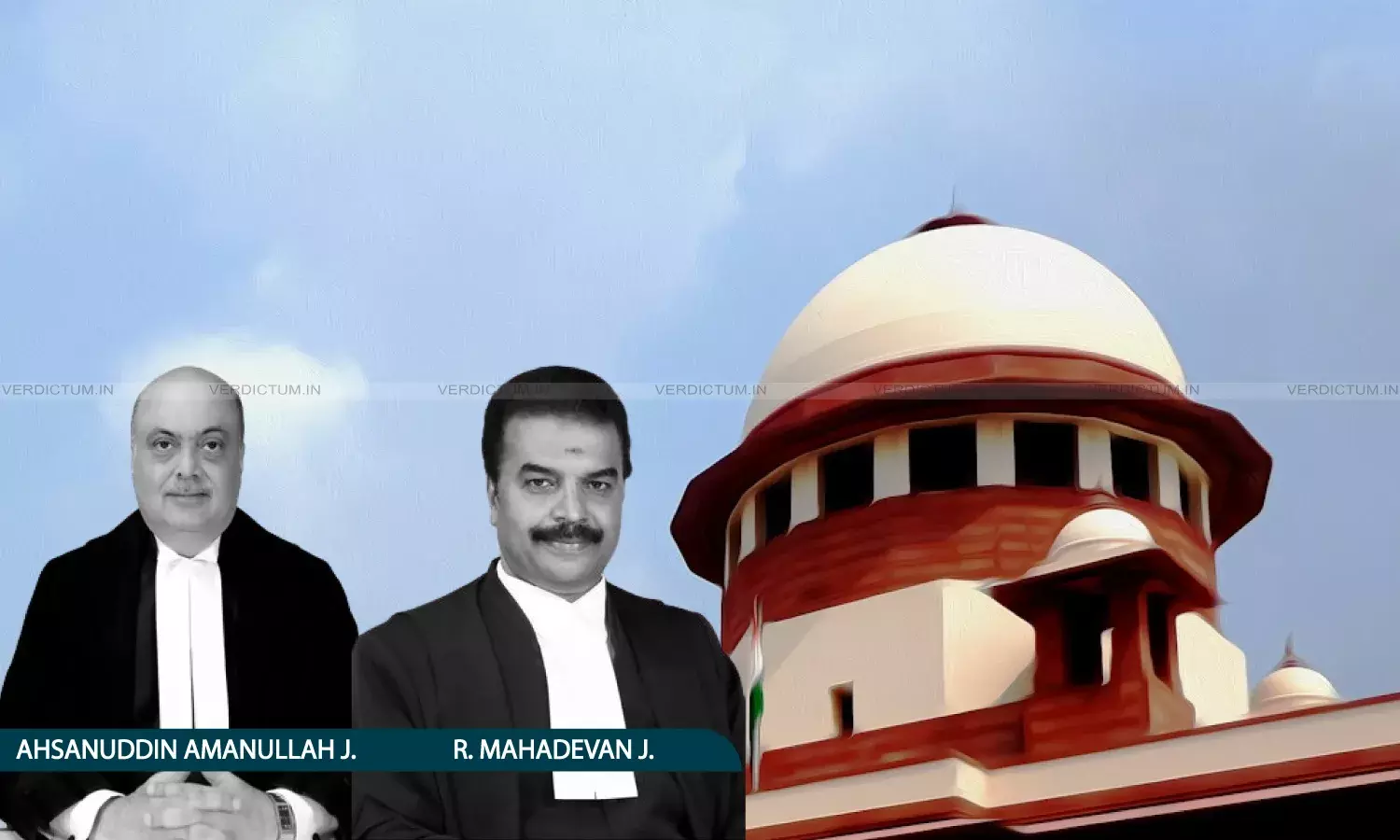
The Supreme Court, while directing the initiation of criminal proceedings against a constable accused of securing appointments in both the Jharkhand and Bihar Police under different identities using forged and fabricated credentials, observed that public employment, particularly in the police service, cannot be converted into an instrument of fraud.
The Court was hearing an appeal filed by the State of Jharkhand, challenging a judgment of the Jharkhand High Court that had set aside the dismissal of a constable from service in departmental proceedings relating to allegations of impersonation, dual employment, forgery, and unauthorised absence.
A Bench of Justice Ahsanuddin Amanullah and Justice R. Mahadevan observed: “The allegations, reinforced by forensic findings, prima facie disclose the commission of cognizable offences such as cheating, impersonation, forgery, use of forged documents and furnishing false information to public authorities under the Indian Penal Code or the corresponding provisions of the Bharatiya Nyaya Sanhita, as applicable”.
The Bench further held: “Public employment, particularly in the police service, cannot be converted into an instrument of fraud. If individuals entrusted with enforcing the law themselves secure entry into service through deception and fabricated credentials, it would seriously erode the rule of law. In these circumstances, while restoring the disciplinary action, it is both necessary and appropriate to direct initiation of criminal proceedings in accordance with the law”.
Standing Counsel Kumar Anurag Singh appeared for the appellants. Advocate Kumar Shivam appeared for the Respondents.
Background
According to the State authorities, the respondent was appointed as a constable in the Jharkhand Police in 2005. While serving as a reserve guard at a police station, he proceeded on compensatory leave but thereafter allegedly remained unauthorisedly absent from duty.
During the specified period, the respondent was allegedly granted an appointment as a constable in the Bihar Police under a different identity, using forged certificates and fabricated credentials. It was alleged that he obtained an appointment in Bihar under another name and different parentage particulars while simultaneously continuing in service with the Jharkhand Police.
Subsequently, enquiries were initiated by the Bihar Police authorities, during which it was reported that the person serving in the Bihar Police and the constable employed in the Jharkhand Police were the same individual.
A departmental proceeding was thereafter initiated by the Jharkhand Police authorities. Following the enquiry, the disciplinary authority dismissed the respondent from service. The appellate authority and revisional authority affirmed the dismissal order.
The respondent challenged the dismissal before the High Court. While the learned Single Judge dismissed the writ petition, the Division Bench allowed the Letters Patent Appeal and set aside the dismissal, holding that there was no sufficient evidence establishing that the respondent had secured appointment in the Bihar Police while serving in the Jharkhand Police.
The State of Jharkhand thereafter approached the Supreme Court. During the pendency of proceedings, the Supreme Court directed the Bihar Police authorities to conduct an independent enquiry into the identities of the respondent and the alleged second appointee.
Court’s Observation
The Supreme Court noted that the disciplinary authority, appellate authority and revisional authority had all concurrently found the respondent guilty of fraud, impersonation, forgery, cheating and securing dual public employment by deception.
The Court observed that the allegations were not limited to mere unauthorised absence from service but involved “a deliberate and premeditated fraud upon two State police forces.”
Referring to the independent enquiry report submitted before the Court pursuant to its directions, the Bench noted that forensic comparison of fingerprints, biometric records and photographs established that the respondent and the alleged second appointee were the same individual.
The Court observed that genealogical records and electoral rolls also suggested that the variation in names and parentage particulars formed part of a manipulated identity trail rather than proof of separate identities.
Rejecting the respondent’s contention that the departmental findings were based on “no evidence”, the Court reiterated that strict rules of evidence applicable to criminal trials do not apply in departmental proceedings.
The Bench referred extensively to the principles governing judicial review in disciplinary matters, including Union of India v. P. Gunasekaran (2015), B.C. Chaturvedi v. Union of India (1995) and State Bank of Bikaner and Jaipur v. Nemi Chand Nalwaya (2011).
The Court observed that the Division Bench of the High Court had exceeded the permissible limits of judicial review by reappreciating evidence and disturbing concurrent findings of fact recorded in departmental proceedings.
The Bench further held that the disciplinary proceedings substantially complied with the procedural safeguards prescribed under the Jharkhand Police Manual and principles of natural justice.
The Court observed: “The continuance of such an employee in service would be wholly detrimental to institutional discipline, public confidence, and the credibility of the police force.”
Holding that the matter disclosed commission of cognizable offences, the Court directed both the Director General of Police, Bihar and the Director General of Police, Jharkhand, to “ensure that the matter is examined by the competent jurisdictional police authority and appropriate steps be taken, in accordance with law”.
Conclusion
The Supreme Court allowed the appeal and set aside the judgment of the Division Bench of the Jharkhand High Court.
The Court restored the dismissal order passed by the disciplinary authority, as affirmed by the appellate and revisional authorities.
Exercising powers under Article 142 of the Constitution, the Court additionally quashed the Bihar Police appointment secured under an alternate identity.
The Bench clarified that observations made in the judgment were confined to adjudication of the service dispute and initiation of criminal proceedings, and that any criminal case shall be decided independently on its own merits.
Cause Title: The State of Jharkhand & Ors. v. Ranjan Kumar & Ors. (Neutral Citation: 2026 INSC 466)
Appearances
Appellants: Standing Counsel Kumar Anurag Singh; Advocates Tulika Mukherjee, Zain A. Khan, Dev Aaryan, Beenu Sharma, Venkat Narayan, Mohd. Abran Khan
Respondents: Advocate Kumar Shivam; Advocates Manoj Tandon, Sameer Ranjan, Rajarshi Singh, Samir Ali Khan, Pranjal Sharma, Kashif Irshad Khan Faridi