

Material Relating To Private Body Which Can Be Accessed By Public Authority Can Also Fall Under Definition Of Information Under RTI Act: Supreme Court
The Supreme Court was considering a matter where a member had put up an application under the Right To Information Act for a copy of the construction agreement between a Co-operative Bank and a Labour Co-operative Society.

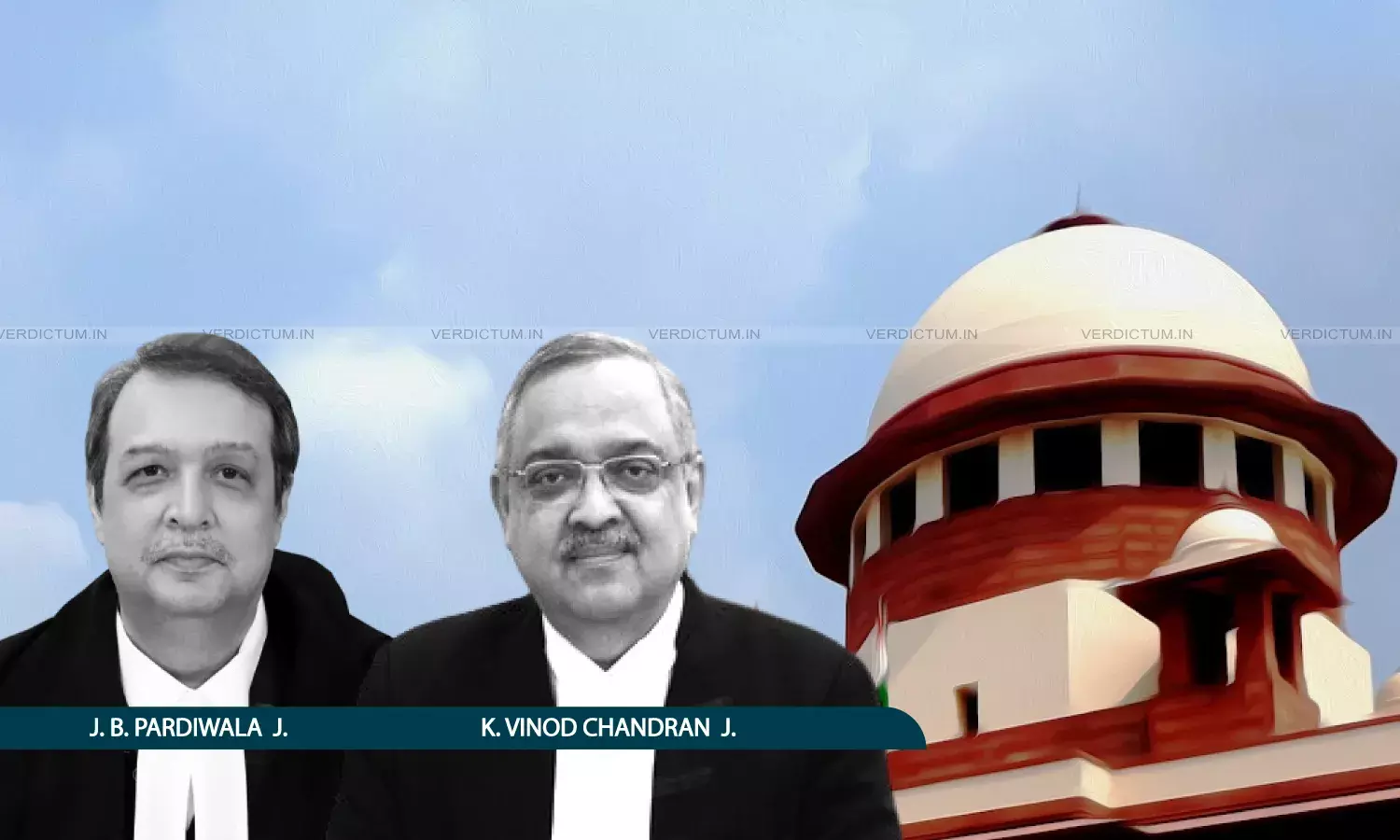
Justice J. B. Pardiwala, Justice K. Vinod Chandran, Supreme Court
While directing the Joint Registrar (General) to supply a copy of the construction agreement between the appellant/Co-operative Bank and a Labour Co-operative Society as well as a copy of the minutes of the last General Body Meeting, the Supreme Court has held that such material relating to a private body, which can be accessed by a public authority, on the strength of statutory powers conferred, would fall under the definition of information under Section 2(f) of the Right To Information (RTI Act).
The Apex Court was considering a matter where a member of the Bank had put up an application under the Right To Information Act for a copy of the construction agreement between the appellant/Co-operative Bank and a Labour Co-operative Society, which was entrusted with the construction of a building, and a copy of the minutes of the last General Body Meeting of the appellant-Bank.
The Division Bench of Justice J. B. Pardiwala and Justice K. Vinod Chandran stated, "Hence, it is not only the material, physically available with a public authority but also such material relating to a private body, which can be accessed by a public authority, on the strength of statutory powers conferred, would fall under the definition of information. As has been rightly noticed in the impugned judgment, the words ‘can be accessed by a public authority’ refers to access being statutorily provided. The power cannot be fettered at all."
“Every citizen would not have the right to ask for the documents since the concept of personal information cannot be restricted to a ‘person’ in flesh and blood and even applies to a private entity, with whose affairs every citizen cannot be found to have an interest, unless it has a relationship to a public activity (Section 8(1)(j). Neither the building contract nor the General Body Meeting concerns a party, totally unconnected with the Society. However, a Member of the Society cannot be denied such information on the ground that it is personal to the Society or that it does not involve any public activity or interest", it added.
Senior Advocate S.P. Chaly represented the Appellant while Advocate Abhilash M.R. represented the Respondent.
Factual Background
The respondent member’s first application was rejected consistently up to the first respondent, the State Information Commissioner, the challenge to which before the Single Judge failed, but the Division Bench directed reconsideration. In the second round, the first respondent, the Single Judge, as well as the Division Bench of the High Court, affirmed the right of the fourth respondent to the documents. The judgment of the Division Bench was challenged before the Apex Court.
Reasoning
The Bench explained that Clause (d) of Section 8(1) refers to injury caused to the competitive position of a third party, when the information involves a commercial confidence, trade secret or intellectual property. On a perusal of the facts of the case, the Bench noted that the documents in question neither encompassed any aspect of trade secret or intellectual property nor of a commercial confidence affecting a competitive position; since the bid was already over and one Labour Contract Society had obtained the contract, the terms of which any Member of the Society would be concerned with.
“As far as clause (j) is concerned the information sought cannot be termed to be a personal information, since the details of the contract sought for, entered into by the appellant-Bank and the Minutes of the General Body Meeting, are sought for by a Member of the Society. That it does not have any relation to any public activity Etc. or interest, in that context, is not significant enough to decline the request, if the documents are otherwise accessible”, it added.
The Bench refused to accept the contention that only on the satisfaction entered by the Registrar that an inquiry can be initiated and only then, the Registrar is enabled to have access of the documents of a Society. “The inquiry by the Registrar under Section 65 of the Co-operative Societies Act can be suo motu; on his own motion, or on various contingencies as coming forth from clause (b) to (f) i.e. of a report; by the Vigilance Officer or by the Director of Co-operative Audit or an application; made before the Registrar, either by a majority of the Members or one third of the quorum for a general body meeting or an Apex or Affiliated Society”, it added.
The Bench also upheld the contention of the respondent member that Section 66 of the Co-operative Societies Act confers supervisory powers and powers of inspection on the Registrar or a person authorised by him.
Decision
Thus, finding the judgment of the Division Bench of the High Court to be perfectly in order, the Bench dismissed the appeals and ordered, “The 2nd respondent shall call for the two documents immediately and in any event within two weeks and supply the same to the 4th respondent.”
Cause Title: The Muppathadam Service Co-Operative Bank Ltd. v. The State Chief Information Commissioner & Ors. (Neutral Citation: 2026 INSC 1153)
Appearance
Appellant: Senior Advocate S.P Chaly, AOR K. Sasi, AOR P. S. Sudheer, Advocates Rishi Maheshwari, Anne Mathew, Bharat Sood, Jai Govind M J, Jashan Vir Singh, Shivam Sharma, AOR Zulfiker Ali, Advocate Anna Oommen
Respondent: Advocates Abhilash M.R., Sayooj Mohandas, Manjari Singh, Ann Melvin, AOR M/s M R Law Associates