

Business-To-Business Exhibition Cannot Be Taken Out Of "Entertainment" Under Bombay Entertainments Duty Act Where Entry Is On Payment: Supreme Court
The Court upheld the levy of entertainment duty on the India International Jewellery Show, holding that an entry-form requirement for screening visitors cannot be used to avoid the plain reading of Section 2(a) of the Bombay Entertainments Duty Act, 1923.

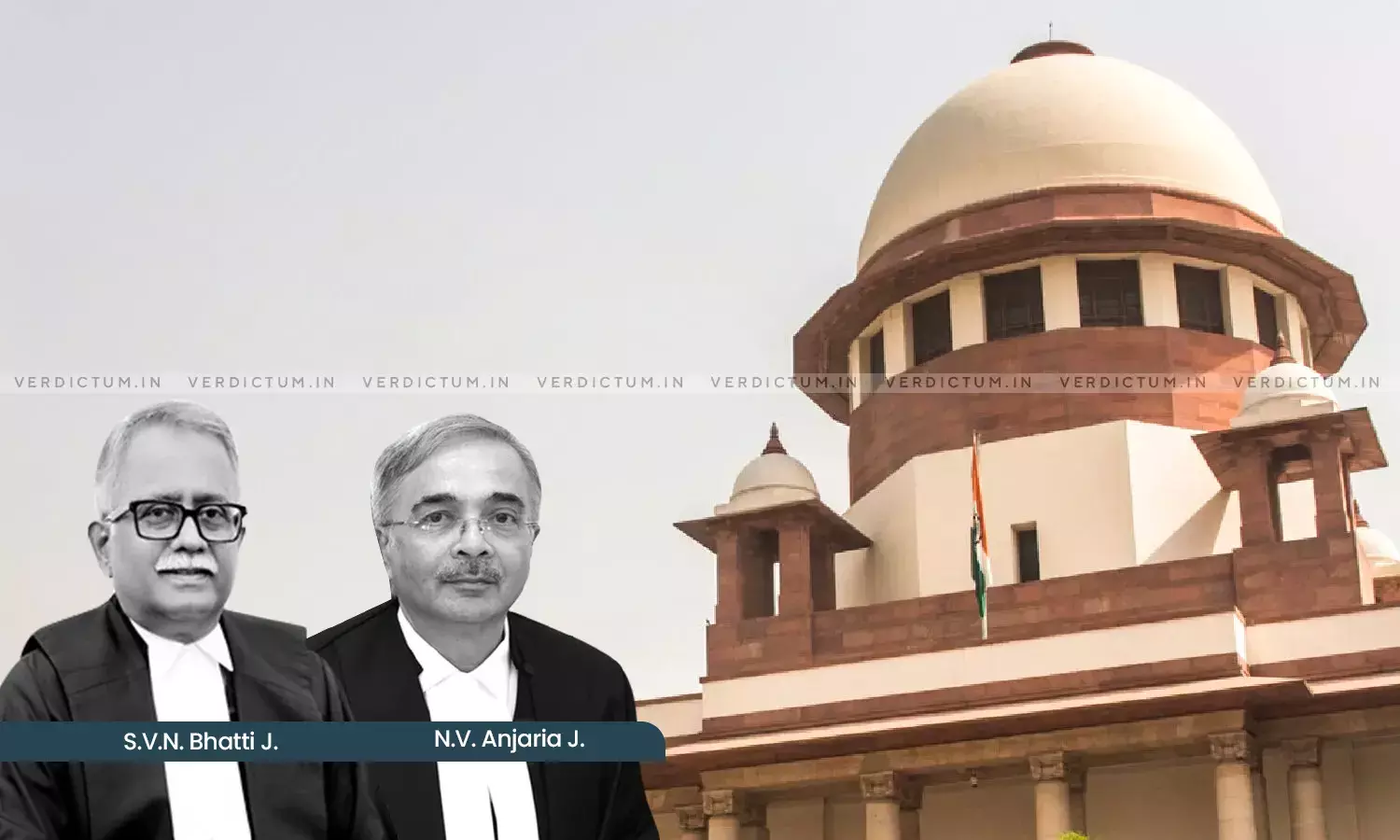
Justice S.V.N. Bhatti, Justice N.V. Anjaria, Supreme Court
The Supreme Court has held that a business-to-business trade exhibition cannot be taken out of the definition of “entertainment” under the Bombay Entertainments Duty Act, 1923, where entry to it is on payment. The Court said that even if an event is a business-to-business transaction, that character does not remove it from the statutory definition.
Dismissing an appeal by the Gem and Jewellery Export Promotion Council, the Court upheld the Bombay High Court’s view that the India International Jewellery Show (IIJS) and IIJS Signature attract entertainment duty. It held that the requirement to fill up an entry form can serve more than one purpose, including security, and cannot be used to “wriggle out” of the plain reading of Section 2(a).
A Bench of Justice S.V.N. Bhatti and Justice N.V. Anjaria observed, “…we notice that, in the case at hand, entry into the IIJS and IIJS Signature is on payment. Further, exhibitions showcase the merchandise of the participating traders. The entry is on payment, and upon entry, even if it is a business-to-business transaction, the same cannot be taken away from the definition of ‘entertainment’ under the Act, 1923. The requirement of filling up the form for entry can be for more than one purpose, including security reasons, and cannot be taken advantage of to wriggle out of an otherwise plain and simple reading of ‘entertainment’ in Section 2(a) of the Act, 1923. The Appellant's case is sufficient to hold that the exhibition falls within the definition of Section 2(a) of the Act, and the instance said in Section 3 is attracted. The impugned Judgment has considered the Appellant’s activity, in the form of a course of exhibitions, in detail. We are in full agreement with the impugned Judgment”.
Advocate Aman Raj Gandhi appeared for the appellant while Advocate Bharat Bagla appeared for the respondent.
The Council, a Section 25 company under the Ministry of Commerce, organises the IIJS exhibitions in Mumbai. Police licensing required a No Objection Certificate from the Additional Collector under the 1923 Act, and the Council deposited sums under protest. On July 31, 2012, the Additional Collector held it liable for Rs 97,09,500 for IIJS 2011.
On appeal, the Divisional Commissioner, Konkan Division, held the show taxable on November 30, 2012, but reduced the assessment for IIJS 2011 to Rs 45,40,125 and ordered a refund of the excess. The Bombay High Court dismissed the Council’s writ petition on March 4, 2013, which led to the present appeal.
The Council argued that the exhibitions are purely business-to-business, that the general public is barred, and that entry follows scrutiny of trade credentials. It also said the test in M/S Geeta Enterprises & Ors. v. State of U.P. & Ors. (1983) was not met. The respondents argued that the words “includes” and “any exhibition to which persons are admitted for payment” bring the event within Section 2(a).
“The literal construction of the Definition Clause, by giving due and permissible meaning to the word, includes that the first limb of the definition clause deals with the 5 events, i.e., exhibitions, performances, amusements, games, or sports. The words ‘to which persons are admitted for payment’ would be the deciding factor in determining whether an event falls within, or in determining the scope of ‘entertainment’ under Section 2(a) of the Act, 1923. The exhibitions to which persons are admitted for payment are a threshold verification of a person’s entry into the event. Geeta Enterprises (supra) has examined the meaning available to the word ‘exhibition’, and for brevity, we do not reiterate what has been well considered in Geeta Enterprises (supra). The facts of Geeta Enterprises (supra) are slightly better than those of the case on hand in the sense that, in Geeta Enterprises (supra), there is no Entry Fee at the threshold, but there is a Fee for availing entertainment. Notwithstanding the same, it has been held that there is gratification for availing entertainment…”, the Bench further said.
The Bench, thus, said it was in full agreement with the High Court and dismissed the appeal, disposing of pending applications.
Cause Title: The Gem and Jewellery Export Promotion Council v. The State of Maharashtra & Ors., (Neutral Citation: 2026 INSC 1246)
Click here to read/download the Judgment