Statutory Amendment Overrides Contractual Clause: Supreme Court Upholds Deduction Of Enhanced Royalty From Security Deposit
The Court held that royalty under Section 9 of the Mines and Minerals (Development and Regulation) Act, 1957, is payable at the rate prevailing on the date of removal or dispatch of minerals and that contractual stipulations cannot override a subsequent statutory enhancement in royalty rates.
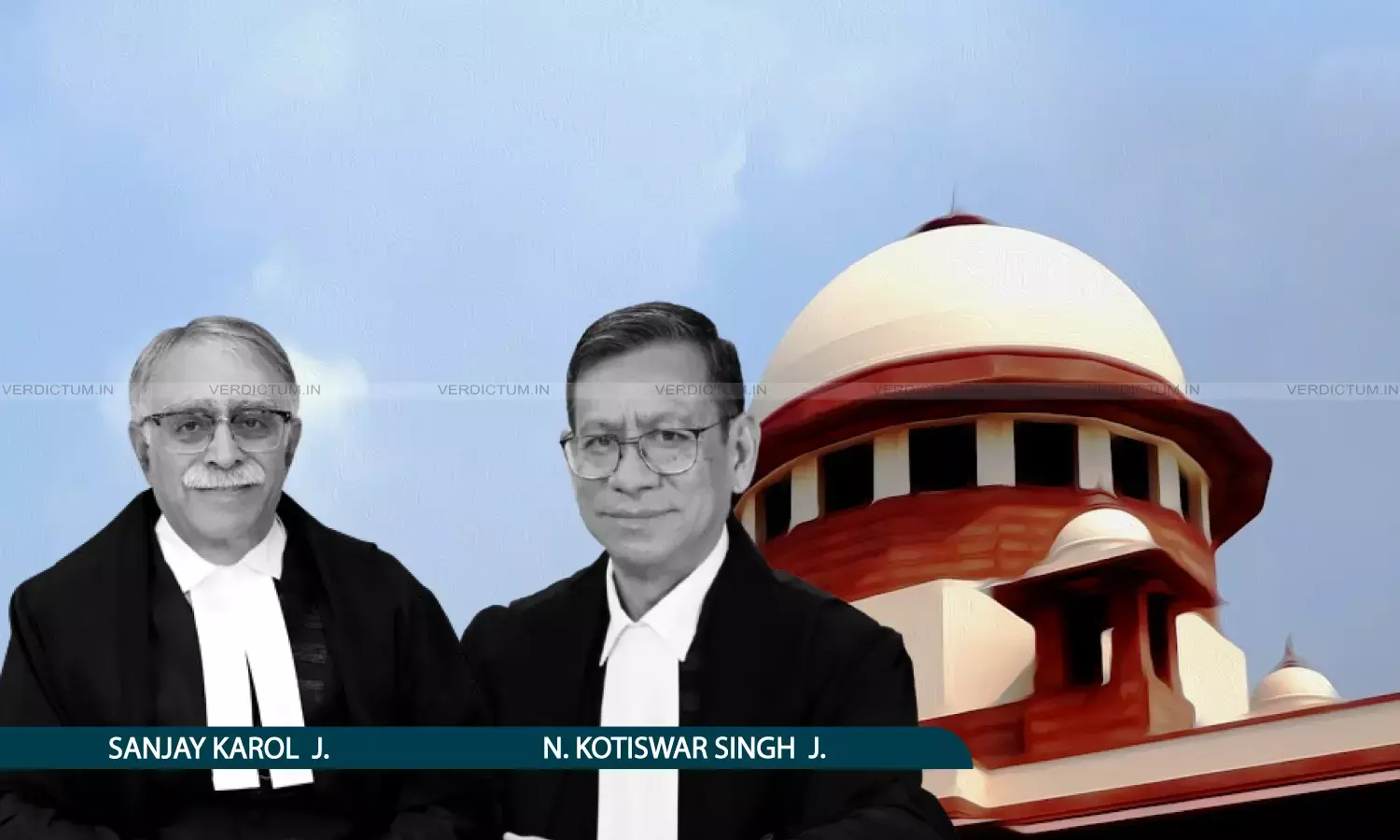
Justice Sanjay Karol, Justice N. Kotiswar Singh, Supreme Court
The Supreme Court has held that where royalty payable on minerals stands enhanced through statutory amendment before actual removal or transportation of minerals, the enhanced royalty becomes payable notwithstanding an earlier contractual arrangement fixing a lower rate.
The Court further held that a contractual provision limiting liability must give way to a subsequent statutory amendment.
The Court was hearing a Civil Appeal arising out of a judgment passed by the Karnataka High Court allowing a writ petition filed by M/s BMM Ispat Ltd., challenging the deduction of an additional 5% royalty amount from its security deposit in connection with iron ore purchased through an e-auction conducted pursuant to orders passed by the Supreme Court in proceedings concerning mining operations in Karnataka.
A Bench of Justice Sanjay Karol and Justice Nongmeikapam Kotiswar Singh observed, “The difference in royalty between 10% and 15% was subtracted from the security deposit and remainder was returned. This, in our view, appears to be the correct approach for a contractual provision would have to give way to a statutory amendment.”
The Bench further observed, “In that view of the matter, the payment is to be made on the date of the movement of the minerals. If the date of the movement is after the enhancement in royalty, a contract entered into prior to the statutory change cannot be limiting its impact.”
Sanchit Garga, AOR, appeared for the appellant. Vrinda Bhandari, AOR, appeared for the respondents.
Background
The dispute arose from e-auction proceedings conducted by the Monitoring Committee constituted pursuant to orders passed by the Supreme Court in Writ Petition (Civil) No. 562 of 2009 concerning mining activities in Karnataka. The Committee had been constituted for regulating the sale of already extracted iron ore stockpiles from mining leases situated in Bellary, Chitradurga and Tumkur districts.
Under the modalities approved by the Supreme Court, successful bidders in the e-auction were required to pay applicable royalty, taxes and other statutory levies in addition to the sale price of iron ore. The modalities specifically contemplated payment of royalty “at 10% of the market price”.
Respondent No.1 emerged as the successful bidder in one such e-auction conducted by the Monitoring Committee. Acceptance letters and sale orders were issued in June 2014, recording royalty at 10%, VAT at 5.5%, and Forest Development Tax at 12%. The acceptance letter further provided that ₹50 per tonne was included to meet the variance in royalty or other taxes that might arise in future.
The contractual conditions further required successful bidders to make an advance payment inclusive of royalty, taxes and statutory levies. Clause 9 of the agreement additionally required bidders to deposit ₹100 per tonne to meet any variance in royalty or other taxes that may arise in future.
Subsequently, by notification dated 1 September 2014, the Central Government amended the Second Schedule to the Mines and Minerals (Development and Regulation) Act, 1957, enhancing royalty payable on iron ore from 10% to 15%.
The respondent thereafter lifted and transported portions of the iron ore stock after the statutory enhancement in royalty came into force. Following audit objections raised by the Accountant General regarding a deficiency in royalty collection, the appellant deducted the differential 5% royalty amount, along with VAT, from the respondent’s security deposit and refunded the balance amount.
The Monitoring Committee supported the deduction and clarified that royalty collection was linked to removal and consumption of minerals from the leased area under Section 9 of the MMDR Act, 1957 and that actual delivery occurred only upon dispatch and transportation of minerals.
The respondent challenged the deduction before the Karnataka High Court, which allowed the writ petition, holding that the royalty applicable on the date of acceptance of the bid alone could be recovered and that subsequent enhancement could not retrospectively alter the concluded contractual arrangement.
Court’s Observation
The Supreme Court undertook an extensive examination of Section 9 of the MMDR Act, 1957, governing royalties in respect of mining leases. The Court summarised the essential facets of Section 9, including the existence of a mining lease, removal or consumption of minerals, persons covered under the provision, rates of royalty and the Central Government’s power to amend royalty rates through notification.
The Court rejected the respondent’s contention that Section 9 of the Act was inapplicable and held that removal and transportation of already extracted minerals pursuant to the auction process still fell within the statutory framework governing royalty.
Referring to Mineral Area Development Authority v. Steel Authority of India Ltd. (2024), the Court reiterated the characteristics of royalty and noted that royalty represents consideration for the privilege of removing or consuming minerals and is generally determined based on the quantity of minerals removed.
The Court further referred to Tarkeshwar Sio Thakur Jiu v. Dar Dass Dey & Co. (1979) and observed that mining operations have been interpreted expansively to include every activity through which minerals are extracted or obtained from the earth.
The Court observed, “The payment is to be made on the date of the movement of the minerals.”
While examining the contractual clauses, the Court noted that although the agreement contemplated payment of ₹50 or ₹100 per tonne towards possible future variation in royalty and taxes, such contractual stipulations could not override a subsequent statutory enhancement in royalty rates brought about through an amendment to the Second Schedule of the MMDR Act.
The Court further held that the word “applicable” used in the earlier Supreme Court order approving the auction modalities denoted applicability of royalty at the relevant time of removal of minerals and did not freeze royalty at the rate existing on the date of auction acceptance.
Referring again to Mineral Area Development Authority (2024), the Court extracted the observation that royalty is payable on the dispatch or removal of minerals from the leased area.
The Court additionally held that the respondent had the opportunity to remove the iron ore before the amendment but chose either to adopt a piecemeal approach or to remove the mineral after the enhancement in royalty had already come into effect. Consequently, the respondent could not avoid liability to pay enhanced royalty.
Conclusion
The Supreme Court held that the deduction of the additional 5% royalty amount from the respondent’s security deposit was lawful and justified under Section 9 of the MMDR Act, 1957.
The Court further held that the Karnataka High Court erred in setting aside the order passed by the Director of Mines and Geology rejecting the respondent’s representation against the deduction.
Accordingly, the appeal was allowed, and the impugned judgment passed by the Karnataka High Court was quashed and set aside. Pending applications, if any, were also disposed of.
Cause Title: The Director of Mines and Geology v. M/s BMM Ispat Ltd. & Anr. (Neutral Citation: 2026 INSC 627)