

Registration As Society Does Not Take Body Outside Article 12 Constitution If Government Control Is Pervasive: Supreme Court Holds National Book Trust Is “State”
The Court said that the Article 12 declaration does not make Trust a Government department or its employees civil servants, dismissed appeal against Delhi High Court Full Bench.

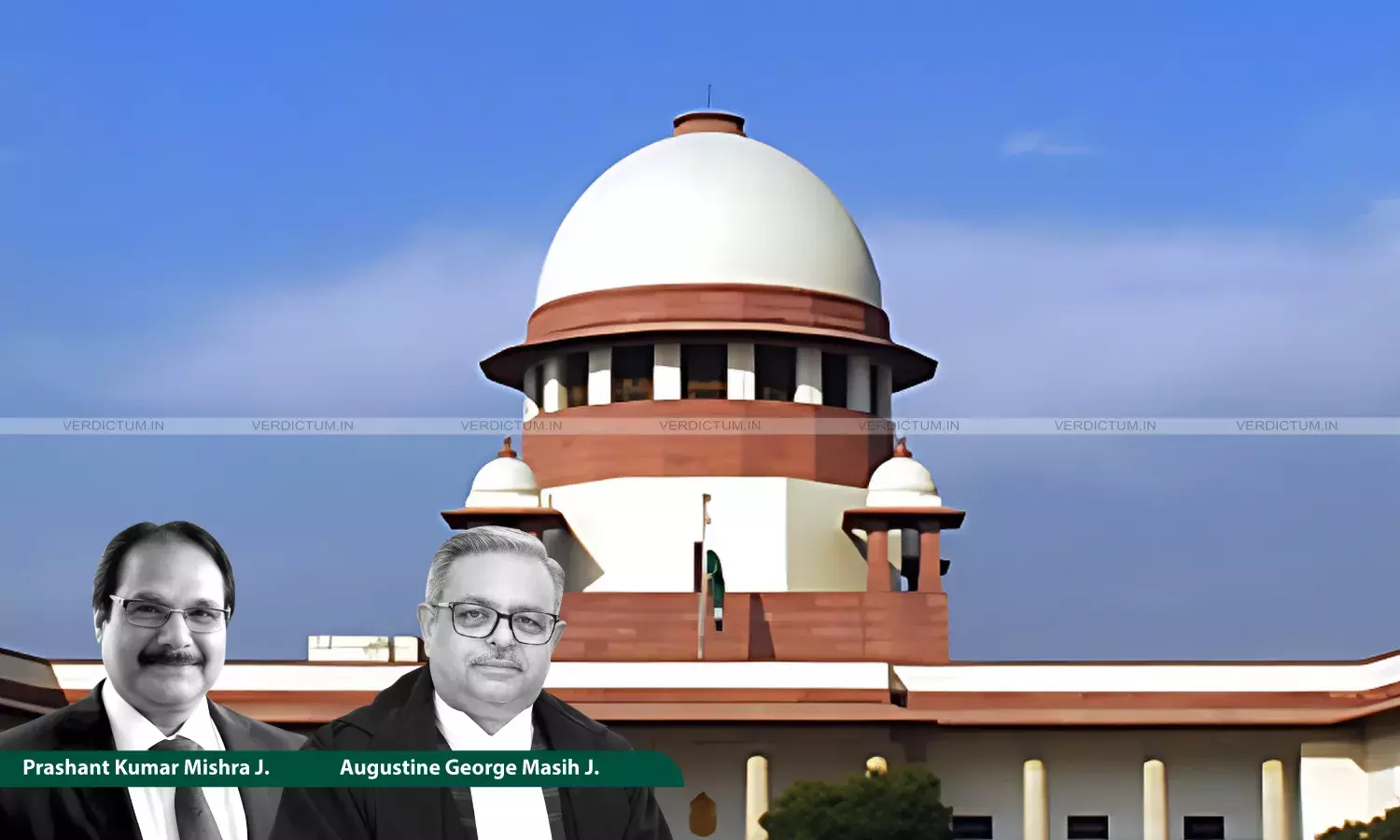
Justice Prashant Kumar Mishra, Justice Augustine George Masih, Supreme Court
The Supreme Court has held that registration as a society does not take a body outside the ambit of Article 12 of the Constitution of India where governmental control over it is pervasive. On whether a body is financially, functionally and administratively dominated by the Government, with that control being particular to the body and pervasive, the Court held that the National Book Trust, India is an “other authority” and therefore “State”.
The Court also clarified that the declaration operates only for Part III of the Constitution, and that it does not convert the Trust into a department of the Government of India, nor make its employees civil servants entitled to protections under Part XIV. It dismissed the appeal against the Delhi High Court Full Bench judgment.
A Bench of Justice Prashant Kumar Mishra and Justice Augustine George Masih observed, “…We find no substance in this submission as the decision of this Court in Ajay Hasia (supra) itself establishes that registration as a society does not place a body mandatorily beyond Article 12 of the Constitution. More so, it is trite that the State may act through a corporation incorporated under the Companies Act, 2013 or a society formed under the Societies Registration Act, 1860. The constitutional inquiry is therefore directed at the substance of the relationship between the body and the Government, and not at the nomenclature or legal form adopted for carrying on its activities”.
“In our considered view, the Trust accordingly satisfies the test of being financially, functionally and administratively dominated by or under the control of the Government, with that control being particular to the Trust and pervasive in character. Its registration as a society, or the fact that it generates part of its income independently cannot displace the cumulative constitutional character of the institution”, it noted further.
Advocate Yashvardhan appeared for the appellant and K.M. Nataraj, A.S.G appeared for the respondent.
The only question before the Court was whether the Trust is “State” under Article 12 of the Constitution of India. The Trust had been constituted pursuant to Government resolutions of June 15, 1957 and September 28, 1962. The appeal arose from a Full Bench judgment of the Delhi High Court dated June 1, 2012, which examined the Trust under Ramana Dayaram Shetty v. International Airport Authority of India and Others (1979) (3-Judge Bench), Ajay Hasia and Others v. Khalid Mujib Sehravardi and Others (1981) (5-Judge Bench) and Pradeep Kumar Biswas v. Indian Institute of Chemical Biology and Others (2002) (7-Judge Bench). It held that the Government exercised deep and pervasive control and that the Trust was an instrumentality or alter ego of the Government.
Before the Supreme Court, the Trust argued that, being a society, it was not a juristic person like a statutory corporation. It also argued that Government grants were only one source of its income. The Court heard Senior Advocate Sanjay Jain as amicus curiae.
The Bench held that the Ajay Hasia tests are indicative and not a mechanical checklist, and that merely regulatory control does not bring a body within Article 12. It rejected the submission on legal form, holding that the inquiry is directed at the substance of the relationship between the body and the Government. It also held that financial autonomy in one aspect cannot be isolated from the structure governing the body’s composition, management and supervision.
“…the State may act through a corporation incorporated under the Companies Act, 2013 or a society formed under the Societies Registration Act, 1860. The constitutional inquiry is therefore directed at the substance of the relationship between the body and the Government, and not at the nomenclature or legal form adopted for carrying on its activities…”, the Bench said.
“We are conscious that financial assistance is an important, but not an exclusive, factor in the inquiry under Article 12 of the Constitution. The Trust has emphasised that Government grants constitute only one of its sources of income and that, for certain years, its own receipts constituted a substantial part of its total income. It has been argued that the Full Bench of the High Court was therefore not justified in treating the mere receipt of Government grants as conclusive. But according to us, neither does the fact that the Trust generates income from the sale of its publications answer the constitutional question in its favour. There has to be a cumulative understanding i.e., financial autonomy in one aspect cannot be isolated from the statutory or regulatory structure governing the body, its composition, management and governmental supervision”, the Bench noted further.
The Court noted that the Chairman is appointed by the Government and holds office at its pleasure. Ministry representatives sit on the governing body and the Executive Committee, whose rule-making power requires prior Government approval. The accounts are audited by the Comptroller and Auditor-General, and alterations to the Trust’s rules need Government approval. It added that publishing books is not, by itself, a sovereign function.
Upholding the Full Bench, the Court held that no interference was called for and placed on record its appreciation of the amicus.
Cause Title: The Chairman, National Book Trust, India & Anr v. A.R. Abdul Gaffar & Ors (Neutral Citation: 2026 INSC 1202)
Appearances:
Appellant: Yashvardhan, Piyush Singh, Avantika Chaudhary, Shubham Raj, Abhishek Kumar Gupta, Kartik Kumar, Nitesh Ranjan, AOR, Advocates.
Respondent: K.M. Nataraj, A.S.G., Madhulika Upadhyay, AOR, Vinayak Sharma, Rajan Kr. Chourasia, Raghav Sharma, Satvika Thakur, Advocates.