

Limitation Period For Appeal U/S 62 IBC Commences On Date NCLAT Pronounces Order: Supreme Court
The Supreme Court was considering the appeals filed against the final Judgment passed by the National Company Law Appellate Tribunal (NCLAT), Chennai.

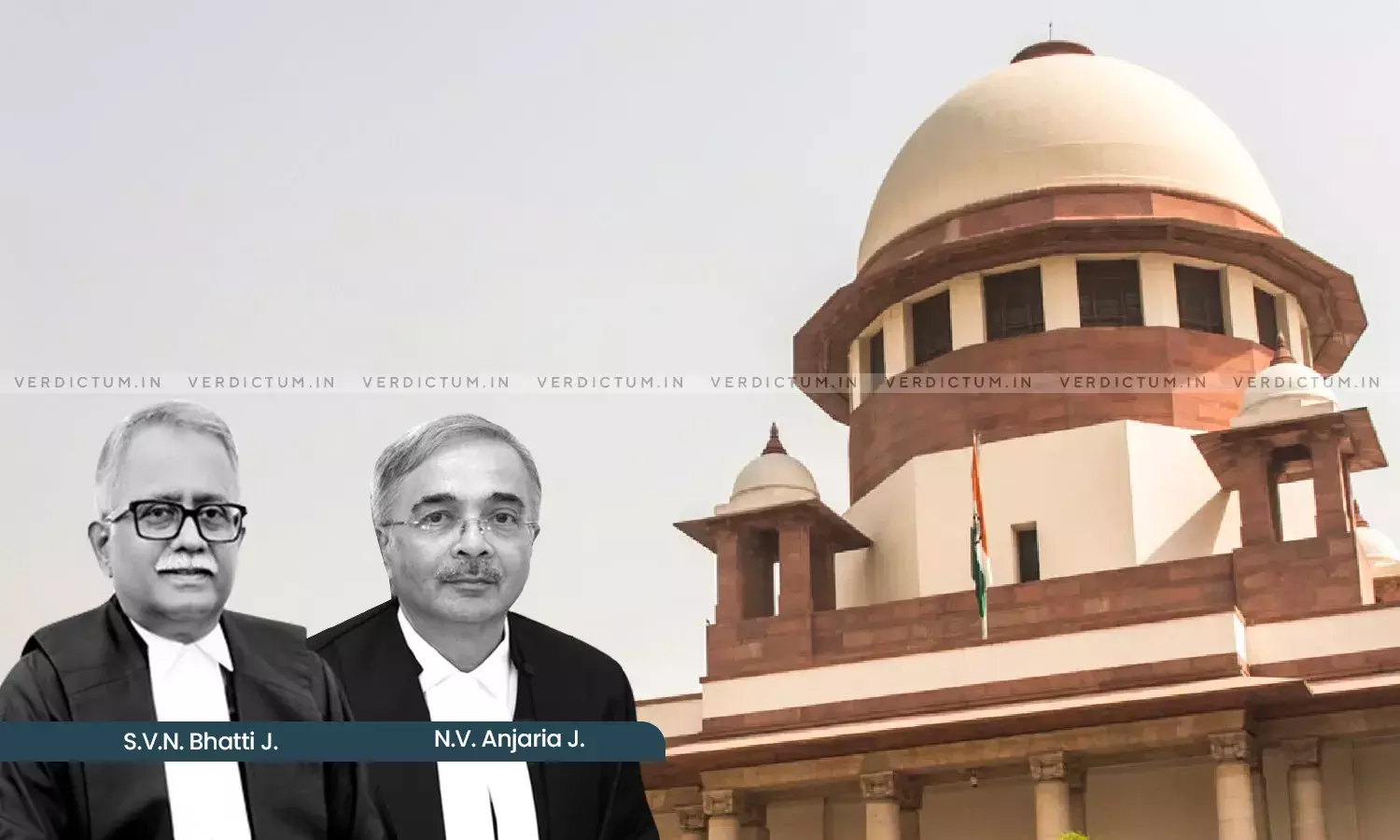
Justice S.V.N. Bhatti, Justice N.V. Anjaria, Supreme Court
The Supreme Court has held that the limitation period for an Appeal commences on the date the NCLAT pronounces the Order under Section 62 of the Insolvency and Bankruptcy Code (IBC). The Court further explained that under the Explanation to Section 12 of the Limitation Act, any period of inaction before filing the Application for a certified copy must be deducted from the statutory limitation period.
The Apex Court was considering the appeals filed against the final Judgment passed by the National Company Law Appellate Tribunal (NCLAT), Chennai, in a Company Appeal under Section 62 of the Insolvency and Bankruptcy Code, 2016 (IBC).
The Division Bench of Justice S.V.N. Bhatti and Justice N. V. Anjaria held, “On a bare reading of the Rule mandating pronouncement of the Order in open Court, knowledge and limitation would commence on the day the Rule is complied with. Consequently, the limitation period commences on the date the NCLAT pronounces the Order for an Appeal to this Court under Section 62 of the IBC. Under Section 12(2) of the Limitation Act, only the “time requisite” for obtaining a copy, i.e., the period between the filing of the Application and the date the certified copy is ready, is excluded. Under the Explanation to Section 12 of the Act, 1963, any period of inaction before filing the Application for a certified copy cannot be excluded and must be deducted from the statutory limitation period.”
Additional Solictor General K. M. Nataraj represented the Appellant while AOR Shradha Agrawal represented the Respondent.
Factual Background
The Corporate Debtor (M/s Samyu Glass Private Limited) manufactured high-quality glass containers and was registered as an Export Oriented Unit. Between 2013 and 2017, the Central Excise and Service Tax Department initiated multiple excise recovery proceedings against the Corporate Debtor. Around November/December 2016, the Corporate Debtor stopped its manufacturing activity. The Corporate Debtor subjected the demands raised by the Appellant to challenge before the Customs, Excise and Service Tax Appellate Tribunal (CESTAT). Andhra Bank, now Union Bank of India, a Financial Creditor of the Corporate Debtor, filed a Petition under Section 7 of the IBC to initiate the Corporate Insolvency Resolution Process (CIRP) against the Corporate Debtor. The Adjudicating Authority initiated the CIRP.
The Deputy Commissioner of Central Tax submitted a proof of claim (Form F) for Rs. 22,60,32,948. The Corporate Debtor, through the Resolution Professional (first Respondent), under the Sabka Vishwas (Legacy Dispute Resolution) Scheme, 2019, approached the Appellant to settle Central Excise arrears. The Resolution Professional presented a Scheme for Rs 4,32,80,741 for settlement before the Revenue. The National Company Law Tribunal, Hyderabad (NCLT), approved the Resolution Plan, and Rs 1,34,657 was approved towards the excise arrears payable to the Appellant.
The Appellants, questioning the Resolution Plan, moved the NCLAT, Chennai in a Company Appeal. Through the impugned Order, NCLAT confirmed the Resolution Plan approved by the NCLT, Hyderabad. Accordingly, the Revenue filed the Civil Appeal under Section 62 of the IBC.
Arguments
The second respondent (M/S Renganayanki Agencies) raised the preliminary objection on limitation by contending that the limitation period, including the condonable period, in the case started on August 3, 2023 and ended on October 1, 2023, i.e., the 60th day. The Appeal was filed on November 21, 2023, i.e., the 111th day. It was thus argued that the Appeal was barred by the period of limitation of 45 days and the condonable period of a further fifteen days.
Reasoning
Referring to the judgment in CA Ramchandra Dallaram Choudhary v. Adani Infrastructure and Developers Private Limited (2026), the Bench reiterated that the IBC’s limitation scheme is strict and time-bound, making condonation of delay outside the statutory framework impermissible. Under Section 62 of the IBC, the absolute outer limit for filing an appeal is 60 days, i.e., the standard 45-day period plus a 15-day grace period upon showing sufficient cause. Beyond this period, the Court loses jurisdiction to condone any delay, it noted.
The Bench further explained that a clear distinction exists between the exclusion of time under Section 12 of the Limitation Act and the condonation of delay under Section 62(2) of the IBC. “Section 62 provides an initial limitation period of 45 days from the date of receipt of the order, extendable by a discretionary condonable period of up to 15 days, creating an absolute outer ceiling of 60 days”, it stated.
Coming to the facts of the case, the Bench noted that the NCLAT pronounced the impugned Judgment on August 2, 2023 and the Appellant applied for a certified copy on September 6, 2023 (35th day). “The 35 days of inaction before filing the Application cannot be excluded and count directly against the initial 45-day statutory window”, it stated while also noting, “The Application remained pending with the Registry from 06.09.2023 until delivery on 11.10.2023 (35 days). This period constitutes “time requisite” under Section 12(2) of the Act, 1963, and is therefore excluded.”
Considering that the Appellant did not file the Appeal until November 21, 2023, consuming another 41 days after receipt of the copy, the Bench noted the actionable period, which was 35 days before applying for the certified copy and 41 days after receiving it, yielded a total of 76 days.
“The absolute statutory ceiling under Section 62 of the IBC is 60 days, i.e., 45 days plus 15 condonable days. Even after excluding the time taken to prepare the certified copy, the Appeal was filed 16 days beyond the absolute outer limit of this Court's jurisdiction to condone delay. Applying the above discussion to the present case, the Appeal is beyond the limitation period”, it held.
Thus, accepting the preliminary objection, the Bench dismissed the Civil Appeal as barred by limitation.
Cause Title: The Assistant Commissioner Of Central Tax, CGST Division v. Sreenivasa Rao Ravinuthala (Neutral Citation: 2026 INSC 1121)
Appearance
Appellant: Additional Solicitor General K. M. Nataraj, Advocates Sharath Nambiar, Vinayak Sharma, Indira Bhakar, Vatsal Joshi, Chitransh Sharma, Anuj Srinivas Udupa, Satvika Thakur, Nikita Capoor, Yogya Rajpurohit, Ritika Ranjan, S. Subramanium, Ishan Bhaduri, Sahaj Joshi, AOR Gurmeet Singh Makker
Respondent: AOR Shradha Agrawal, Ayshwarya Chandar