

Testimony Of Hostile Witnesses Can Be Utilized To Support Acquittal If It Inspires Credibility: Supreme Court
The Bench noted that if a corroborated hostile witness testimony can sustain conviction, it can equally justify acquittal when it undermines the prosecution case.

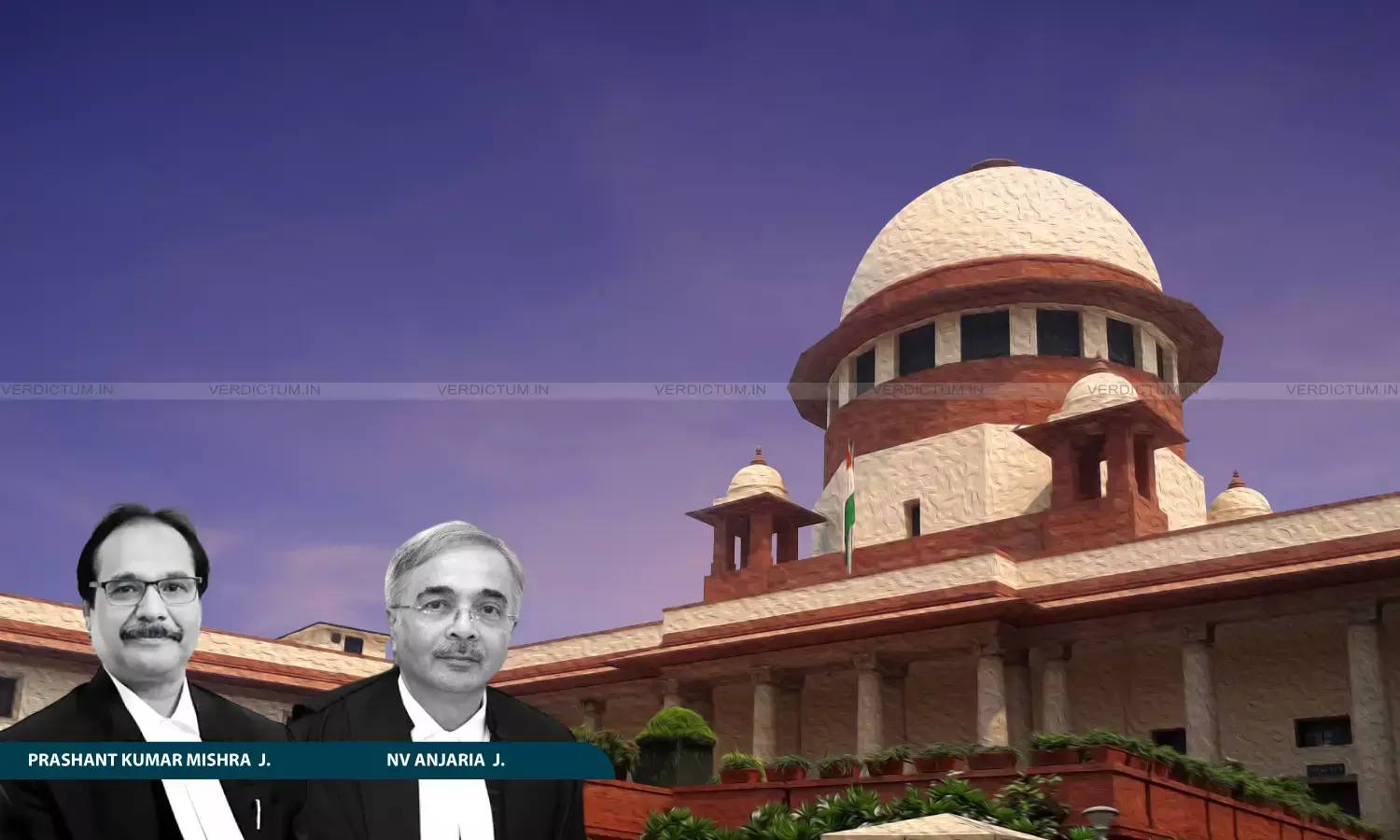
Supreme Court, Justice Prashant Kumar Mishra, Justice N.V. Anjaria
The Supreme Court while setting aside a conviction for murder and atrocities, has observed that the testimony of a hostile witness is not only admissible for conviction but can also be properly utilized to justify an acquittal.
The Bench determined that if a hostile witness’s account effectively demolishes the fulcrum of the prosecution's case when read alongside other ocular or documentary evidence, the benefit of that discredit must flow to the accused.
Justice Prashant Kumar Mishra and Justice N.V. Anjaria in an appeal arising from a 2013 incident involving allegations of caste-based violence and murder, observed, “…when the testimony of a hostile witness is admissible subject to be feeded by corroboration and the conviction on that basis could be arrived at, the reverse is also true as a canon of appreciation of evidence. What necessarily implies is that as the evidence of a hostile witness can be used for convicting the accused, such evidence could indeed be applied and utilised also for the purpose of acquitting the accused, when what is testified by the hostile witness inspires credibility, when read with the other evidence on record, either ocular or documentary. The dictum would be that the testimony of a hostile witness or statement in the deposition of hostile witness could be properly employed to discredit the prosecution case and a conclusion of acquittal could well be supported through it and could be founded therein”.
Advocate D. Ramakrishna Reddy appeared for the appellant and Advocate Kumar Vaibhaw appeared for the respondent.
As per the facts, the prosecution alleged that on May 12, 2013, the appellant, confronted the deceased, Shiva Shankar, near his house in Ogipur village. The motive was attributed to a previous incident where the deceased had eloped with the appellant's sister, leading to a village Panchayat decision that the deceased stay away from the village.
It was alleged that the appellant beat the deceased with a shabad stone, causing fatal head injuries, and used casteist slurs against the deceased’s mother, PW1, when she intervened. Shiva Shankar succumbed to his injuries while being shifted to a hospital in Hyderabad.
Thereafter, the Court of the Special Sessions Judge for Trial of Offences snder SC/ST Act, Ranga Reddy District, convicted the appellant under Sections 302 and 323 IPC and relevant sections of the SC/ST Act.
Consequentially, the appellant was sentenced to life imprisonment, and this conviction was subsequently confirmed by the Telangana High Court on February 04, 2025. The appellant then moved the Supreme Court via a Special Leave Petition, leading to the present criminal appeal.
The Court noting the weak, contradictory and crumbling evidence presented by the prosecution, observed that the primary eyewitness, PW3, turned hostile and explicitly denied informing the mother of the deceased about the attack, directly contradicting her testimony.
Furthermore, the alleged genesis of the crime, the village Panchayat, was disproved as other witnesses (PW4 and PW5) testified that no such meeting ever occurred. The Court also found the medical evidence to be unreliable due to significant discrepancies in the Postmortem Report regarding the date and time of the autopsy, which the medical officer failed to explain satisfactorily. Given that the incident occurred in a public area with high traffic, the failure to examine any independent witnesses further eroded the prosecution’s credibility.
“In wake of such weak, contradictory and crumbling evidence, where the prosecution miserably struggled to be finally unable to prove its case, the conviction recorded by the Trial Court and confirmed by the High Court is not sustainable. Both the courts committed a concurrent error in convicting the appellant. The judgment and order of the trial court and the High Court deserve to be set at naught”, the Bench noted.
Consequently, the Supreme Court allowed the appeal and set aside the judgment and order of the Telangana High Court. The Court acquitted Talari Naresh of all charges and ordered his immediate release from custody, provided he is not required in any other case.
Cause Title: Talari Naresh v. The State of Telangana (Neutral Citation: 2026 INSC 486)
Appearances:
Appellant: D. Ramakrishna Reddy and D. Bharathi Reddy, Advocates.
Respondent: Kumar Vaibhaw and Devina Sehgal, Advocates.