

Recruiting Authority Can Devise Selection Procedures Where Rules Don’t Prescribe Detailed Method: Supreme Court
The appeal before the Supreme Court was filed against the judgment of the Gauhati High Court revolving around the recruitment process undertaken by the Department of Excise and Prohibition of the Nagaland Government.

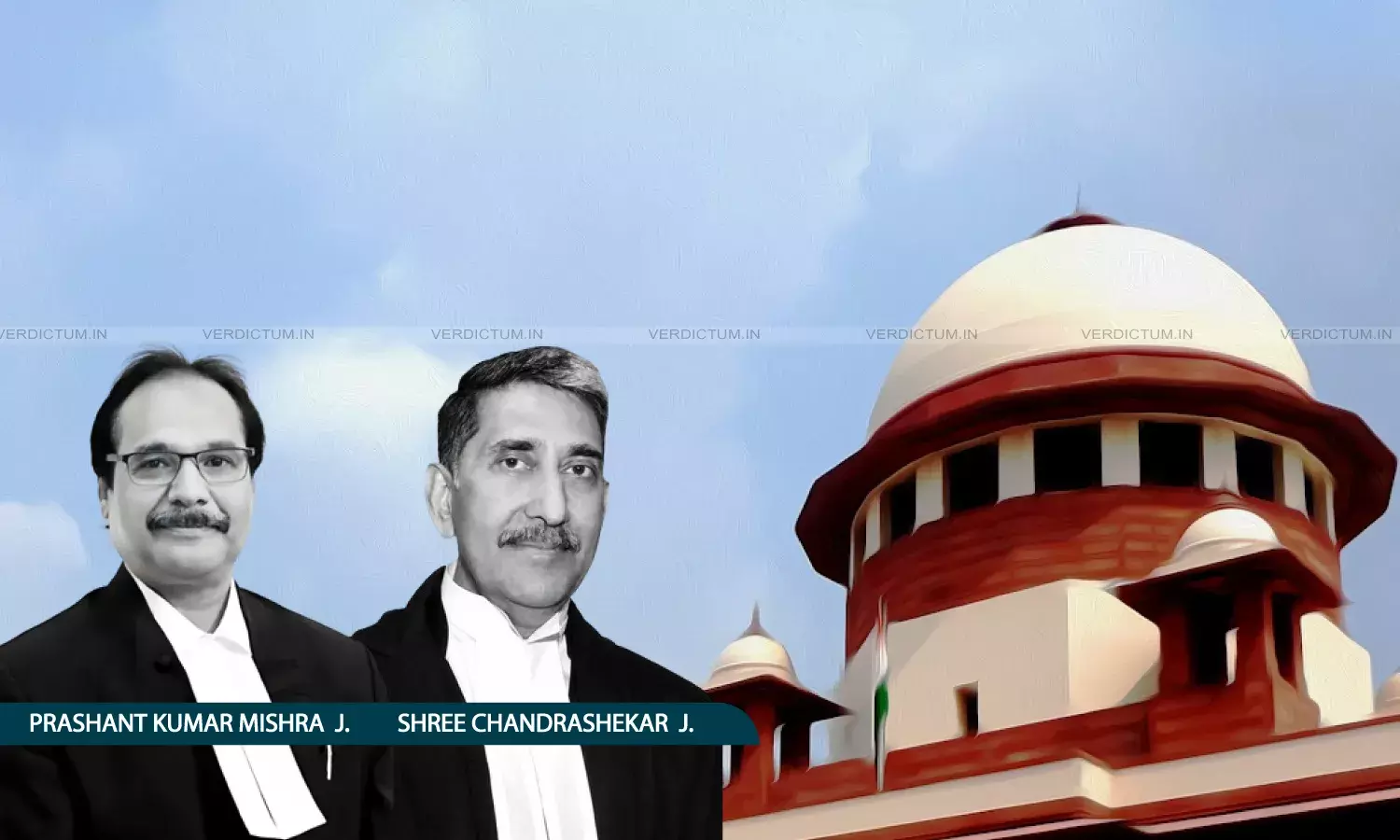
Justice Prashant Kumar Mishra, Justice Shree Chandrashekhar, Supreme Court
While dismissing the appeal of the candidates who had applied for the post of Excise Constables in Nagaland, the Supreme Court has observed that the Recruiting Authority has the discretion to devise selection/shortlisting procedures where applicable Rules do not prescribe a detailed method.
The appeal before the Apex Court was filed against the judgment of the Division Bench of the Gauhati High Court revolving around the recruitment process undertaken by the respondent, the Department of Excise and Prohibition of Nagaland Government.
The Bench of Justice Prashant Kumar Mishra and Justice Shree Chandrashekhar held, “In these circumstances, and having regard to the discretion available to the competent recruiting authority in devising selection/shortlisting procedures where the applicable Rules do not prescribe a detailed method, we find no ground to interfere with the judgment and order dated 23.06.2026 passed by the Division Bench of the High Court.”
Senior Advocate Parthiv K Goswami represented the Appellant while Senior Advocate K N Balgopal represented the Respondent.
Factual Background
The dispute pertained to a recruitment process undertaken by the respondent, the Department of Excise and Prohibition, Government of Nagaland, for filling the posts of Excise Constable. An Advertisement was issued inviting applications from indigenous inhabitants of Nagaland for 40 Excise Constable posts, prescribing Class VIII as the required educational qualification. Six additional posts were subsequently notified by an Addendum Order, taking the total number to 46. Subsequently, in continuation of the original advertisement, the Board issued a Corrigendum, notifying the inclusion of a written examination in the recruitment process, in line with other uniformed services.
The appellant approached the High Court claiming that Clause 4 of the Advertisement stipulated that the recruitment process would consist of two stages of Physical Test and Suitability Test/Viva-Voce and thus the introduction of a written examination was contrary to the terms notified in the initial advertisement. The Single Bench allowed the appellants’ writ petition. Aggrieved, the State preferred a Writ Appeal and, vide the impugned judgment, the Division Bench set aside the judgment of the Single Judge. Thereafter, the recruitment process continued, and the list of the 46 selected candidates was notified. The appellants had pointed out that three of the forty-six acceptance letters were only received and mere publication of the select list did not render the Appeal infructuous, given candidates had yet to be appointed against the posts.
Reasoning
The Bench noted that the recruitment was governed by the 1999 Rules, Rule 5(i)(a) of which provides for direct recruitment through “competitive examination/selection” and Rule 7(1) provides for a Selection Board for direct recruitment to the relevant posts.
“Schedule II prescribes direct recruitment as the method of recruitment to the Group C (Non Gazetted) post of Excise Constable and Schedule III prescribes Class VIII as the requisite educational qualification for the same. Nothing in the recruitment process, therefore, contravened the 1999 Rules. We may add that the written examination, based on the Class VIII syllabus, falls under “competitive examination/selection” within the meaning of Rule 5(i)(a) and, therefore, Rule 5(ii), which requires the Government to consult with the Commission to adopt a different method of recruitment, is not attracted at all”, it added.
The Bench also noticed that the Advertisement empowered the Departmental Recruitment Board to rectify any omission or commission through notifications and addenda under Clause 15 and expressly vested in it the authority to take a final and binding decision in any dispute concerning the recruitment process under Clause 16.
The Bench further took note of the fact that the appellants had not been able to demonstrate how the process operated discriminatorily or caused any prejudice to them, as admittedly having participated in the selection process despite being aware of the revised procedure.
Thus, holding that the competent recruiting authority can devise selection/shortlisting procedures where the applicable Rules do not prescribe a detailed method, the Bench dismissed the appeal.
Cause Title: T. Akon Phom and Others v. State of Nagaland and Others (Neutral Citation: 2026 INSC 1211)
Appearance
Appellant: Senior Advocate Parthiv K Goswami, AOR Diksha Rai, Atiga Singh, Advocates Purvat Wali, Lakshmi Agarwal
Respondent: Senior Advocate K N Balgopal, AOR K. Enatoli Sema, Advocates Nitya Nambiar, Amit Kumar Singh, Chubalemla Chang, Prang Newmai, Yash Bhushan Agarwal, Lungnim A Shishak