

‘Washed-Off Theory’ May Operate In Promotional Matters But Not For Assessing Compulsory Retirement: Supreme Court
The Supreme Court was considering an appeal challenging the judgment upholding the orders of compulsory retirement passed against the appellant.

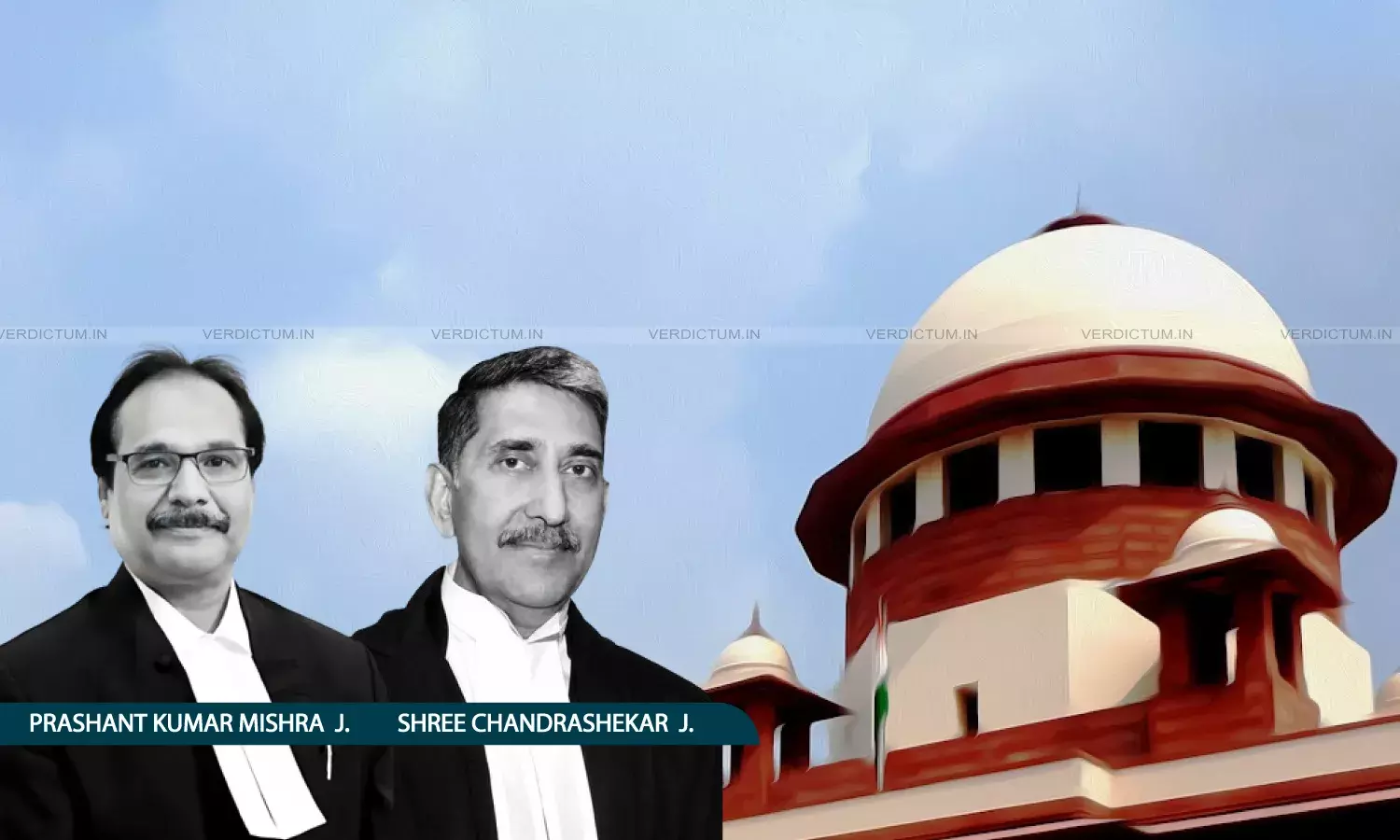
Justice Prashant Kumar Mishra, Justice Shree Chandrashekhar, Supreme Court
While upholding an order of compulsory retirement passed against a former CISF Inspector, the Supreme Court has held that the “washed-off theory” may operate in matters relating to promotion, but it has no application where the competent authority assesses the suitability of an employee for continued retention in service.
The Apex Court was considering an appeal challenging the judgment of the Delhi High Court dismissing the writ petition filed by the appellant and upholding the orders of compulsory retirement passed against him by the competent authority.
The Division Bench of Justice Prashant Kumar Mishra and Justice Shree Chandrashekhar held, “As is clear from the above, while the “washed-off theory” may operate in matters relating to promotion, it has no application where the competent authority assesses the suitability of an employee for continued retention in service. The Committee was, therefore, justified in considering the appellant's entire service record, including adverse material preceding the appellant's promotion.”
“It also cannot be lost sight of that the appellant was serving in the CISF, a disciplined and uniformed force entrusted with vital security functions. Members of such force are expected to maintain a consistently high standard of efficiency, vigilance and discipline. Viewed in that light, the decision of the competent authority warrants no interference.”
Advocate Sumant Bharadwaj represented the Appellant while Additional Solicitor General Vikramjit Banerjee represented the Respondent.
Factual Background
The appellant joined the Central Industrial Security Force as an Assistant Sub-inspector in 1982. While in service, he was promoted twice, firstly to the post of Sub-Inspector and later to the post of Inspector. Upon attaining the age of 50 years, the appellant’s case was placed before the Internal Screening Committee for assessment under Rule 56(j) of the Fundamental Rules. The Committee found the appellant to be unfit for retention in the service. The said view was affirmed by the Review Committee in 2010 and consequently, the appellant was compulsorily retired from service. The appellant’s representation was also rejected by the Representation Committee.
Assailing the order of compulsory retirement, the appellant filed a writ petition before the High Court. The High Court opined that the efficiency of the appellant to perform his duties slackened in the last 2 years of the period under review and held that the decision of the Committee in compulsorily retiring the appellant was not arbitrary or unreasonable. Aggrieved thereby, the appellant approached the Apex Court.
Reasoning
The Bench, at the outset, explained that the object underlying compulsory retirement is to weed out the dead wood so as to maintain a high standard of efficiency and integrity in public service.
“It is trite law that an order of compulsory retirement is not punitive in nature and implies neither stigma, prejudice nor any suggestion of misbehaviour. The order of compulsory retirement is in public interest and is passed on the subjective satisfaction of the Government. Furthermore, the principles of natural justice, audi alteram partem find no application in the context of compulsory retirement. However, this cannot be construed to mean that the order of compulsory retirement is insulated from judicial scrutiny. Albeit, the High Court or this Court would not examine the matter as an Appellate Court, but nevertheless, can interfere, if the order so passed is malafide, based on no evidence or is arbitrary and perverse”, it added.
On a perusal of the facts of the case, the Bench noted that in the last two years immediately preceding to order of compulsory retirement, the appellant’s performance suffered discernible decline, with the gradings dropping from “Good” to “Average” and remaining stagnant thereafter. It was further noticed that after his last promotion in 2003, the appellant was inflicted with one minor penalty of censure for furnishing a false reason to obtain leave, apart from being warned on four occasions for negligence in duties and cautioned twice for lethargic attitude.
“The Committee was, therefore, justified in considering the appellant's entire service record, including adverse material preceding the appellant's promotion”, it held.
Finding no infirmity in the decision of the Committee, the Bench held that the Committee considered the appellant's entire service record while according due weight to his declining performance during the immediate preceding years, in conformity with the settled principles governing compulsory retirement. Concurring with the view taken by the High Court affirming the same, the Bench dismissed the Appeal.
Cause Title: Sushil Sharma v. Union of India and Others (Neutral Citation: 2026 INSC 809)
Appearance
Appellant: Advocates Sumant Bharadwaj, Vedant Bharadwaj, AOR Mridula Ray Bharadwaj, Advocate D.M. Sharma, Amrita Behera, Pooja Gupta, Anshu Singh, Anshita Sharma, Shiva Khandelwal
Respondent: Additional Solicitor General Vikramjit Banerjee AOR N. Visakamurthy, Advocates Nachiketa Joshi, Praneet Pranav, Raman Yadav, AOR Arvind Kumar Sharma