

Criminal Proceedings Against Accused Cannot Continue When Similarly Situated Co-Accused Stands Discharged: Supreme Court
The Court held that the continuation of criminal proceedings against a public official alone becomes arbitrary and violative of Article 14 when similarly placed IFS officers, occupying more prominent positions in the administrative chain, have already been discharged.
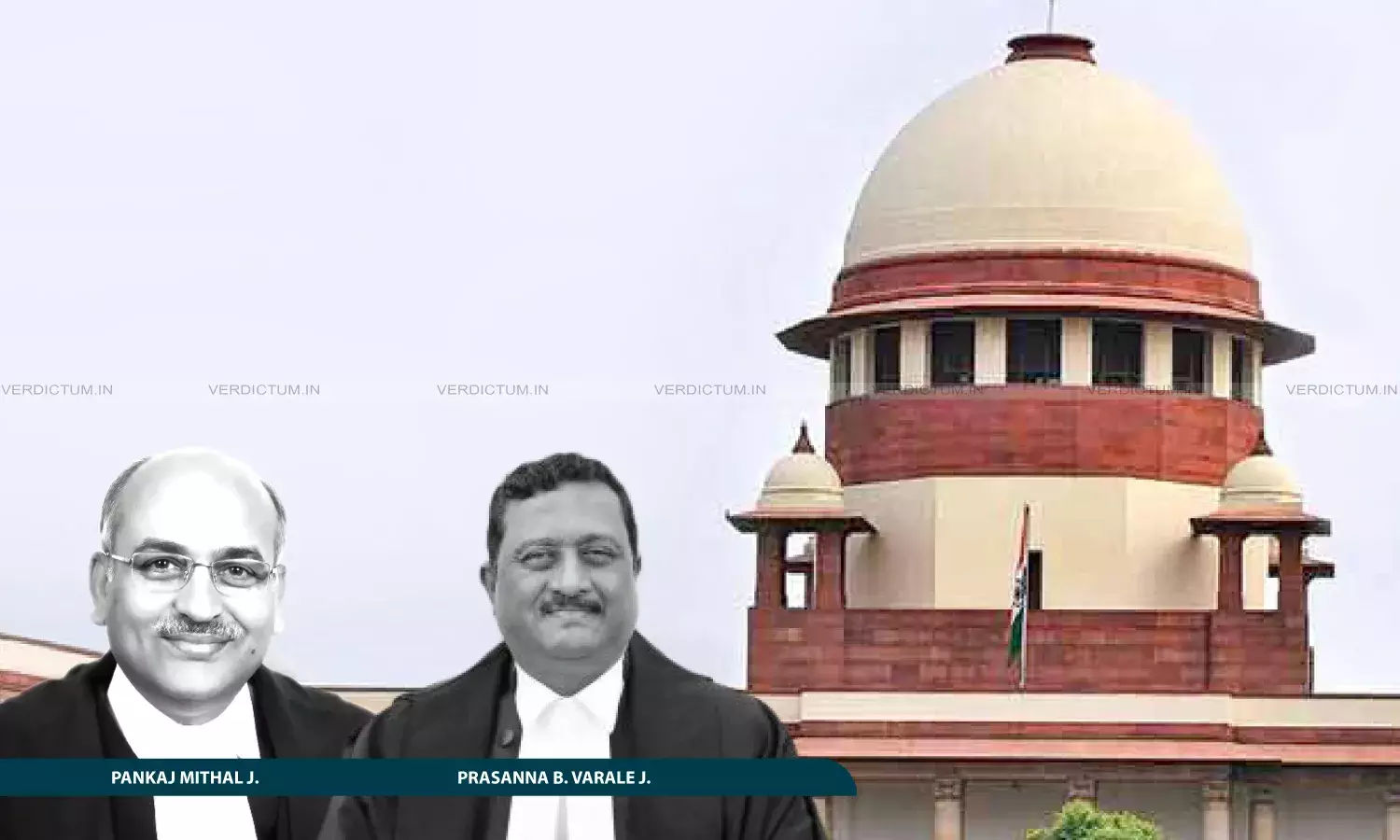
Justice Pankaj Mithal, Justice Prasanna B. Varale, Supreme Court
The Supreme Court has held that criminal proceedings cannot be selectively continued against one accused where similarly situated co-accused, against whom allegations are equal or even more serious, have already been discharged by the Court.
The Court observed that the principle of parity is a foundational tenet of criminal jurisprudence and mandates equal treatment of similarly situated accused persons.
The Court was hearing an appeal challenging the refusal to discharge the appellant, a public official, in criminal proceedings arising out of alleged irregularities relating to administrative approvals and official decision-making concerning forest and environmental matters.
A Bench of Justice Pankaj Mithal and Justice Prasanna B. Varale observed: “Furthermore, it is not in dispute that two co-accused, namely Indian Forest Service officers who were similarly situated and even more prominently placed in the administrative chain of events, have already been discharged by the High Court. A comparative examination of the roles ascribed to the discharged co-accused and the present Appellant shows no distinguishable basis that would justify differential treatment.
“The principle of parity, which is a fundamental tenet of criminal jurisprudence, requires that similarly situated accused persons be treated alike. When the allegations and evidence against the Appellant are not even qualitatively stronger than those against the discharged co-accused, the continuation of proceedings against the Appellant alone would be arbitrary and violative of Article 14 of the Constitution of India”, the Bench added.
Advocate P. Vamshi Rao appeared for the appellant. Advocate Suvendu Suvasis Dash appeared for the State of Odisha (Vigilance).
Background
The FIR alleged large-scale illegal felling and transportation of valuable timber under the guise of salvage operations in the Chitrakonda and Kalimela forest ranges. According to the prosecution, a private firm appointed as the Raw Material Procurer (RMP) was permitted to remove timber in violation of government policy, which prohibits the felling of standing trees.
It was alleged that the appellant, then serving as Forest Range Officer, along with forest officials and private persons, conspired to facilitate clandestine felling of live trees and transportation of timber for pecuniary gain.
Following the investigation, a charge sheet was filed under the Prevention of Corruption Act, IPC and Odisha Forest Act. The appellant sought discharge under Section 227 CrPC, contending that neither the FIR nor the materials collected during the investigation disclosed any specific role attributable to him.
The discharge application was rejected by the Special Judge (Vigilance), and the challenge before the Orissa High Court also failed, leading to the present appeal before the Supreme Court.
Court’s Observation
The Supreme Court found that the allegations in the FIR and charge-sheet were joint and omnibus in nature and failed to disclose any distinct role attributable specifically to the appellant.
The Court observed that neither the Trial Court nor the High Court undertook an independent assessment of the material, qua the appellant, before rejecting his plea for discharge.
The Bench held that while the prosecution had generally alleged conspiracy involving several officials and private persons, there was no material indicating the precise involvement of the appellant in the alleged offences.
Referring to Neelu Chopra v. Bharti (2009), the Court reiterated that mere reproduction of penal provisions is insufficient and that the prosecution must disclose the specific role played by each accused person.
The Court observed: “What is required to be brought to the notice of the court is the particulars of the offence committed by each and every accused and the role played by each and every accused in committing of that offence.”
The Bench further held that continuation of criminal proceedings in the absence of specific allegations would amount to abuse of the process of the Court.
Relying upon State of Haryana v. Bhajan Lal (1992), the Court held that where allegations taken at face value do not disclose the commission of an offence or specific involvement of the accused, criminal proceedings deserve to be quashed.
The Court also noted that two co-accused IFS officers occupying more prominent positions in the administrative hierarchy had already been discharged by the High Court in connected proceedings.
The Bench found no distinguishing feature justifying differential treatment between the appellant and the discharged IFS officers.
The Court observed: “A comparative examination of the roles ascribed to the discharged co-accused and the present Appellant shows no distinguishable basis that would justify differential treatment.”
The Court further emphasised that criminal trials are not ritualistic exercises and that compelling an accused to undergo trial without sufficient material causes stigma, hardship and irreparable injury to reputation and liberty.
The Bench observed: “The criminal trial is not a mere formality, nor a ritualistic procedure to be endured regardless of merit.”
Referring to Yogesh v. State of Maharashtra (2008), the Court reiterated that even at the stage of framing of charge, there must at least exist a grave suspicion against the accused founded on legally sustainable material.
Conclusion
The Supreme Court held that the material on record did not disclose any specific role or overt act attributable to the appellant and that the allegations against him were vague and generalised.
The Court further held that continuation of proceedings against the appellant alone, despite discharge of similarly situated IFS officers, violated the principle of parity and Article 14 of the Constitution.
Accordingly, the appeal was allowed, and the appellant was discharged from all offences alleged against him.
Cause Title: Susanta Kumar Dalei @ Susanta Kumar Dalai v. State of Odisha (Vigilance) (Neutral Citation: 2026 INSC 510)
Appearances
Appellant: Advocates P. Vamshi Rao, Srijan Sinha, Abhishek Choudhury, Meka Venkata Rama Krishna
Respondent: Suvendu Suvasis Dash
