

Severance Compensation In Land Acquisition Must Reflect Loss Of Utility Of Remaining Land: Supreme Court
The Court found that the construction of a wide drain had left portions of the unacquired agricultural holdings practically isolated because heavy farming machinery could not cross the narrow bridges.
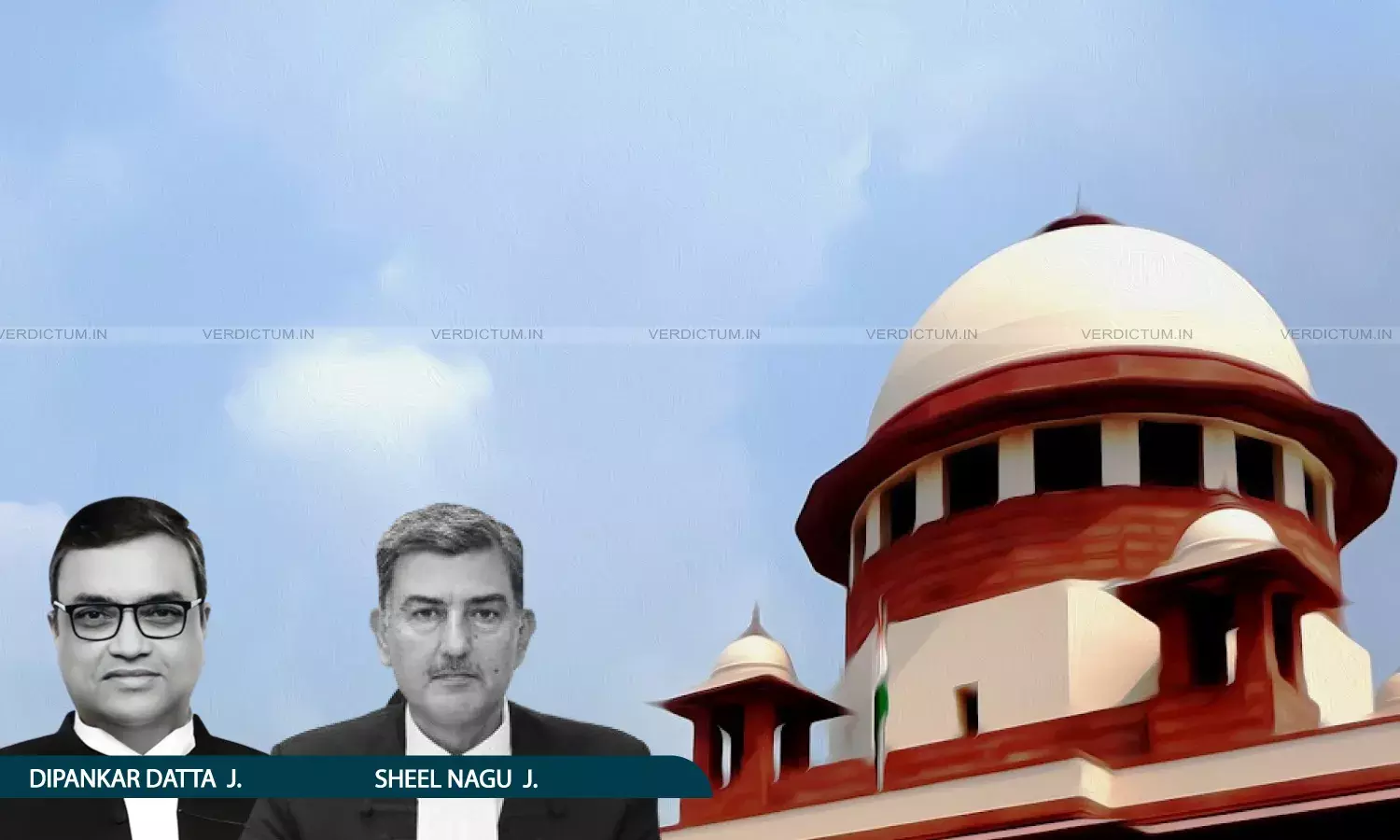
Justice Dipankar Datta, Justice Sheel Nagu, Supreme Court
The Supreme Court has held that where land acquisition destroys the functional integrity of the remaining property, severance compensation must reflect the actual loss of utility and diminution in value of the unacquired land.
The Court consequently restored severance charges at 50% of the market value of the remaining unacquired land.
The Court was hearing 47 civil appeals challenging a common judgment of the Punjab and Haryana High Court which modified compensation awarded by the Reference Courts for lands acquired under the Land Acquisition Act, 1894 for constructing the Aspal Extension Drain.
A Bench of Justice Dipankar Datta and Justice Sheel Nagu observed: “This Court has long recognized that rendering unacquired land inaccessible constitutes a constructive total loss of its agricultural utility. In Walchandnagar Industries Ltd. v. State of Maharashtra and Another, this Court considered that when an acquisition destroys the functional integrity of a landowner's remaining system, the State is liable to compensate for the actual loss of utility of the remaining, unacquired infrastructure.”
The Bench, while examining the Punjab & Haryana High Court’s approach, further observed: “The High Court’s decision to reduce severance charges to a flat 40% of the acquired land’s value is legally and factually unsustainable. Under Section 23(1) of the Act of 1894 the damage caused due to severance damage is explicitly designed to compensate for the diminution in value of the unacquired remaining land. The Reference Court’s award of 50% of the value of the unacquired land was fully justified. Accordingly, the Reference Court's 50% severance award on the unacquired land is hereby restored.”
Senior Advocate Ajay Tewari appeared for the appellants. Senior Advocate Sanjay Hegde appeared for the respondents.
Background
The State had acquired parcels of agricultural land situated across six villages in Punjab for constructing an approximately 18-kilometre-long drain. The Land Acquisition Collector awarded no compensation for severance, despite the landowners’ contention that the drain had bifurcated their holdings and rendered the remaining portions difficult to use.
The Reference Courts subsequently awarded severance compensation at different rates, including 50% of the value of the remaining unacquired land in three villages. The High Court replaced these awards with a uniform 40% of the market value of the acquired land, relying on Tehal Singh v. State of Punjab through Collector Land Acquisition Drainage Circle Patiala (1987).
The landowners challenged, among other aspects, the High Court’s decision to calculate severance compensation with reference to the acquired strip instead of the remaining land whose utility had been impaired.
Court’s Observations
The Court observed that Section 23(1), thirdly, of the Land Acquisition Act, 1894 requires compensation for the damage sustained by an interested person because the acquired land has been severed from their other land.
The Bench found that the High Court had committed a fundamental legal error by shifting the basis of calculation from the remaining unacquired land to the portion acquired by the State. The Court noted that a narrow strip of approximately 79 kanals had been acquired from the lead landowner, while the acquisition had bifurcated nearly 250 kanals of the remaining holding.
The Court stated that calculating compensation against the narrow acquired strip considerably reduced the amount payable and failed to compensate the landowners for the permanent loss of utility affecting the substantially larger remaining holdings. Referring to Smt. Tribeni Devi v. Collector of Ranchi (1972), the Bench added that physical separation resulting in severe diminution in the value of the land left behind warranted separate and adequate severance compensation.
The Court held: “Accordingly, to uphold the constitutional mandate of Krishan Kumar (supra) and restore project-wide parity across all contiguous revenue estates, the High Court’s decision to reduce severance charges to a flat 40% of the acquired lands’ value is set aside. The Reference Court’s award of 50% severance charges calculated on the market value of the unacquired remaining land is hereby fully restored across all villages under challenge.”
The Court further observed that the High Court had mechanically applied the formula in Tehal Singh v. State of Punjab through Collector Land Acquisition Drainage Circle Patiala (1987) based on the distance of the severed land from the village settlement. The Bench found that this approach disregarded the physical nature of the drain and its effect on access to the remaining holdings.
The Court noted evidence showing that the drain was between 100 and 130 feet wide, with banks extending between 10 and 30 feet in height. Bridges were situated approximately two kilometres apart and were not wide enough to permit combine harvesters and other heavy machinery to cross.
The Bench observed: “The physical barrier of the Aspal Extension Drain—measuring 100 to 130 feet in width with banks up to a minimum of 10 feet extending to 30 feet constitutes an insurmountable gap, because modern mechanized farming machinery (such as tractors and combine harvesters) cannot physically cross a 7-feet bridge, the unacquired remaining land on the opposite bank was left in a state of absolute, practical isolation.”
The Court consequently held that the High Court had misapplied the precedent by overlooking the facts demonstrating that the drain had rendered the remaining land partially unusable.
“By ignoring facts, the High Court misapplied the Tehal Singh (supra) precedent. The drain's massive physical barrier and the inaccessibility of the severed piece of land rendered the unacquired land partially unusable”, the Bench added.
On a related issue, the Court clarified that severance damages constitute an independent auxiliary head of compensation under Section 23(1), thirdly, of the Land Acquisition Act, 1894. They do not form part of the market value determined under the first clause of Section 23(1).
Relying on State of Punjab v. Amarjit Singh (2011), the Bench affirmed that additional compensation under Section 23(1A) and solatium under Section 23(2) are payable only on the market value of the land and not on severance damages or compensation for trees, tubewells and structures.
Conclusion
The Supreme Court disposed of the 47 civil appeals by setting aside the High Court’s cap on severance compensation and restoring the Reference Courts’ award of 50% severance charges calculated on the market value of the remaining unacquired land.
The Court also restored a uniform market value of ₹5 lakh per acre across the villages involved in the appeals. It affirmed the compensation for 280 pleaded fruit-bearing trees, the flat award of ₹50,000 per tubewell and the denial of benefits under Sections 23(1A) and 23(2) of the Land Acquisition Act, 1894 on auxiliary assets.
The authorities were directed to calculate and pay the additional compensation within six months. If recalculation resulted in any amount becoming recoverable from a landowner, recovery could be undertaken within nine months only after written intimation and a sufficient opportunity of hearing. No order was made as to costs.
Cause Title: Surinder Ahuja & Anr. v. State of Punjab & Anr. (Neutral Citation: 2026 INSC 1068)
Appearances
Appellants: Senior Advocate Ajay Tewari; AORs Tarun Gupta, Amit K. Nain, Tushar Bakshi, Subhasish Bhowmick, Abhimanyu Tewari and Goldy Goyal; Advocates Gagandeep Sharma, Brijesh Kumar Sangwan, Vernekar Venkatesh Narayan, Dilmrig Nayani, Siddhat Awasthy, Siddhant Saroha, Kanishk Bhatt, Shravil Budkulia, Dinesh Verma, Rajat Sharma and Honey Verma
Respondents: Senior Advocate Sanjay Hegde, Advocates Nupur Kumar and Rooh-e-Hina Dua
