

Grievous Or Simple Hurt Not Pre-Condition To Attract Offence Of Attempt To Murder U/S.307 Of IPC: Supreme Court
The Supreme Court was considering a Special Leave Petition filed by the petitioner, aggrieved by the dismissal of his request to alter the charge to one under Section 307.

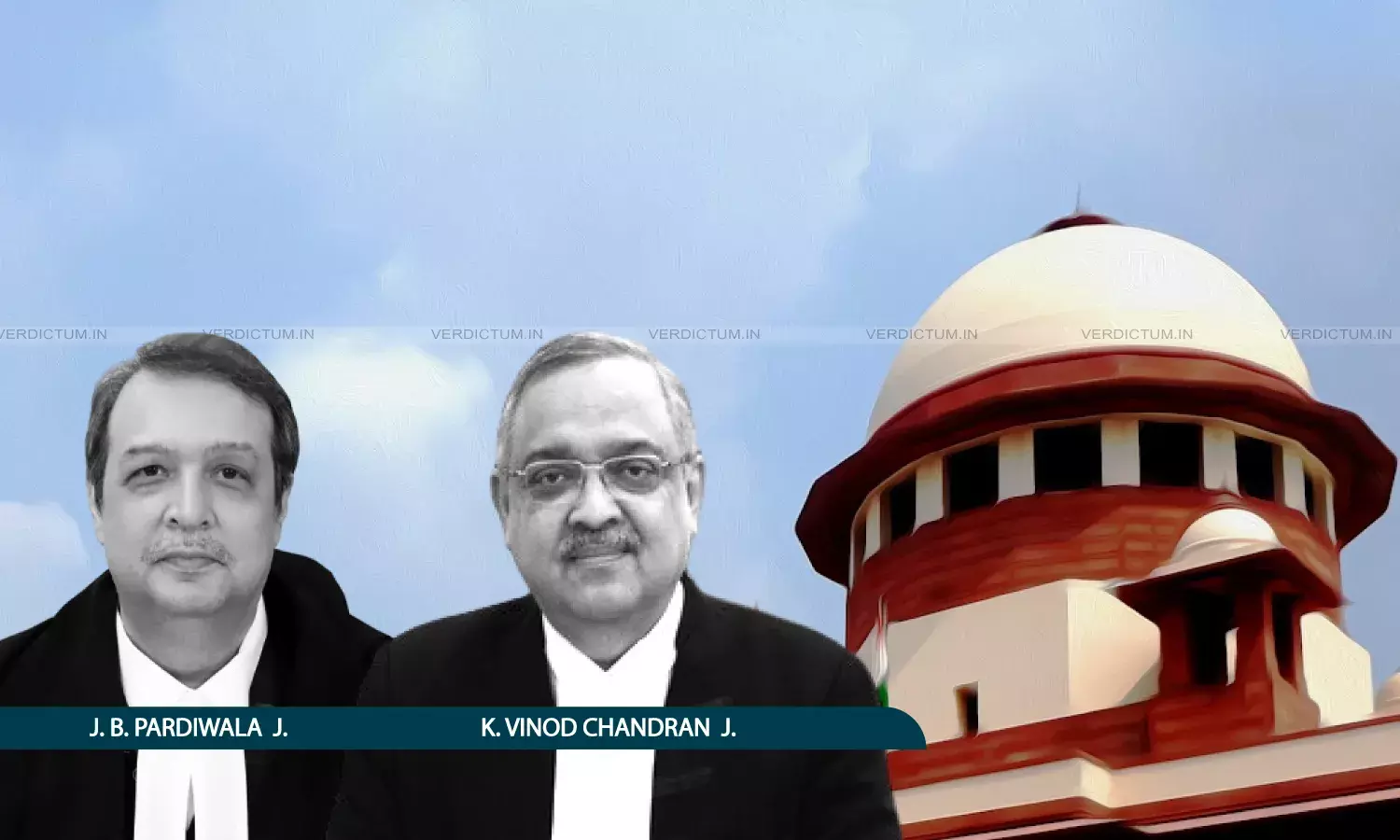
Justice J. B. Pardiwala, Justice K. Vinod Chandran, Supreme Court
The Supreme Court has observed that hurt, grievous or simple, is not a precondition to attract Section 307 of the Indian Penal Code (IPC), but if the act of causing such hurt is done with the intention or knowledge that such act could have caused death, making the perpetrator guilty of murder, then a graver punishment is provided.
The Apex Court was considering a Special Leave Petition filed by the petitioner aggrieved by the dismissal of his request to alter the charge to one under Section 307 of the IPC.
The Division Bench of Justice J. B. Pardiwala and Justice K. Vinod Chandran held, “We are of the opinion that the grievousness of the injuries or the possibility of injury which could have led to death, is not a necessary ingredient to attract Section 307.”
“Hurt, grievous or simple, is not a precondition to attract Section 307, but, if there is a hurt, be it simple or grievous, and the act causing such hurt is with the intention or knowledge that such act could have caused death; making the perpetrator guilty of murder, then a graver punishment is provided”, it added.
Advocate Raghav Nagpal represented the Petitioner while AOR Samar Vijay Singh represented the Respondent.
Factual Background
A dispute arose with respect to waterlogging, occasioned by draining of rainwater, which led to an assault by the accused on the petitioner, his brother and uncle. The petitioner and his brother sustained multiple injuries caused by the armed assailants, as complained of before the police. An FIR was lodged under Sections 147, 148, 149, 323, 325, 506 of the Indian Penal Code, 1860 (IPC) and six accused were arrayed. Charges were framed, and the trial commenced.
At the investigation stage, when the injury report of the Neurosurgeon was obtained, the accused moved for examination of the injuries by a Medical Board. According to the Board, the injuries sustained, though grievous, did not pose any danger to life. The petitioner moved an application for altering the charge to one under Section 307 of the IPC, which was opposed by the accused. The Court of the Judicial Magistrate First Class dismissed the application. According to the Court, the Medical Board’s report prevailed, and hence, there was no cause to bring in Section 307.
A challenge by way of revision to the Sessions Court also failed. It was specifically contended before the Sessions Court that initially the Investigating Officer had registered the FIR under Section 307 and only on the examination by the Medical Board, as requested by the accused, Section 307 was deleted. The Sessions Court, while affirming the findings of the Magistrate, also found that there was no allegation by the first informant, the petitioner, that they had been attacked by the accused persons with the intention to kill them. The High Court, in a revision filed, by the impugned order agreed with the order of the Magistrate on the ground that the Neurosurgeon was working in a private hospital, which was superseded by the opinion of the Medical Board.
Reasoning
The Bench explained that Section 307 has two limbs, insofar as the punishment is concerned, but only one regarding the culpability. The Bench stated that the culpability is found if there is commission of any act with such intention or knowledge that the act could result in death, making the perpetrator guilty of murder. The Bench noted that the second limb provides that if such an act, done with intention or knowledge, results in hurt to any person, then the offender would be liable either to imprisonment for life or to such punishment as provided in the first limb.
The Bench was of the view that the nature of the hurt on which the courts laboured in the impugned orders could not on that sole basis result in a finding of attempt to murder. “But the finding of the Sessions Court that there is no intention or knowledge alleged, could be taken as a reason or justification for not bringing in Section 307”, it mentioned.
The Bench took note of the fact that at the time of taking cognisance, the injured victim did not complain of Section 307 having not been incorporated, which was absent in the chargesheet itself. The injured were very conscious of the injuries sustained by them and were also aware of the manner in which the acts were perpetrated by the accused. “No such case of an intention or knowledge as would attract Section 307 having been raised at the initial stage or at the stage of cognizance or when the evidence was being led; which the investigation also did not detect, the application made at the later stage, cannot be entertained and hence, the finding leading to rejection of incorporation of Section 307, is justified”, it held.
Thus, finding no merit in the petition, the Bench dismissed the same.
Cause Title: Surender Kumar v. State of Haryana & Ors. (Neutral Citation: 2026 INSC 1006)
Appearance
Petitioner: Advocate Raghav Nagpal, AOR Siddharth Jain
Respondent: AOR Samar Vijay Singh, Advocates Raj Singh Rana, Sabarni Som, Aman Dev Sharma, Karan Kapoor, Manik Kapoor, AOR Shrey Kapoor