

Labour Court Decides Whether Misconduct Is Proved; Competent Disciplinary Authority Decides What Punishment Follows: Supreme Court
The Bench noted that a disciplinary authority must consider past record and mitigating factors afresh after post-remand guilt confirmation.

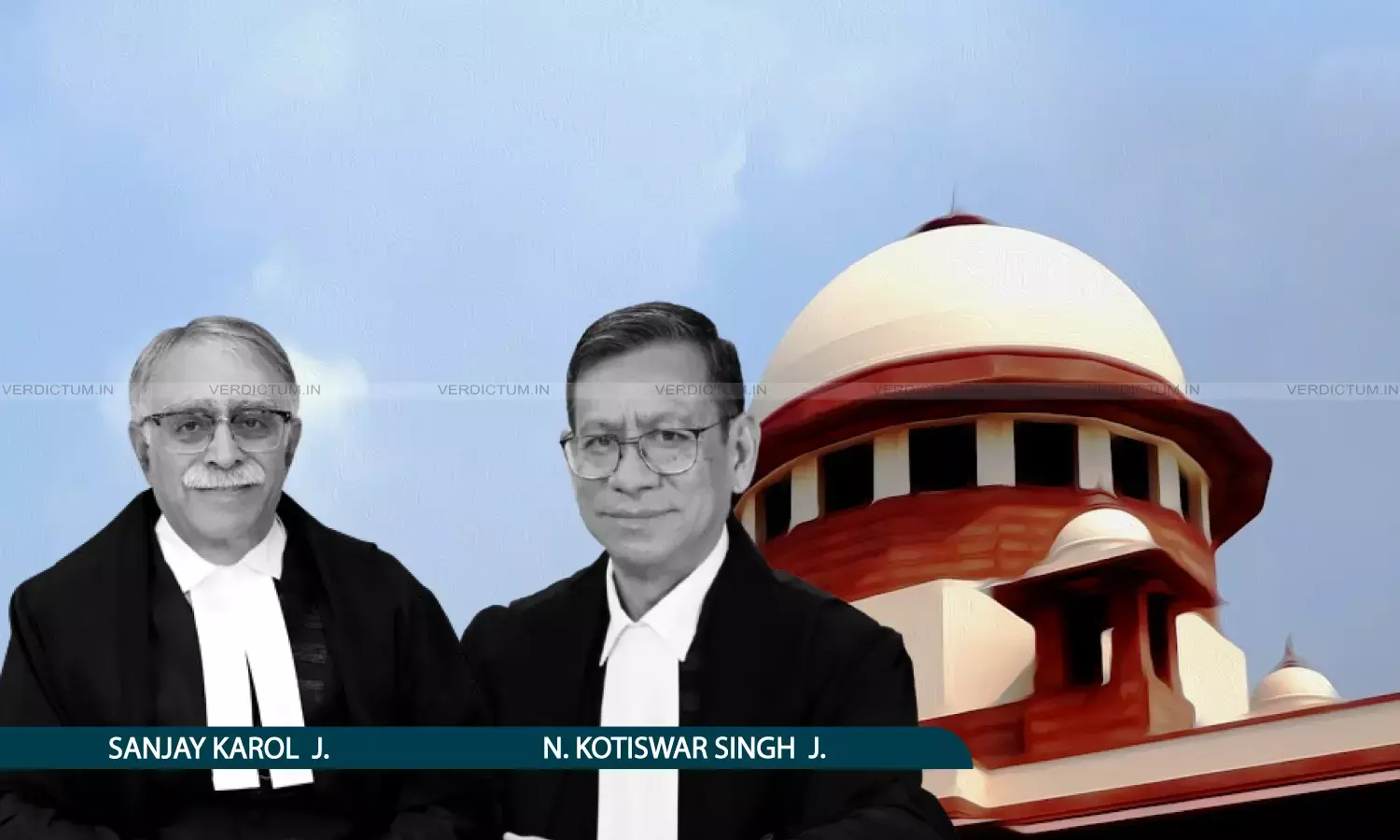
Justice Sanjay Karol, Justice N. Kotiswar Singh, Supreme Court
The Supreme Court has held that the Labour Court decides whether misconduct is proved, whereas a competent disciplinary authority decides what punishment follows in service law. The Bench clarified that while an employer may successfully prove an employee's misconduct through de novo evidence before a Labour Court after an internal inquiry is set aside, this process operates solely at the stage of proving guilt. It does not displace or extinguish the disciplinary authority’s statutory obligation to independently evaluate the surviving findings before deciding on the final punishment.
Further, the Court held that a disciplinary authority cannot mechanically act upon a stale, pre-remand show-cause notice that was originally based on a vitiated domestic enquiry. Because the legal foundation of the misconduct shifts entirely to the post-remand adjudicatory findings of the Labour Court, the competent authority is legally mandated to apply its mind afresh to the quantum of punishment. This requires a conscious evaluation of mitigating, individual variables, such as the employee's length of service, past record, and the absence of fatal indicators like corruption or financial fraud, rather than treating judicial confirmation as an automated mandate for dismissal.
A Division Bench comprising Justice Sanjay Karol and Justice Nongmeikapam Kotiswar Singh observed, “…The Labour Court decides whether misconduct is proved. The competent disciplinary authority decides what punishment should follow”.
While referring to the principle in Workmen of Firestone Tyre & Rubber Co. of India (P) Ltd. v. Management, (1973) 1 SCC 813 observed that it, “…enables the employer to sustain the charge of misconduct by leading evidence before the Labour Court where the domestic enquiry is defective. That principle, however, operates at the stage of proving misconduct. It does not dispense with the disciplinary authority’s duty to consider the findings that ultimately survive and to decide the appropriate penalty under the applicable Service Regulations...”.
Asmita Singh, AOR and petitioner-in-person appeared while Pallavi Sharma, AOR appeared for the respondent.
As per the facts, the appellant, Surekha Domaji Bele, was an Upper Division Clerk with the Maharashtra State Electricity Distribution Company Limited (MSEDCL) who had rendered over two decades of service before being suspended in September 2006 on charges of indiscipline, insubordination, and document tampering.
A subsequent domestic enquiry proceeded ex parte, culminating in an April 2008 show-cause notice proposing her dismissal. The appellant challenged this notice before the Labour Court, which declared the internal departmental enquiry unfair and perverse.
Previously, the Industrial Court on revision set aside the Labour Court's order in August 2015 and remanded the matter, permitting the management to lead independent evidence to prove the misconduct directly before the Labour Court.
Post-remand, the Labour Court found the misconduct proved in June 2017, pursuant to which, on the same finding, the disciplinary authority promptly executed a dismissal order in July 2017 by explicitly relying on the unreplied 2008 show-cause notice and further directed that her eleven-year suspension period be treated as an independent punishment. The Labour Court, Industrial Court, and the Bombay High Court concurrently rejected her subsequent challenges against the dismissal.
Therefore, now the Supreme Court noted that when a domestic enquiry is declared defective, the employer’s right to sustain the charges via de novo evidence before the Labour Court is well-recognized, but this right pertains solely to the question of guilt.
The Court extracted the clear ratio that a judicial confirmation of misconduct does not absolve the disciplinary authority of its statutory obligation under Regulation 88(j) of the MSEDCL Service Regulations to apply its independent mind to the final punishment.
“…the question of punishment stands on a different footing. The disciplinary authority was required to consider the findings which ultimately survived, namely the findings recorded in the de novo adjudication before the Labour Court, and thereafter apply its mind to the appropriate punishment. This consideration necessarily included the gravity of the misconduct, the nature of the charges proved, the Appellant’s long service, past record, absence or presence of financial loss or dishonesty, and whether a lesser penalty would meet the ends of justice”, the Bench observed.
“…The Appellant’s failure to reply to the earlier show-cause notice could not have been treated as conclusive when the enquiry on which that notice was founded had itself been found defective and the misconduct was subsequently thereafter established through a separate adjudicatory process and not before the departmental forum”, the Bench further noted.
Furthermore, because the charges lacked elements of corruption, moral turpitude, or pecuniary loss, the authority's failure to independently evaluate her 21 years of clean service or the prolonged 11-year suspension period invalidated the decision-making process.
“Before imposing the penalty of dismissal from service, the disciplinary authority failed to consider the relevant factors bearing on punishment, including the nature and gravity of the misconduct, the Appellant’s long service, past record, age, absence of financial loss to the Respondent – Company, or dishonesty, and the possibility of imposing a lesser penalty”
In the directions, the Court set aside the Bombay High Court's judgment and ruled that the direction treating the suspension period as an independent punishment shall not operate. It directed the MSEDCL to treat the appellant as eligible for subsistence allowance from March 2007 until her dismissal date in July 2017.
Since the appellant has already crossed the age of superannuation, the Bench ordered the competent authority to pass a fresh order regarding the appropriate penalty within three months, taking into account her past record and length of service to determine the consequential retiral benefits.
Cause Title: Surekha Domaji Bele v. Executive Engineer, Testing Division, MSEDCL (Neutral Citation: 2026 INSC 639)
Appearances:
Appellant: Petitioner-in-person, Asmita Singh, AOR.
Respondent: Pallavi Sharma, AOR.