

Land Is Considered The New Gold: Supreme Court Restores 1955 Mutation Of 280-Acre Gurugram Shamilat Land In Favour Of Wazirabad Gram Panchayat
The Court held that once the land was shown in revenue records as shamilat deh, and no pre-1950 partition or individual cultivating possession was proved, it vested in the gram panchayat and would now enure to Municipal Corporation Gurugram as successor-in-interest.
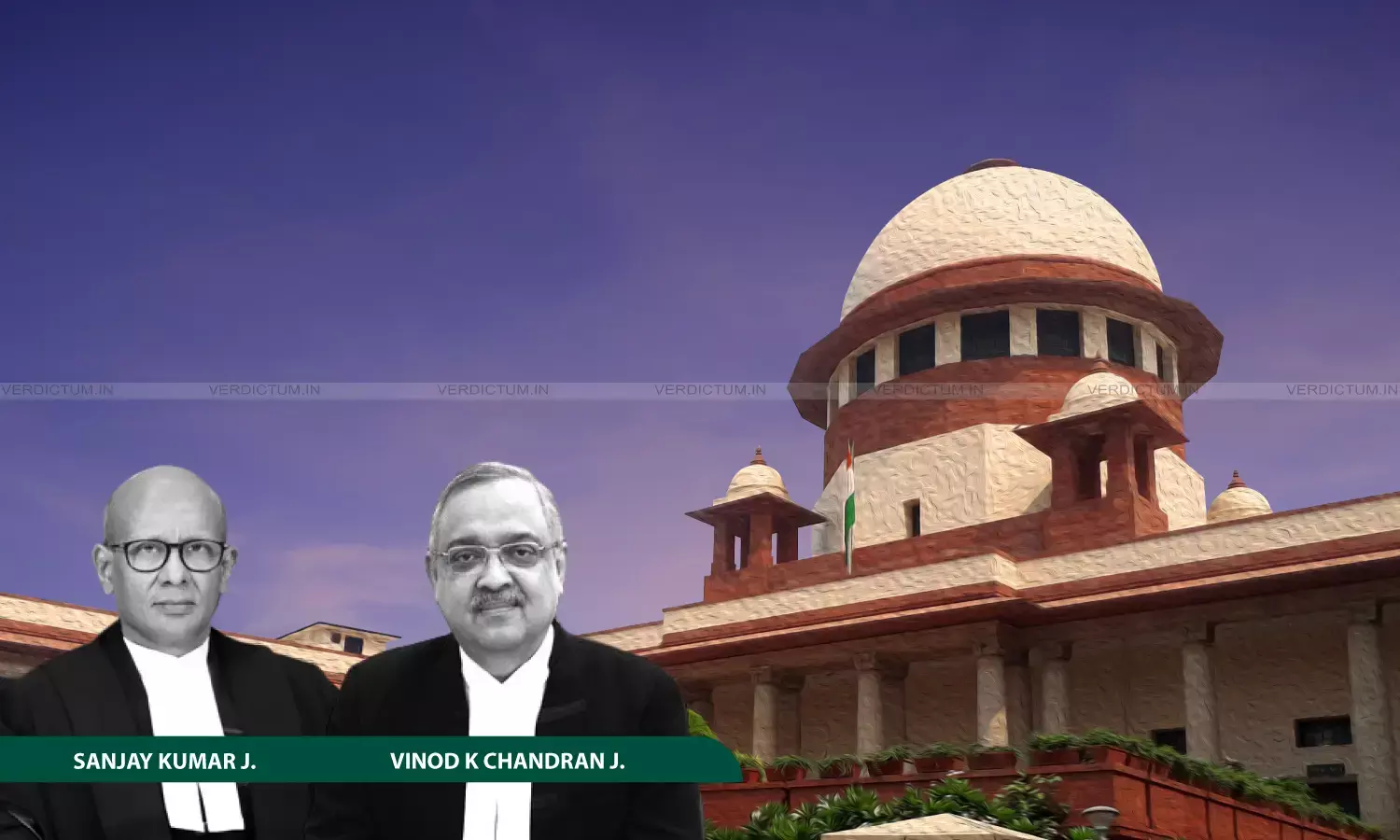
The Supreme Court, while allowing appeals concerning nearly 280 acres of shamilat land in Gurugram, has restored the 1955 mutation recorded in favour of Wazirabad Gram Panchayat, holding that the disputed Haiderpur land formed part of shamilat deh (village-owned) and would now enure to the benefit of Municipal Corporation Gurugram as its successor-in-interest.
The Court was hearing appeals filed by Suraj Bhan and others, and by Gram Panchayat, Wazirabad, against a common judgment of the Punjab and Haryana High Court which had set aside the Commissioner’s order restoring the panchayat mutation and had revived orders recognising ownership in favour of private claimants.
A Bench of Justice Sanjay Kumar and Justice K. Vinod Chandran observed: “We, therefore, find that the plaintiffs in Case No. 18/DRO failed to make out any tenable grounds to interfere with the mutation effected on 13.09.1955 in favour of the Gram Panchayat, Wazirabad. The facts demonstrate that the subject land was not shamilat patti but constituted part of the shamilat deh of Haiderpur and though the proprietors, viz., patti Chitru, Ramratan and Medha; patti Sadasukh; and patti Ahmed Ali Khan, had the right to seek partition thereof in accordance with their shares, no such partition took place prior to 26.01.1950 and, in consequence, the shamilat deh of 436 Bighas 18 Biswas continued as such, attracting Section 2(g)(1) of the Act of 1961, and vested in the Gram Panchayat, Wazirabad. It was not necessary in such a situation to even prove that the land in question was used, as per the revenue records, for the benefit of the village community or a part thereof or for common purposes of the village”.
The judgment began with these remarks: "Land is considered the ‘new gold’. More so, when such land is proximate to expanding urban agglomerations."
Senior Advocate Rajive Bhalla appeared for the appellants, while Senior Advocate Sanjay Poddar appeared for the respondents.
Background
The dispute concerned a large tract of land in Haiderpur, an uninhabited village contiguous to Wazirabad in Gurugram. After the Punjab Village Common Lands (Regulation) Act, 1953, the land was mutated in favour of Gram Panchayat, Wazirabad in 1955. Decades later, a representative suit was filed before the revenue authority by persons claiming through pattis of Haiderpur, asserting that the land was not shamilat deh but belonged to the pattis and had not vested in the panchayat.
The Assistant Collector initially accepted the private claim over most of the land, excluding a small portion used as a pond and path. The Collector affirmed that view. However, the Commissioner, Gurgaon Division, allowed revisions filed by the gram panchayat and others, holding that the land was shamilat deh and restoring the 1955 mutation in favour of Gram Panchayat, Wazirabad.
The Punjab and Haryana High Court then allowed writ petitions filed by private parties and restored the orders of the Assistant Collector and Collector. The High Court reasoned that the land was not shown to have been used for common purposes, that Haiderpur was uninhabited, and that the mutation in favour of the panchayat had been effected without notice to the proprietors. The Supreme Court stayed the High Court judgment in 2008 and has now allowed the appeals.
Court’s Observations
The Supreme Court first traced the concept of village common land, relying on customary law materials and earlier decisions, including Jagpal Singh v. State of Punjab (2011) and Sarjeet Singh v. Hari Singh (2015). It noted that shamilat deh represented common land reserved for village use, while shamilat patti was land set apart for a particular patti or group.
The Court observed: “Shamilat deh is, thus, the land collectively owned by village owners, also called ‘Aala Maliks’. It was reserved for common use of the villagers and consisted of grazing grounds, roads, rivers, ponds, cremation grounds, hills, etc.”
It further explained: “On the other hand, shamilat patti was the land set apart for members of a patti, based on religion, community, sect, family, etc., and used by them to the exclusion of all others. But for the members of that patti, no one else was entitled to use that land.”
The Court held that the revenue records did not support the private claim that the land was shamilat patti. The Sharat-wajib-ul-arz showed the total shamilat deh area of Haiderpur as 444 bighas 4 biswas, of which the disputed 436 bighas 18 biswas formed part.
The Bench stated: “Once this extent of 436 bighas 18 biswas was not shown to be in actual and separate cultivating possession of the proprietors individually, the land invariably constituted shamilat deh and could not be treated as allotted to anyone in particular.”
The Court added that shamilat deh remained non-exclusive property until partitioned: “As noted by Dr. Minoti Chakravarty Kaul, shamilat deh is non-exclusive property till partitioned and no proprietor can acquire a permanent right to occupy or claim any portion thereof till such partition.”
The Supreme Court found that the private claimants had failed to prove any partition of the shamilat deh before January 26, 1950, or any individual cultivating possession pursuant to such partition.
The Court held: “However, no proof of any such steps being taken was ever produced. Though the Sharat-Wajib-ul-arz also spoke of a possible partition of the shamilat deh amongst the proprietors, there is no evidence of any such partition having taken place before 26.01.1950, whereby the pattis, Chitru, Ramrattan and Medha (10 biswas share); Sadasukh (5 biswas share); and Ahmed Ali Khan (5 biswas share) separately apportioned and settled their shares in the shamilat deh.”
The Bench further noted: “In situations coming under these provisions, it is necessary for a claimant seeking exclusion of land from the classification of shamilat deh to prove that such land was partitioned before 26.01.1950 and was brought into the cultivating possession of individual co-sharers as per such partition.”
The High Court had faulted the 1955 mutation for want of notice to proprietors. The Supreme Court rejected that reasoning, holding that the 1953 and 1954 statutes had statutorily vested shamilat deh in gram panchayats.
The Court observed: “Upon enactment of these two Acts, the lands classified as shamilat deh vested in gram panchayats without exception, thereby putting an end to ownership of the proprietors in such lands.”
It added: “This reasoning is clearly contrary to the inevitable fallout of the two Acts, which decimated all existing rights of proprietors and directed vesting of shamilat deh in gram panchayats. Thus, there was no question of notice or hearing being given to any proprietor in that regard, as the mandate of those Acts was absolute and permitted no exemption.”
The Court also rejected the argument that Haiderpur, being uninhabited, had no gram panchayat and could not be connected with Gram Panchayat, Wazirabad.
The Bench noted: “Though it was contended before us that there was no gram panchayat for Haiderpur, as it was an uninhabited village, we find that the documentary evidence clearly indicates to the contrary.”
It held that later notifications also showed Wazirabad and Haiderpur clubbed together under Gram Panchayat, Wazirabad: “These documents show that Haiderpur was always under the control of a notified gram panchayat.”
The Court also rejected the challenge to the locus of Municipal Corporation, Gurgaon, to step into the shoes of Gram Panchayat, Wazirabad. It referred to Section 161 of the Haryana Municipal Corporation Act, 1994, under which shamilat deh vests in the municipal corporation.
The Court observed: “Further, we find the argument that the Municipal Corporation, Gurgaon, had no locus to step into the shoes of the Gram Panchayat, Wazirabad, to be without merit.”
The Supreme Court found that neither the revenue authorities nor the High Court had properly examined how the plaintiffs and others claiming through the pattis traced their title.
The Court stated: “The indubitable fact apparent from the record is that the right of these four persons to maintain this suit in a representative capacity either on behalf of the named pattis or those purportedly claiming under them was never verified or tested.”
It further noted that no genealogy or document was produced to establish the link between the pattis and the claimants: “However, neither the Shajra nasb nor any other document was produced in proof of the genealogy/lineage of those pattis, whereby these 524 persons came into the picture.”
Conclusion
The Apex Court, accordingly, concluded: “The impugned common judgment dated 24.08.2007 passed by the Punjab and Haryana High Court is, therefore, unsustainable on facts and in law. The appeals are, accordingly, allowed setting aside the same and confirming the mutation effected on 13.09.1955 in favour of the Gram Panchayat, Wazirabad, which shall enure to the benefit of its successorin-interest, the Municipal Corporation, Gurgaon (now, Gurugram)”.
The Supreme Court allowed the appeals, set aside the Punjab and Haryana High Court’s common judgment, and confirmed the mutation effected in 1955 in favour of Gram Panchayat, Wazirabad.
All other pending applications, including intervention and impleadment applications, were dismissed.
Cause Title: Suraj Bhan and others v. Ashvarya Estate Pvt. Ltd. and others (Neutral Citation: 2026 INSC 786)
Appearances
Appellants: Senior Advocates Rajive Bhalla, Dr K.S. Chauhan and P.S. Teji, with Lokesh Sinhal, Sr. A.A.G., B.K. Satija, Sr. A.A.G., Samar Vijay Singh, AOR, Ajit Kumar Ekka, AOR, and Advocates Sabarni Som, Nikunj Gupta, Aman Dev Sharma, Gaj Singh, Rohit Pandey, Abhishek Chauhan, R.S.M. Kalky, S.P. Singh, Nav Parkash Singh Teji, Deeksha Singh, Ravi Shankar Singh and Aditi Chauhan
Respondents: Senior Advocates Sanjay Poddar, Sridhar Potaraju, Neeraj Kumar Jain and A.M. Dar, with Arun K. Sinha, AOR, Ankita Chaudhary, AOR, Dr. Mrs. Vipin Gupta, AOR, M.A. Chinnasamy, AOR, Chand Qureshi, AOR, Jogy Scaria, AOR, Saurabh Mishra, AOR, and Advocates Anjali Rajput, Chamundeswari Pemmasani, Sumit Sinha, Niharika Singh, Arlene Noronha, Rakesh Singh, Lalit Mohan, Govind Chaudhary, Manoj Bhardwaj, Shivam Goel, Shikhar Sareen, Abhilash Vashisht, Chand Kapoor, Krishna Kumar, Nandani Gupta, C. Raghavendren, C. Rubavathi, T. Meikandan, Ch. Leela Sarveswar, Saurabh Gupta, Chandni Sharma, Mohit Yadav, Md. Imran Siddiqui, Chandan Kumar Singh and Shrimay Mishra
