

"Offending Observations": Apex Court Takes Suo Motu Cognizance Of Patna HC Observation That Removing Salwar & Pressing Chest Is Not Attempt To Rape
The Court issued notice to the accused, observing that the High Court’s judgment regarding the distinction between outraging modesty and attempted rape contained offending observations.

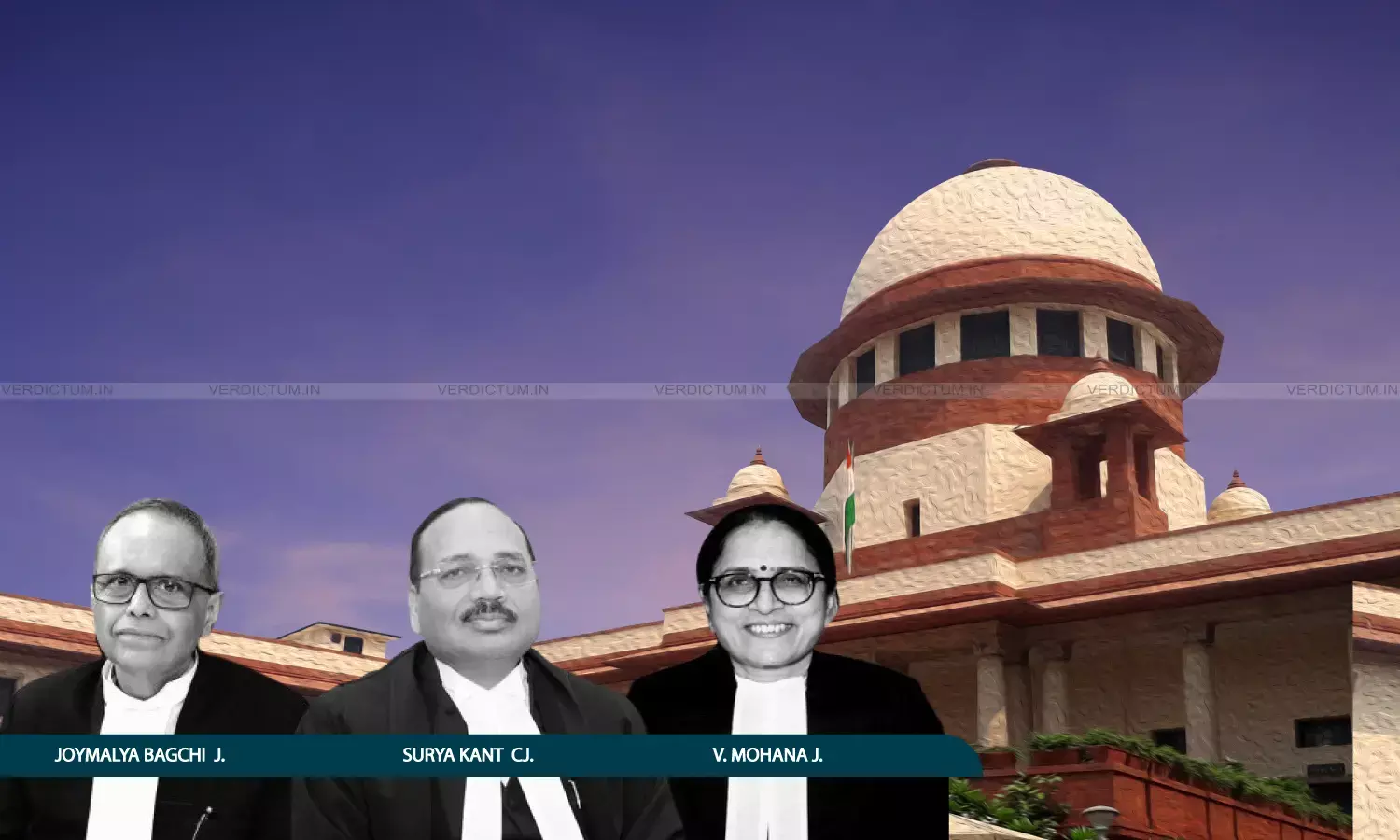
The Supreme Court took suo motu cognizance after the Patna High Court observed that locking a victim inside a photographic studio, attempting to remove her salwar and physically molesting her by pressing her chest did not unequivocally establish an attempt to commit rape.
Vide order dated July 9, 2026, the Patna High Court had made the observation and set aside the conviction of an accused under Section 376 read with Section 511 of the Indian Penal Code.
The Bench comprising Chief Justice Surya Kant, Justice Joymalya Bagchi and Justice V Mohana ordered, "Issue notice, returnable on so-and-so date. Learned Advocate General for the State of Bihar has entered appearance...We request the learned AG to effect service on the contesting respondent through the local police through the local police. List this matter for further consideration on so-and-so date.
Advocate General SD Sanjay appeared for the State of Bihar
Chief Justice Kant said, "There are some offending observations in the judgment passed by the High Court. But we'll be able to set aside only after hearing this accused. So you please ensure through your local police that he is served."
The High Court had observed that while the prosecution successfully proved the essential ingredients of outraging the modesty of a woman under Section 354 IPC, the total absence of any physical or overt act demonstrating a clear path toward penetration rendered the trial court's finding of attempted rape legally unsustainable.
Consequently, noting that the appellant had already undergone nearly three and a half months in judicial custody, the High Court allowed the appeal, modified the legal findings, and acquitted him of the principal sexual assault charges.
The Bench of Justice Purnendu Singh held, "I find that the appellant used criminal force against the victim by confining her inside the studio, closing the door, attempting to remove her salwar, and physically molesting her by pressing her chest. These acts clearly establish the use of criminal force upon a woman with the intention, or at least the knowledge, that such acts were likely to outrage her modesty, thereby satisfying the essential ingredients of Section 354 IPC...In light of the settled principles of law governing the distinction between an offence of attempt to commit rape and an offence of outraging the modesty of a woman, it appears that, even if the prosecution case is accepted in its entirety, the acts attributed to the appellant, as alleged in the FIR and deposed to by the victim, do not unequivocally establish the commission of an offence punishable under Section 376(1) read with Section 511 of the IPC."
The prosecution's case emerged from a criminal complaint lodged by the informant, who alleged that she had accompanied her father to the photographic studio owned by the accused for the purpose of getting a photograph clicked. After capturing the photograph, the accused instructed the informant’s father to step outside into the courtyard to view the preview on a computer screen.
Taking advantage of the father's absence, the accused bolted the studio door from the inside, undressed himself, and attempted to remove the informant’s lower attire with an explicit intent to commit sexual assault. Upon hearing the frantic screams of the victim from within the closed room, her father rushed to the door, forced it open, and confronted the accused, who then shoved him aside and fled the scene as a local crowd gathered.
Following an investigation, the police submitted a chargesheet, and the trial court subsequently convicted the accused for the offences of attempted rape and wrongful confinement.
The High Court had noted that while a victim of a sexual offence can be treated as a "sterling witness" whose solitary evidence may invite a conviction, such testimony must be of an exceptionally high standard, consistent throughout, and free from material lacunae.
The High Court had held that the acts of the accused—namely, confining the victim, locking the door, and using criminal force to violate her modesty—squarely attracted the ingredients of outraging the modesty of a woman rather than an attempt to rape.
Accordingly, the matter will now be heard by the Supreme Court on a further date.
Cause Title: In Re: Order Dated 09.07.2026 Passed By The High Court Of Judicature At Patna In Criminal Appeal (SJ) No. 775/2013 And Ancillary Issues