

Can't Expect Teachers Without Job Security To Guarantee A Child’s Future: Supreme Court Directs Exclusive Selection For SSA Para-Teachers
While holding that cadre recruitment under Article 309 cannot be subverted by blanket regularisation, the Court mandated a time-bound annual calendar for the absorption of eligible contractual staff.

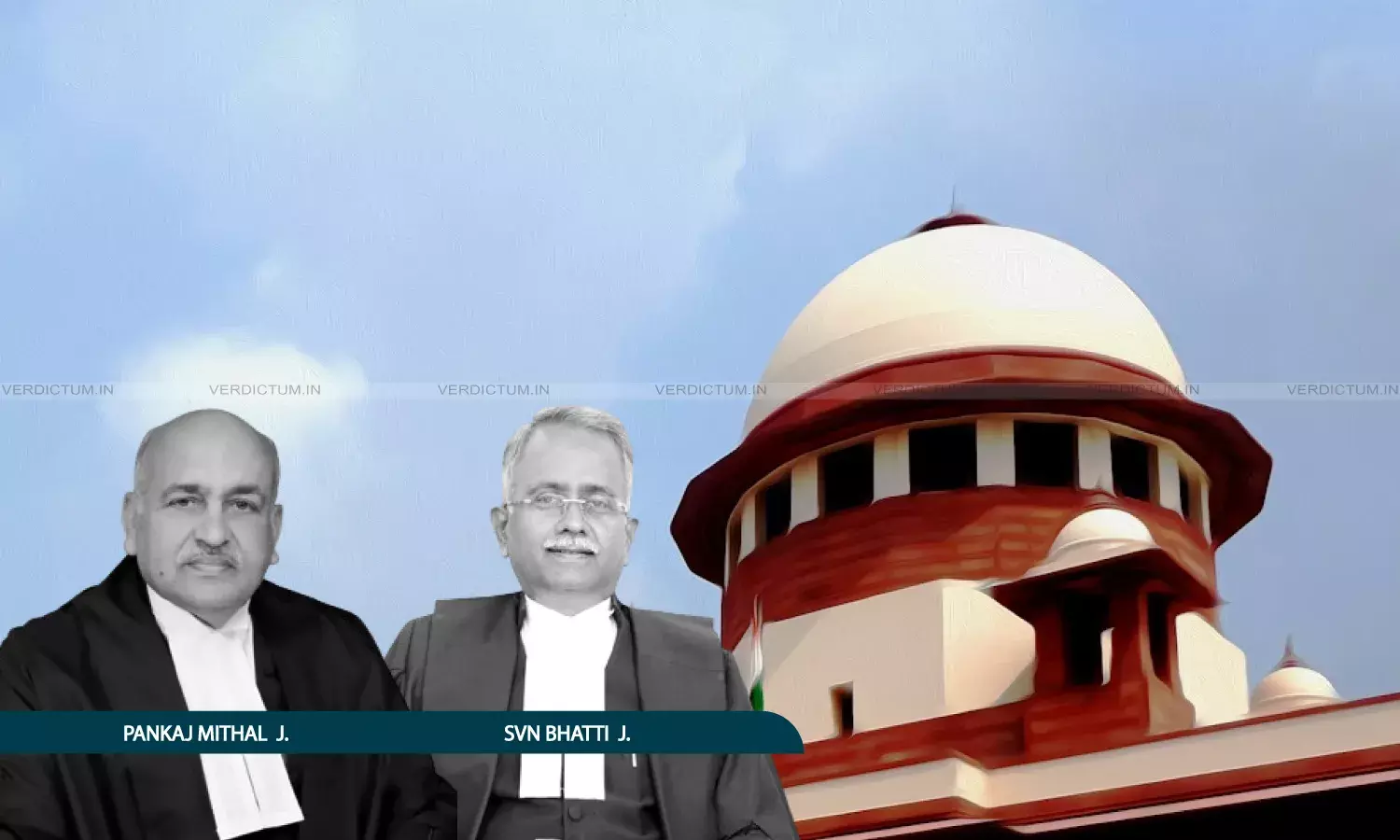
The Supreme Court has held that the executive cannot expect Para-Teachers to guarantee a child's future and education while denying them the security of their own employment. The Court observed that the teacher-student bond is a long-term relationship that requires stability, making it fallacious for the State to resist regularisation while simultaneously failing to implement its own statutory framework for their absorption.
Consequently, the Bench observed that while a "direct leap" from scheme-based posts to the state cadre bypassing statutory rules is prohibited, the State must immediately conduct exclusive recruitment drives to fill 50 percent of sanctioned vacancies from the pool of eligible para-teachers.
Highlighting that a sense of employment security is a sine qua non for enhancing efficiency in the education sector, the Court noted that a cadre post under the State is governed by Article 309 of the Constitution of India, which requires a constitutionally aligned recruitment process that cannot be bypassed via judicial regularisation under Articles 226 or 142. However, to eliminate ad hocism, the Bench issued a mandatory Annual Recurring Calendar requiring the State of Jharkhand to determine vacancies by March 31 and initiate exclusive recruitment for para-teachers by April 1 every year, ensuring a structured and lawful bridge to permanent employment.
Justice Pankaj Mithal and Justice S.V.N. Bhatti observed, “…The State of Jharkhand ought not to delay in issuing a notification exclusively for para-teachers for their appointment as Assistant Teachers/Sahayak Acharya. For policy and practical reasons, and given the financial implications for the exchequer, the State of Jharkhand must explore the option of notifying exclusively the 50 per cent of vacant posts marked as Assistant Teachers under the 2012 and 2022 Rules. The sense of security of employment is a sine qua non for enhancing efficiency in any service, and education is no different. The teacher-student bond is not temporary but spans the academic years. Expecting a para-teacher, without a guarantee of their employment, to guarantee a child's future and education is fallacious…”.
Senior Advocates Colin Gonsalves, Gopal Sankaranarayanan, and Advocate Prashant Bhushan appeared for the appellants and Senior Advocate Arunab Choudhary appeared for the respondent.
The Appellants were para-teachers engaged on a contractual basis since 2002 under the Sarva Shiksha Abhiyan (SSA). Despite serving for over two decades and possessing Teacher Eligibility Test (TET) qualifications, they were denied regular status and pay parity with Assistant Teachers.
They approached the Court seeking a direction for their regularisation into the state cadre, citing their continuous service and the identical nature of their duties compared to regular teachers.
The Jharkhand High Court had earlier dismissed a batch of writ petitions on December 16, 2022, holding that contractual employees have no vested right to regularisation if their entry was not through a regular competitive selection process. The para-teachers challenged this dismissal, arguing that their long-standing experience and qualifications created a legitimate expectation for permanency.
The Court noted that scheme-based posts under the SSA are distinct from cadre posts created under Article 309, and thus blanket regularisation would violate State of Karnataka v. Umadevi (2006) 4 SCC 1.
However, it criticised the State for resisting the teachers' claims while failing to give effect to the 2012 and 2022 Rules, which earmark 50 percent of vacancies for para-teachers.
“We are of the view that the State cannot be heard, on the one hand, to successfully resist the prayer for regularisation of para-teachers as Assistant Teachers/Sahayak Acharyas, while, on the other hand, not give effect to its own statutory framework for regularisation of the services of para-teachers…The time has come for the executive to conduct periodic performance audits and eliminate ad hocism in public employment. The courts do not advise the executive, but the executive, by putting in place ad hoc mechanisms, would affect society's progress and the future of children. Therefore, the following directions are issued to the State of Jharkhand to issue a notification inviting applications exclusively from para-teachers for appointment to 50 per cent of the marked vacancies for both Assistant Teachers and Sahayak Acharyas. The filling-up exercise for 50 per cent of available/earmarked vacancies for para teachers is undertaken every academic year, and the right to be considered is extended to para teachers. For the above-mentioned purpose, the following schedules, (I) for this Academic Year and (II) for future Academic Years, are directed to be implemented by the State of Jharkhand…”, the Bench observed.
“…A cadre post under the State of Jharkhand is governed by Article 309 of the Constitution of India, which creates public employment, and the State must follow a constitutionally aligned recruitment process. The direct leap from one to the other, bypassing the statutory rules, would create a new mode of recruitment not sanctioned by law. This is prohibited by Umadevi (supra) and the line of precedents. In an attempt to cure the purported irregularity in appointment, if para-teachers are regularised under Articles 226 or 142, it would change the source of appointment altogether”, the Bench further observed.
Accordingly, the Court issued a strict schedule for the State of Jharkhand to notify 50 percent of vacant Assistant Teacher and Sahayak Acharya posts exclusively for para-teachers.
For the current academic year, vacancies must be determined within four weeks, followed by an advertisement within two weeks. The entire process, including the issuance of appointment orders based on academic and TET merit, must be completed within 10 weeks of the advertisement.
“Dr. Sarvepalli Radhakrishnan believed that the relationship between teachers and students is of a sacred character. He further stated that “the kind of education that we provide for our youth is determined overwhelmingly by the kind of men and women we secure as teachers.” It is in the light of this elevated ideal that the present case must be understood. With the para teachers’ long-stated experience, the claim for regularisation is certainly a legitimate expectation. However, whether the para-teachers deserve a regular government post, is subsumed by the educational standards expected by the State from its teachers and the short-term and long-term goals that the State has set for itself in imparting education to its wards…While the para-teachers desire that they be made Assistant Teachers, their desirability is tested by the Government to provide the best teachers in the field…”, the Bench in the judgment noted at the outset.
Cause Title: Sunil Kumar Yadav and Others v. The State of Jharkhand and Others. (Neutral Citation: 2026 INSC 462)
Appearances:
Appellants: Colin Gonsalves, Gopal Sankaranarayanan, Senior Advocates and Prashant Bhushan, Advocate.
Respondent: Arunab Choudhary, Senior Advocate.