

Cannot Deny Regularization To Similarly Placed Employees After Regularizing 30,000 Workers: Supreme Court Grants Relief To Left-Out Muster Roll Workers In Assam
The Court said that the State cannot extend policy benefit to one set of eligible workers and deny same relief to others due to administrative lapses or clerical omissions.

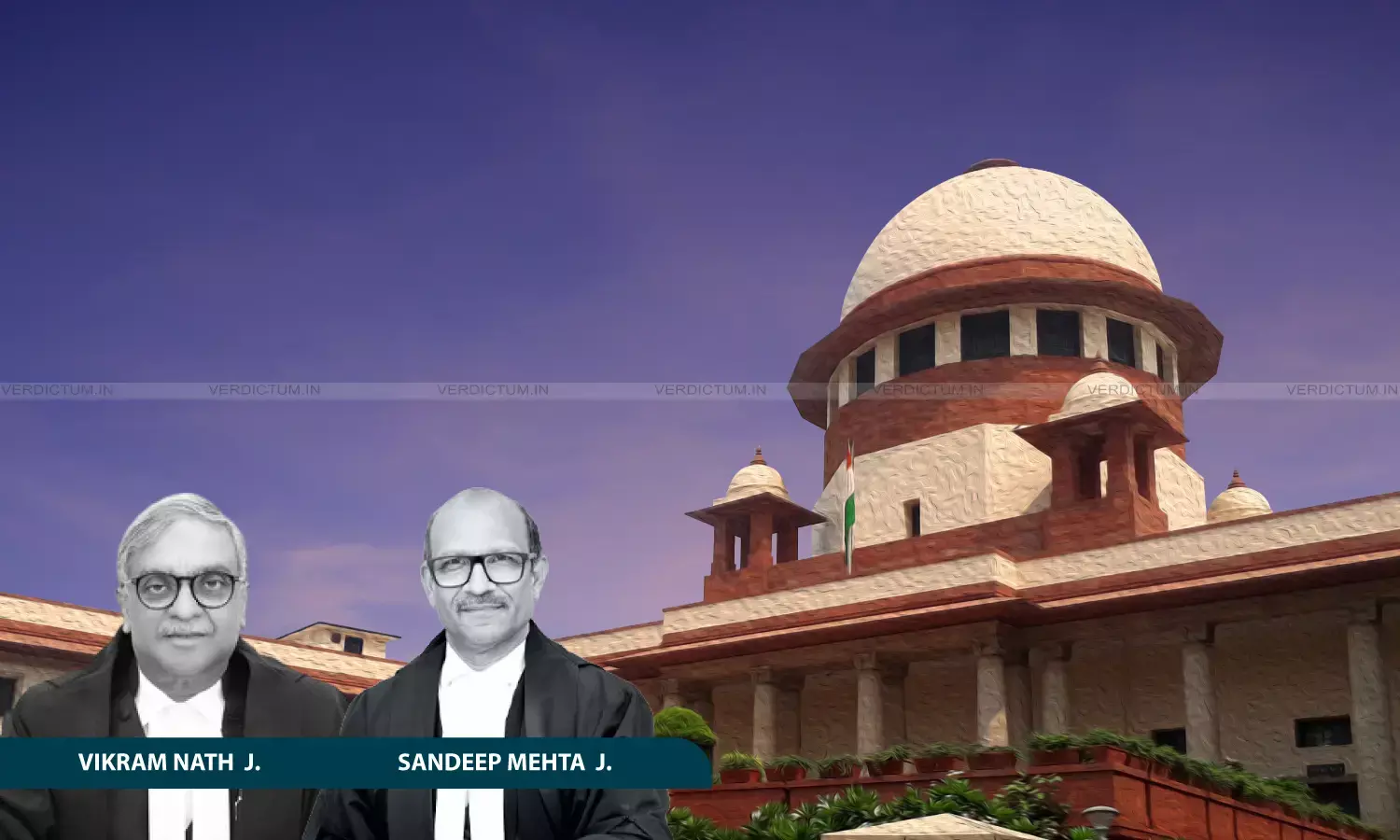
Justice Vikram Nath, Justice Sandeep Mehta, Supreme Court
The Supreme Court while directing the State of Assam to regularize left-out muster roll workers, has held that it cannot deny regularization benefits to workers who were left out of an earlier regularization exercise despite being similarly situated to nearly 30,000 workers already regularized under a July 22, 2005 Cabinet decision. The Court ruled that such exclusion violates Article 14 of the Constitution of India and clarified that the decision in Secretary, State of Karnataka v. Umadevi 200 6) 4 SCC 1 cannot be mechanically invoked to defeat legitimate claims arising from long and continuous service.
The Court observed that once the State consciously framed and implemented a policy regularizing a defined class of workers engaged prior to April 1, 1993, it was constitutionally obligated to extend equal treatment to all eligible members of that class. The Bench further held that the State, as a model employer, cannot repeatedly assure courts that left-out workers would be considered for regularization and later rely on technical objections to deny them parity.
Justice Vikram Nath and Justice Sandeep Mehta extensively examined the scope of paragraph 53 of Umadevi and the subsequent clarification in State of Karnataka & Ors. v. M.L. Kesari & Ors. (2010) 9 SCC 247. It observed, “…we are unable to accept the contention of the State that the appellants cannot be granted regularization on the ground that they were not initially appointed against duly sanctioned posts. The State, having engaged the appellants prior to 1st April, 1993, utilised their services continuously for decades, and having itself framed and implemented a Cabinet policy regularizing nearly 30,000 similarly situated workers, cannot now exclude the appellants by taking shelter behind a rigid or technical reading of Umadevi (supra). In absence of any cogent distinction or reasoned decision justifying such exclusion, the action of the State is manifestly arbitrary. It is inconsistent with its obligation to function as a model employer and does not withstand scrutiny under Article 14 of the Constitution”.
Senior Advocates Anitha Shenoy, Manish Goswami, B K Sharma appeared for the appellants and Senior Advocate Jaideep Gupta, Chinmoy Sharma, Senior A.A.G. appeared for the respondents.
In the matter, pursuant to the policy, approximately 30,000 workers were regularized through creation of posts. However, several similarly situated employees were allegedly excluded due to clerical and administrative lapses. These workers approached the High Court seeking parity and regularization.
A Single Judge Bench of the Gauhati High Court had allowed their claims, but a Division Bench later reversed the decision by relying upon Umadevi and holding that Muster Roll, Work Charged and Casual workers were not entitled to regularization or consequential pensionary benefits. The workers then approached the Supreme Court.
Before the Court, the workers argued that their case was not based upon the limited “one-time measure” contemplated in Umadevi, but on enforcement of the State’s own Cabinet policy that had already been implemented for thousands of similarly situated employees. They contended that denial of the same benefit to the remaining eligible workers amounted to hostile discrimination under Article 14.
Accepting the contention, the Court held that the reliance placed by the Division Bench on Umadevi and M.L. Kesari was misplaced. The Bench clarified that paragraph 53 of Umadevi carved out a limited prospective exception for employees who had completed ten years of service as on April 10, 2006, but the present controversy concerned equal treatment flowing from a consciously implemented State policy.
The Court noted that once the State regularized a large body of workers belonging to one identifiable class, it could not arbitrarily deny the same treatment to the remaining eligible employees without demonstrating any rational distinction. The Bench noted that the exclusion of the appellants was attributable not to any fault of the workers, but to administrative omissions committed by the State machinery.
“…it is evident that engaging workers on muster rolls was a consistently employed policy of the State which continued for prolonged period of time. The appellants were not engaged for sporadic or seasonal purposes but were taken on muster rolls and have rendered continuous service for decades in departments performing regular governmental 66 functions. The State itself acknowledged the magnitude of the issue and framed a Cabinet policy to regularize similarly situated workers, acting upon it in respect of nearly 30,000 employees. In such circumstances, to deny consideration to the fraction of remaining eligible workers including the appellants, by taking shelter under a rigid reading of Umadevi (supra) would defeat the very principles of fairness and non-arbitrariness that this Court has consistently upheld”, it noted.
The Bench observed that the State had repeatedly assured the High Court through affidavits that the cases of left-out workers were under consideration and that an appropriate policy would be framed in their favour.
“The repeated undertakings given by the State before the High Court, coupled with the earlier implementation of the Cabinet decision in favour of nearly 30,000 similarly situated workers, clearly gave rise to a legitimate expectation in the minds of the appellants who were deprived of the benefits of the policy. In the maze of administrative deficiencies, they were entitled to expect that the policy decision would be implemented in a fair, complete and non-discriminatory manner, and that their cases would also be considered as part of the same exercise. Though legitimate expectation does not create a vested right, it is firmly rooted in the principles of fairness and non-arbitrariness that flows from Article 14 of the Constitution”, the Bench said.
Allowing the appeals, the Court restored the judgment of the learned Single Judge and directed that the appellants be treated as regularized in terms of the July 22, 2005 Cabinet decision from the same date on which similarly placed workers had received the benefit. The Court further directed the State to create supernumerary posts wherever necessary and extend all consequential benefits including pay fixation, continuity of service, pensionary and post-retiral dues.
The Court also clarified that retired employees would receive notional regularization with consequential arrears for recalculation of pension and gratuity, while legal heirs of deceased employees would be entitled to receive accrued benefits in accordance with law. The entire exercise has been directed to be completed within one year.
In connected appeals filed by the All Assam Work Charge Employee Association, the Court held that Work Charged employees constitute a distinct class and that observations made by the High Court against them without hearing the association could not prejudice their independent claims for pensionary and post-retiral benefits. The Court clarified that such employees would remain free to pursue their claims before the competent authorities in accordance with law.
Cause Title: Sukhendu Bhattacharjee and Others v. The State Of Assam and Others (Neutral Citation: 2026 INSC 523)
Appearances:
Appellants: Manish Goswami, Sr. Adv., Gaurav Shukla, Brahmjeet Singh, Rameshwar Prasad Goyal, AOR, Somiran Sharma, AOR, Somiran Sharma, Kabir Hazarika, Rishabh Patel, Nihal Singh Shekhawat, Dr. Mrs. Vipin Gupta, AOR, Krishna Kumar, Nandani Gupta, B K Sharma, Sr. Adv., Neha Tandon, Gautam Talukdar, AOR, Siddhartha Jha, AOR, Anitha Shenoy, Sr. Adv., Srishti Agnihotri, AOR, Sadhana Madhavan, Kavana Rao, D. P. Singh, Anchal Kanthed, Advocates.
Respondents: Jaideep Gupta, Sr. Adv., Chinmoy Sharma, Sr. A.A.G., Diksha Rai, AOR, Nimisha Menon, Purvat Wali, Sagun Srivastva, Irfan Hasieb, Vijay Deora, Aditya Agarwal, Riddhi Bose, Rishi Agarwal, Racheeta Chawla, Sampriti Baksi, Chinmoy Pradip Sharma, Sr. A.A.G., Ankit Roy, AOR, Irfan Hasieb, Vijay Deora, Aditya Agarwal, Mrinalini Ramesh, Bharadwaj S., AOR, Vignesh Adithiya, Brijesh Kumar Tamber, AOR, B.K. Sharma, Sr. Adv., Kaushik Choudhury, AOR, Jyotirmoy Chatterjee, Aaheli Roy, Nilim Sarma, Manish Raghav, AOR, Yalint Stefen, Collvin Seuzul, Hitesh Kumar Sharma, Anupam Kumar Sharma, Akhileshwar Jha, Satvik Sharma, Yallana Honis.