

24-Hour Timeline Under Article 22(2) Constitution Starts From Detention, Not Formal Arrest: Supreme Court
The Bench disapproved Orissa, Madras and Kerala High Court judgments distinguishing “temporary detention” during NDPS search from arrest; directs release on bail of three accused after unexplained 18-hour gap.

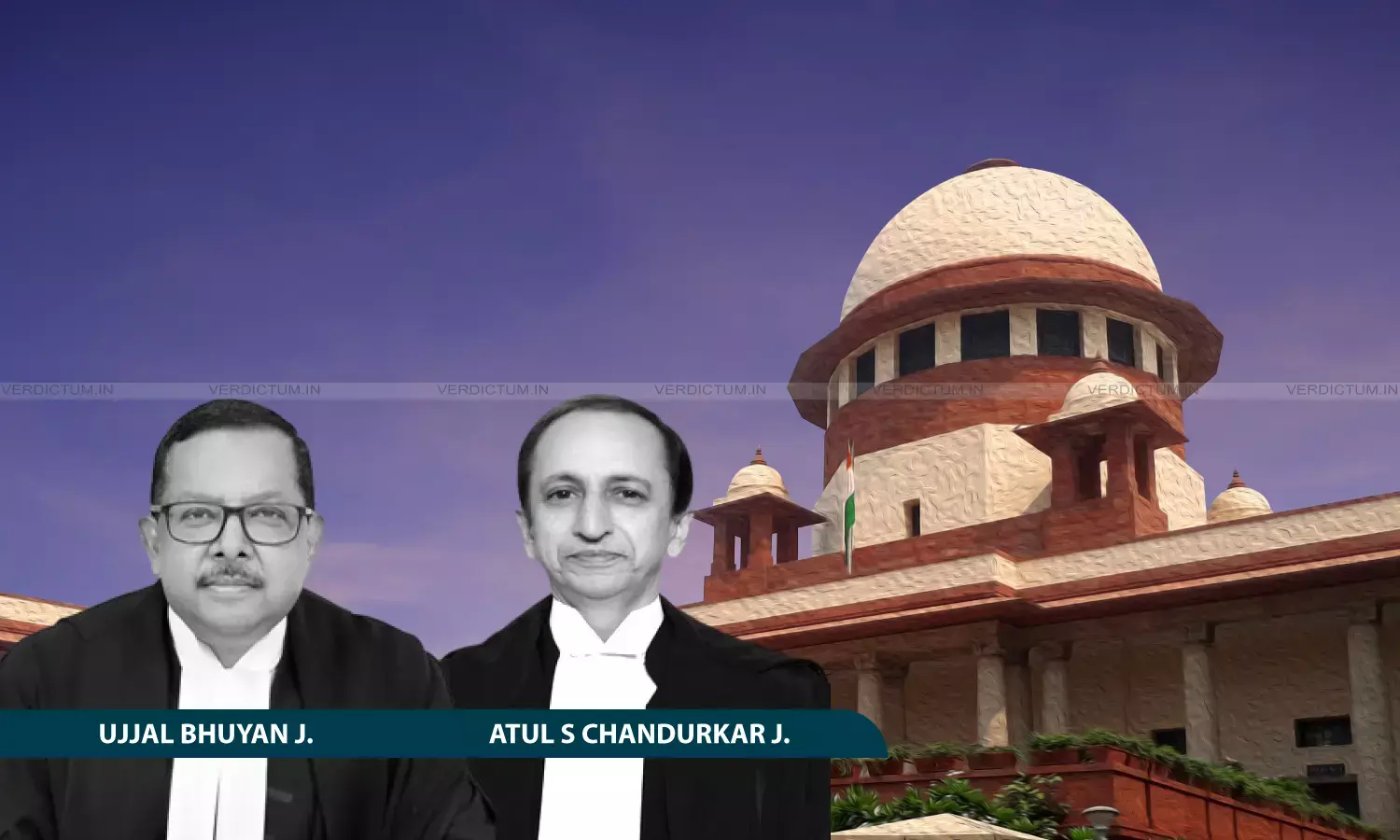
The Supreme Court taking its endeavour further to ensure that no custodial violence takes place during interrogation, has held that the Constitution of India does not recognise any detention dehors arrest. The Court noted that the 24-hour period under Article 22(2) of the Constitution of India for producing a person before a magistrate therefore begins when the person’s liberty is curtailed, not when the arrest is formally recorded. It said that any attempt to draw an artificial distinction between “arrest” and “detention” would dilute the fundamental protection.
The Bench disapproved High Court decisions that treated detention during search and seizure under the NDPS Act as distinct from arrest. It held that such decisions do not lay down the correct law, and that there is “no such thing called temporary disruption of liberty.” It set aside the Tripura High Court’s refusal of bail and directed the release of three accused.
A Bench comprising Justice Ujjal Bhuyan and Justice Atul S. Chandurkar observed, “…The key expression appearing in clause (2) of Article 22 is ‘arrested and detained in custody’. What is the meaning of this expression? Does it mean that the two crucial words appearing in this expression, ‘arrest’ and ‘detain’, should be assigned separate meanings or they mean one and the same thing. It is important to note that the expression is conjunctive and not disjunctive. Had it been disjunctive, two separate meanings could have been assigned to the two words. But the expression being joint and conjunctive, the two words appearing therein would mean one and the same thing. This is because the Constitution does not recognize any detention dehors arrest. Thus, the prescription of 24 hours time period would commence the moment a person is detained by the arresting authority suspecting him to have committed an offence, when his liberty is effectively curtailed. To that extent, the words appearing in clause (2) of Article 22 i.e. ‘arrested’ and ‘detained’ are synonymous. Any attempt to draw an artificial distinction between ‘arrest’ and ‘detention’ would dilute or negate the fundamental protection guaranteed by the Constitution under clause (2) of Article 22. Such an endeavour should be avoided. We must adopt that interpretation which enhances and furthers the constitutional objective”.
Senior Advocate Rouf Rahim appeared for the appellants and Raghavendra P. Shankar, Additional Solicitor General appeared for the respondent.
“…it is evident that the endeavour of this Court has always been to ensure that no custodial violence takes place during interrogation, which is one of the worst forms of human rights violations. Therefore, the 24 hours deadline mandated under clause (2) of Article 22 would mean and commence from the time when a person is intercepted and detained by the investigating agency, in this case officials of the NCB, when his liberty is curtailed”, the Bench said.
The Bench summarised the following:
(i) The 24 hours timeline as mandated under clause (2) of Article 22 of the Constitution of India would commence from the date and time of detention of the person detained, when his liberty stands curtailed, and not from the time of his formal arrest;
(ii) in the event such detention continues beyond 24 hours before the person is produced before a Magistrate, he shall be forthwith released from custody;
(iii) while computing the 24 hours deadline, no other time period is permitted to be excluded therefrom except the time necessary for the journey from the place of arrest to the court of the Magistrate;
(iv) the decisions of the Orissa High Court in Aryaman Pattnayak, Madras High Court in Kannan and Kerala High Court in Arun K. Thomas do not lay down the correct law qua interpretation of clause (2) of Article 22 of the Constitution of India;
(v) the detaining authority should keep in mind not only the 24 hours deadline mandated by clause (2) of Article 22 of the Constitution but also ensure that such detention should not extend beyond a reasonable period within the 24 hours period, considering the circumstances of the case in terms of Section 58 BNSS (Section 57 CrPC);
(vi) at the time of production, the Magistrate is duty bound to record the actual date and time of detention of the person produced before him, when his liberty stood curtailed, and examine whether the 24 hours deadline has been complied with or not from the time of such detention. If there is breach of the 24 hours deadline, the concerned person shall be released forthwith from detention;
(vii) the Magistrate shall also examine at the time of production whether the detention of the person produced, though within the time frame of 24 hours, has exceeded the period which can be construed to be reasonable in the circumstances of the case. If he is satisfied that detention in custody has been for a longer period than what is reasonable, he may decline remand.
In the matter, Sujit Das, Suman Das and Rupak Sarkar are accused in an NDPS case registered by the Divisional Preventive Force, Customs Division, Agartala. The prosecution said they were intercepted on September 29, 2025 at about 2:00 pm after a tip-off, and that 60.79 kg of methamphetamine (Yaba) tablets were recovered over two seizures, the second completed at 5:00 pm. They were shown as arrested at 11:00 am and 11:15 am on September 30, 2025, and produced before the Magistrate at 4:45 pm.
The Special Judge rejected bail on March 30, 2026, and the Tripura High Court did so on April 29, 2026, relying on Section 37 of the NDPS Act. Notice was issued on July 24, 2026. On September 21, 2026 the Supreme Court took up the Article 22(2) point, which had not been argued in the High Court, and called for an affidavit from the Investigating Officer.
The Union argued that the interval was spent on statutory formalities and that interception was not arrest. The Court held that “arrested and detained in custody” in Article 22(2) is conjunctive, so the two words mean the same thing. It rejected the “buffer zone” reasoning of the Kerala High Court, calling it unconstitutional, and noted that the only time excluded from the 24 hours is the journey to the magistrate. It relied on Niranjan Singh v. Prabhakar Rajaram Kharote 1980 2 SCC 559 and on the concern about custodial abuse in D.K. Basu.
The accused were therefore arrested for Article 22(2) purposes at 2:00 pm on September 29, 2025, and the production at 4:45 pm the next day breached the mandate. The Court also found the 18-hour gap between the end of the search and the recorded arrest unexplained and unreasonable under Section 58 BNSS.
The Court directed that the accused be produced before the Special Court within seven days and released on bail. It laid down that magistrates must record the actual time of detention and may decline remand if detention was unreasonably long. A copy was ordered to be circulated to all Directors General of Police, Registrars General of the High Courts and State Judicial Academies.
Cause Title: Sujit Das & Ors. etc. v. Union of India (Neutral Citation: 2026 INSC 1195)
Appearances:
Appellants: Senior Advocate Rouf Rahim.
Respondent: Raghavendra P. Shankar, Additional Solicitor General.
Click here to read/download the Judgment