

State Government Cannot Delegate Power To Refer Dues Dispute U/S 17(2) Working Journalists Act: Supreme Court
The Bench set aside the High Court orders while exercising Article 142 powers to direct government re-examination of references and preserve pending proceedings.

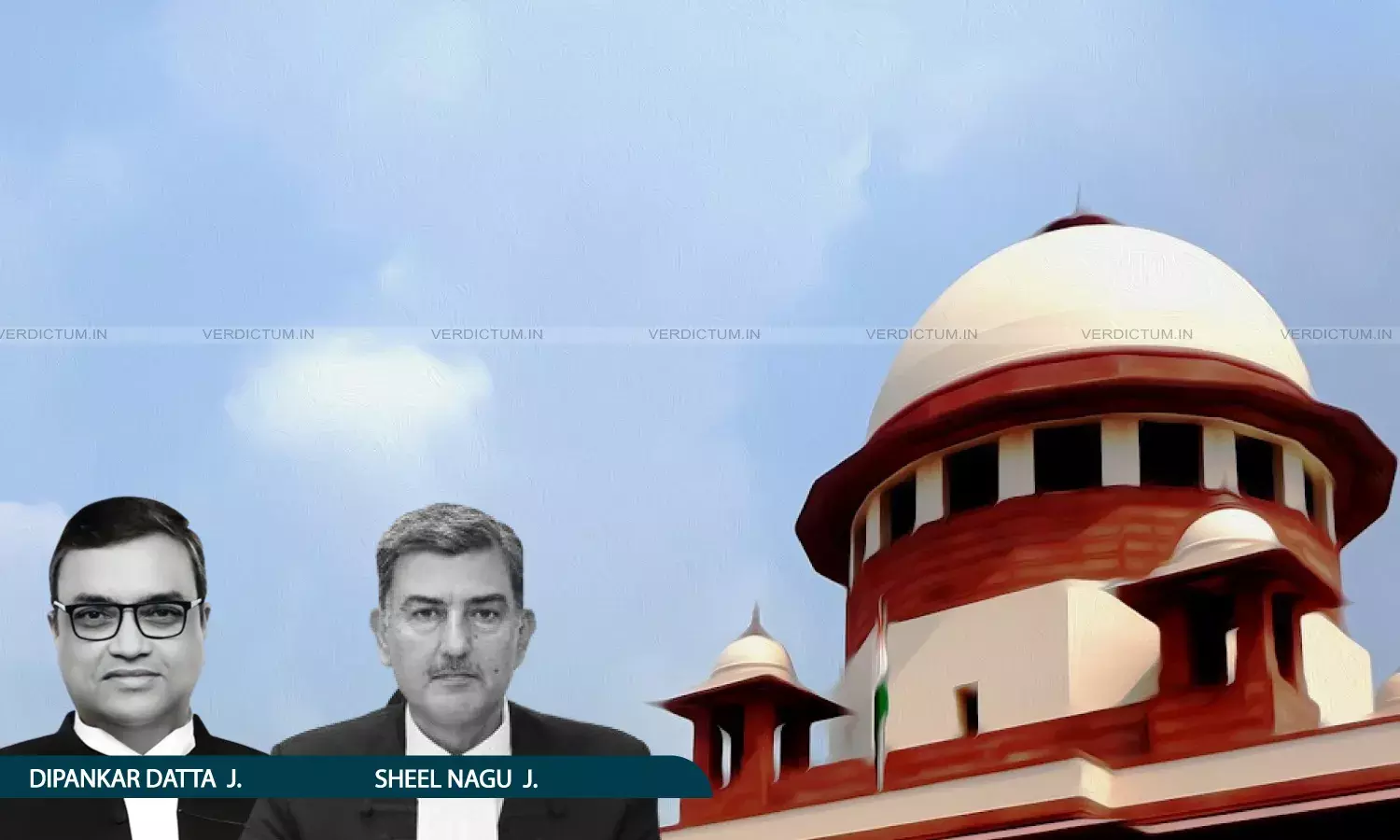
Justice Dipankar Datta, Justice Sheel Nagu, Supreme Court
The Supreme Court held that while Section 17(1) of the Working Journalists and Other Newspaper Employees (Conditions of Service) and Miscellaneous Provisions Act, 1955 explicitly allows the State Government to delegate its recovery powers to a specified authority, no such delegation is permissible under Section 17(2) for making a reference to a Labour Court.
Expressly invoking the legal maxim unius est exclusio alterius, the Court determined that the legislature intentionally withheld the power of delegation for making references, leaving the ultimate administrative responsibility of reaching a satisfaction on the existence of a dispute solely with the State Government.
Addressing the disruption caused by invalidating references issued under a 2016 Government of Maharashtra notification, the Bench utilized its extraordinary jurisdiction under Article 142 of the Constitution of India to protect ongoing litigations and awards. The Court directed the State Government to independently review all past references within six months, issue fresh formal orders of satisfaction where appropriate, and permit Labour Courts and High Courts to proceed seamlessly from the current stage without forcing litigants to restart proceedings de novo.
A Division Bench comprising Justice Dipankar Datta and Justice Sheel Nagu observed, “On the plain language of Section 17, we have no hesitation to hold that though the power of delegation is available to the State Government under sub-section (1) of Section 17, such power is unavailable under sub-section (2) of Section 17…We are, thus, of the considered opinion that the GoM fell in grave error in delegating power to the specified authorities to make reference under sub-section (2) of Section 17 to the Labour Court.”.
“The reason is this. In the field of administrative law, it is well-known that an authority who is conferred power by the Constitution or by a statute can delegate to a subordinate what such authority is empowered to do. As in the present case, express power of delegation is given to the State Government by sub-section (1) of Section 17…”, the Bench further noted.
Advocate Sudheer Voditel appeared for the appellant and Senior Advocate Sudhanshu S. Choudhari appeared for the respondent.
The appellants, comprising newspaper employees and journalists' unions, had approached the Labour Court seeking recovery of unpaid dues from their respective employers, including Dainik Bhaskar Group and All India Reporter Private Limited. The references to the Labour Courts were made by Additional and Deputy Commissioners of Labour pursuant to a notification dated May 11, 2016, issued by the Industries, Energy and Labour Department, Government of Maharashtra, delegating its Section 17(2) power. The employers raised preliminary objections challenging the competency of the delegatees to make the references.
The Division Bench of the Bombay High Court set aside the reference made to the Labour Court, holding the delegation invalid. Relying on this precedent, a Single Judge at the Aurangabad Bench subsequently allowed sixteen writ petitions filed by Dainik Bhaskar, setting aside a Labour Court award. Aggrieved by these decisions, the employees and union representatives filed appeals before the Supreme Court.
Examining the statutory framework, the Court noted that sub-sections (1), (2), and (3) of Section 17, while forming a single sequential scheme, confer distinct responsibilities. The Court clarified that once an employer disputes an employee's claim under sub-section (1), the delegated authority becomes functus officio.
“As one proceeds to the next stage contemplated under Section 17(2), the legislature in no uncertain terms makes the position clear that the administrative power to make a reference rests with the State Government and none else. What a reference to the Labour Court presupposes is a satisfaction reached by the State Government that there exists a dispute between the employee and the employer under the Working Journalists Act, which needs to be resolved by a decision of the Labour Court. This satisfaction, which must precede the making of the reference, is the responsibility of the State Government upon giving due regard to the materials on record placed before it, which could even include the materials collected by the specified authority while it proceeded, after delegation in its favour by the State Government, in terms of subsection (1) of Section 17. The provision of sub-section (2) of Section 17 leaves absolutely no room for the specified authority to undertake the function which is solely entrusted to the State Government thereunder. In other words, the power of delegation which is traceable in sub-section (1) of Section 17 cannot be borrowed therefrom to apply it to a situation requiring action under sub-section (2) of Section 17”, the Bench said.
Operatively, the Court directed the Government of Maharashtra to revisit all references made by delegatees within six months. Where fresh satisfaction is recorded, proceedings before Labour Courts or High Courts will resume from the current stage. Concluded proceedings where reference validity was not challenged remain unaffected.
Cause Title: Sudhir & Ors. v. Head of Human Resource, Dainik Bhaskar Group (D.B. Corp. Ltd.) & Ors. (Neutral Citation: 2026 INSC 834)
Appearances:
Appellant: Sudheer Voditel, Ravindra Bana, AOR, Tejaswi Kumar, Aparna Bhat, Sr. Adv., Rajkumari Banju, AOR, Karishma Maria, Saransh Khandelwal, Sudhanshu S. Choudhari, Sr. Adv., Mahesh Prakash Shinde, Vatsalya Vigya, AOR, Pranjal Chapalgaonkar, Yash Singhania. Advocates.
Respondent: Savita Singh, Rajat Joseph, Hrishikesh Chitaley, Kaustubh Kadasne, Sumit Kumar, Aniruddha Joshi, Rajeev Panday, Rajeev Kumar Panday, Shailesh Suman, Rajeev Maheshwaranand Roy, P Srinivasan, Mahesh Prakash Shinde, Vatsalya Vigya, Anand Dilip Landge, Siddharth Dharmadhikari, Aaditya Aniruddha Pande, Shrirang B. Varma, Sudheer Voditel, Ravindra Bana, Tejaswi Kumar, Aparna Bhat, Rajkumari Banju, Karishma Maria, Advocates.