

Supreme Court Applies Principle Of Parity; Directs Release Of Murder Accused Who Completed 20 Years Of Imprisonment
The Supreme Court was considering a Miscellaneous Application preferred by the applicant seeking modification of an earlier judgment.

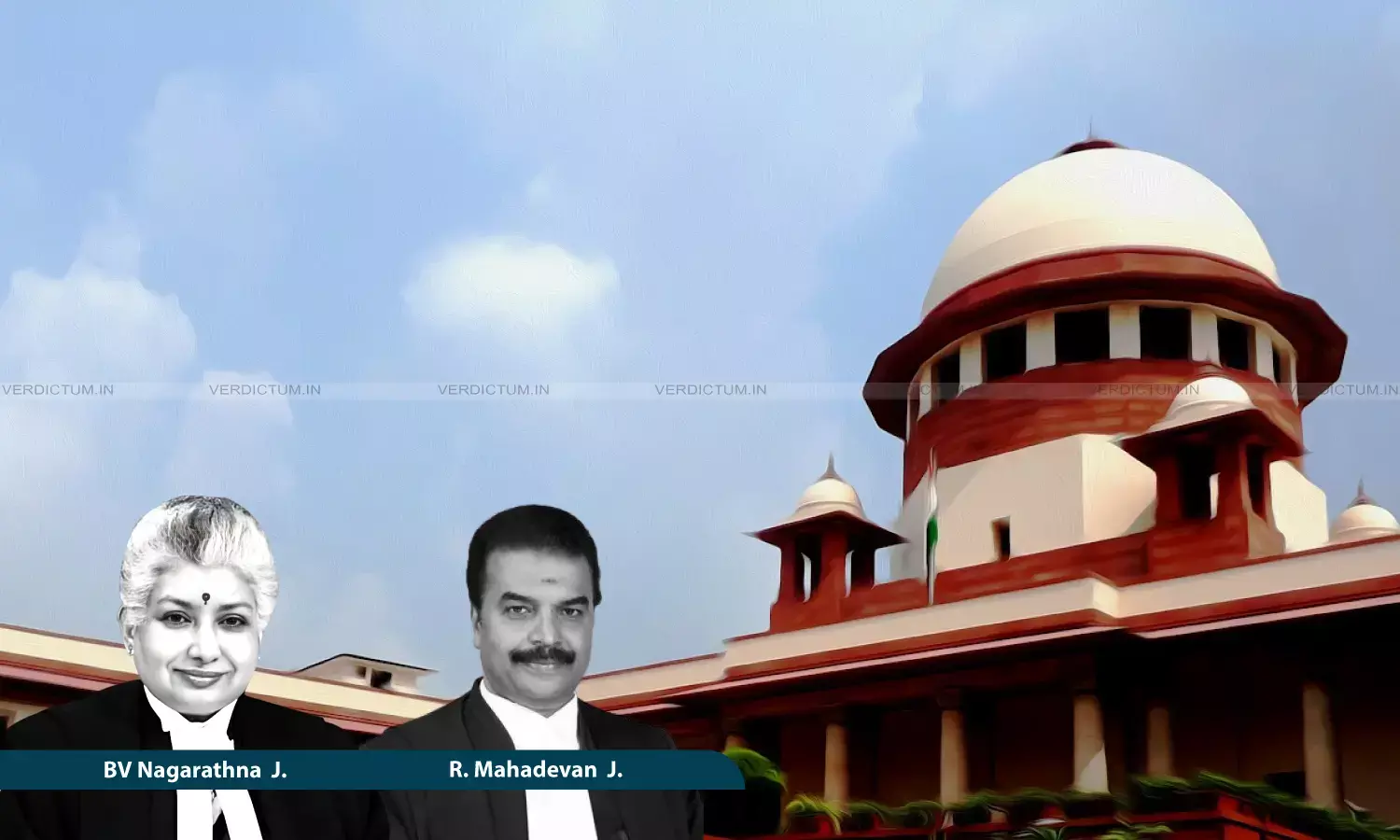
Justice B.V. Nagarathna, Justice R. Mahadevan, Supreme Court
The Supreme Court has applied the principle of parity and directed the release of a murder convict who had already completed twenty years of imprisonment with remission after noting that the co-accused’s sentence of death penalty was modified to imprisonment for a fixed term of twenty years and he was released after having completed his sentence.
The Apex Court was considering a Miscellaneous Application preferred by the applicant/appellant, one Sudesh Pal, seeking the Court’s indulgence to modify the judgment in Criminal Appeal wherein the sentence of imprisonment for life awarded to him by the High Court was confirmed.
The Division Bench of Justice B.V. Nagarathna and Justice R. Mahadevan held, “We note the applicant herein has already completed twenty four years’ of imprisonment with remission. The point to be considered is the principle of parity with regard to the nature of the punishment that has been imposed on the accused. When the benefit of commutation of death penalty to life imprisonment was granted by this court to the co-accused Madan and the imprisonment also was for a fixed term of twenty years and he has been released, we find that by application of the principle of party, insofar as the case of the applicant is concerned, who was not imposed the death penalty by the High Court, but had the benefit of commutation to life imprisonment must also be restricted to a similar period of twenty years.”
Advocate Aarif Ali represented the Appellant while AOR Vishwa Pal Singh represented the Respondent.
Factual Background
The case dates back to the year 2003, when an FIR was registered based on a written complaint against nine accused, including the applicant/appellant under Sections 147, 148, 149, 302, 307, 452 and 323 of the Indian Penal Code, 1860 (IPC). Charges were framed against the applicant/appellant and other co-accused persons by the Sessions Court under Sections 148, 302,149, 307,149, 323,149 and subsequently, vide the judgement dated July 31, 2015, the applicant/appellant and the co-accused Madan and Ishwar were convicted under Section 302 read with Section 149 of IPC. The applicant/appellant and co-accused Madan were awarded the death penalty and a fine of Rs 50,000, whereas the third co-accused Ishwar was sentenced to imprisonment for life.
When the matter reached the Apex Court, the Criminal Appeal preferred by the applicant/appellant was dismissed, and his sentence of imprisonment for life awarded by the High Court was confirmed. With respect to the criminal appeal preferred by the co-accused Madan, the Court, while confirming his conviction under Section 302 IPC, converted the death penalty imposed upon him to imprisonment for a fixed term of twenty years without remission. The miscellaneous application thus came to be filed by the applicant/appellant praying for his release on account of prolonged incarceration, old age and on parity with the co-accused, Madan, whose sentence of death penalty was modified and he was released having completed his sentence.
Reasoning
The Bench noted that the applicant had already completed twenty-four years of imprisonment with remission. The Bench took note of the fact that the benefit of commutation of the death penalty to life imprisonment was granted to the co-accused. The Bench found that the applicant had the benefit of commutation to life imprisonment for a similar period of twenty years and thus applied the principle of party.
Considering that the applicant had already completed the twenty years of imprisonment with remission, the Bench directed that the applicant be released.
Cause Title: Sudesh Pal v. State of Uttar Pradesh (Neutral Citation: 2026 INSC 768)
Appearance
Appellant: Advocates Aarif Ali, Mujahid Ahmad, AOR Chand Qureshi, Advocates Rajkumar Yadav, Mohd Faiz Ahmed
Respondent: AOR Vishwa Pal Singh, Advocates Ambrish Tiwari, Srikant Singh, Srajan Shankar Kulshreshtha, Suraj Pal Singh Mina, Anurag Nagar, Shivom Garg, Amit Kumar