

Section 413 BNSS- Appeal By Victim Against Order Of Acquittal Passed By Magistrate Has To Be Filed Before Sessions Court: Supreme Court
The Supreme Court upheld the order of the High Court rejecting the appeal filed before it.

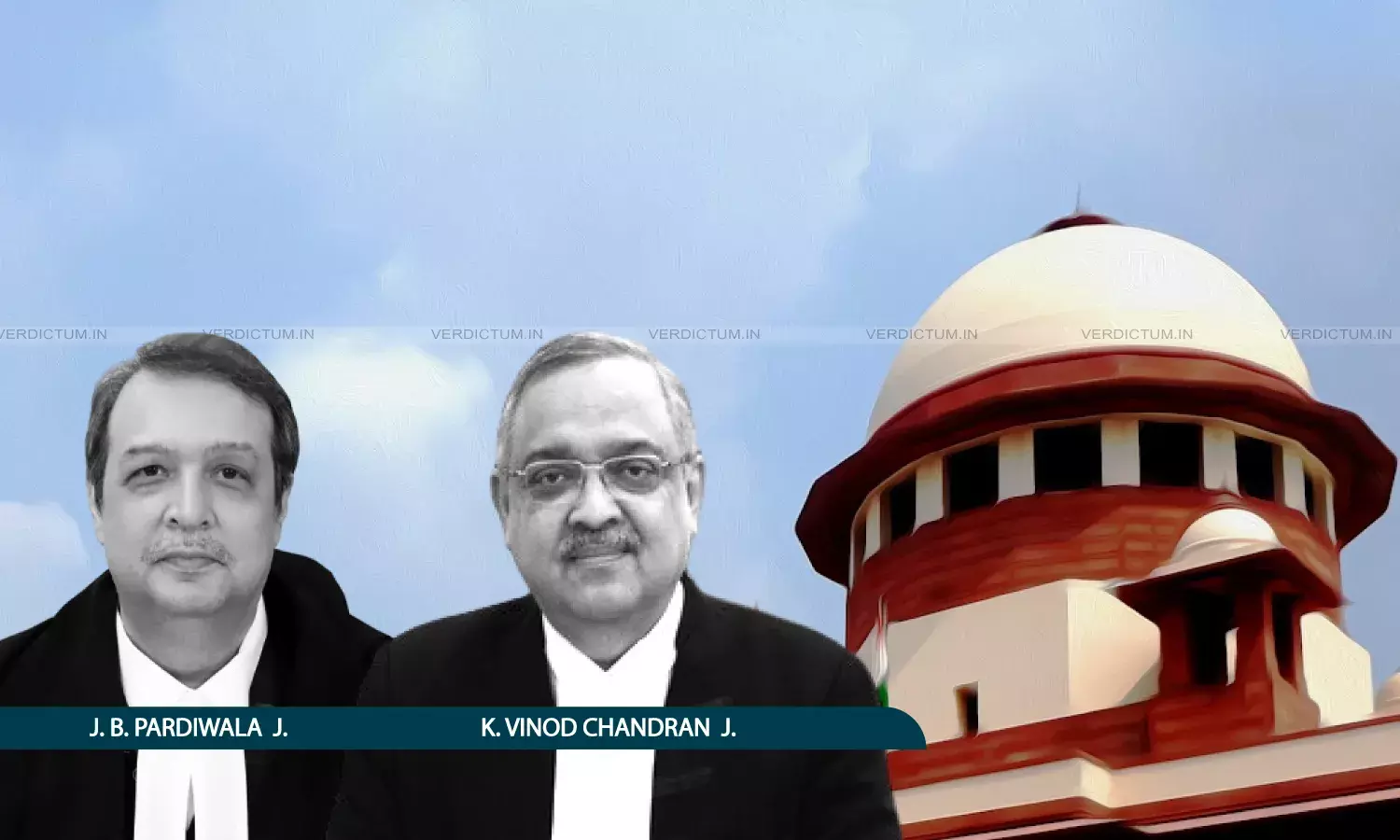
Justice J. B. Pardiwala, Justice K. Vinod Chandran, Supreme Court
The Supreme Court has held that as per the proviso to Section 413 of the Bharatiya Nagrik Suraksha Sanhita, 2023 (BNSS), an appeal filed by a victim against an order of acquittal passed by a Magistrate has to be filed before the Sessions Court.
The Apex Court was considering a Special Leave Petition filed against an order rejecting the appeal filed before the High Court from an order of acquittal passed by a Judicial Magistrate, giving liberty to file an appeal before the Sessions Court.
The Division Bench of Justice J. B. Pardiwala and Justice K. Vinod Chandran held, “Going by the proviso to Section 413, an appeal filed by a victim against an order of acquittal also has to be before the Court to which an appeal ordinarily lies against the order of conviction of such Court. The order of acquittal passed by a learned Magistrate, hence, has to be appealed before the Court in which a conviction ordered by a Magistrate can be appealed, which is the Sessions Court.”
Advocate Jayesh Gaurav represented the Petitioner, while Standing Counsel Nishant Awana represented the Respondent.
Factual Background
The victim, the father of the person who died in a hospital, was before the Judicial Magistrate pursuant to the registration of an FIR alleging an offence under Section 304A read with Section 34 of the Indian Penal Code, 1860, a bailable offence. The allegation raised was that the petitioner’s son, who was suffering from ‘depressive disorders’, was admitted to a hospital, where he committed suicide. The petitioner attributed the death by suicide to the negligence of the doctor and a nurse. The Judicial Magistrate acquitted the accused.
The matter was admitted by a Single Judge; however, later, when it came up for final hearing, another Single Judge found, on the basis of the statutory provision, that the appeal was not maintainable before the High Court.
Reasoning
The Bench, at the outset, explained that Section 419 of the BNSS provides such appeal in case of acquittal to the Court of Session with the sanction of the District Magistrate, only from an order of acquittal passed by a Magistrate in respect of a cognizable and non-bailable offence and in all other appeals, from an acquittal passed by an Original Court or an Appellate Court, appeal is enabled to the High Court with the sanction of the State Government.
The Bench noted that the proviso to Section 413 of the BNSS regulates the matter, insofar as an appeal from an acquittal by the victim is concerned and Section 413 prohibits any appeal to lie from any judgment or order of the Criminal Court except as provided by the Sanhita. The Bench stated, “Hence, the proviso confers on the victim a right to proffer an appeal against any order of acquittal, conviction for a lesser offence or on the ground of inadequate compensation. In which event, such appeal shall lie to the Court to which an appeal ordinarily lies against the order of conviction of such court.”
The Bench was of the view that when there is a conviction in a trial held by a Magistrate of the First Class or the Second Class, an appeal lies to the Sessions Court. Thus, finding no infirmity in the order of the High Court, the Bench dismissed the petition and suggested, “The petitioner, if still desirous of filing an appeal, can approach the Jurisdictional Sessions Court.”
Cause Title: Subhas Chandra Sarkar v. The State of West Bengal & Ors. (Neutral Citation: 2026 INSC 1052)
Appearance
Petitioner: Advocates Jayesh Gaurav, Kuldeep Rai, Vijay Singh, Petitioner-in-person
Respondent: Standing Counsel Nishant Awana, Advocates Rini Badoni, G.S. Awana, Suraj Kundu, Amogh Pandey, Mayank Chaudhary, AOR Manish Gupta, Advocates Prateek Gupta, Shipra Bhardwaj, Sowmya China, Manaswee Gupta, Payal Singh, Vivek Chandrasekar, Riya, Ravi, Mehul Jain, Yash Tewari, Ankit Gupta, Shubham Aggarwal, Amit Mishra, Vaishnavi Mishra, Phallya Jain, AOR Ananta Prasad Mishra, Advocates Susmita Mahala, Mamata Pal, Santosh Kumar Sharma, Rajesh Kumar Nayak