

Stranger To Auction Making Higher Offer Has No Locus: Supreme Court
The Court set aside High Court’s remand of a non-participant’s plea offering Rs 42.25 crore.

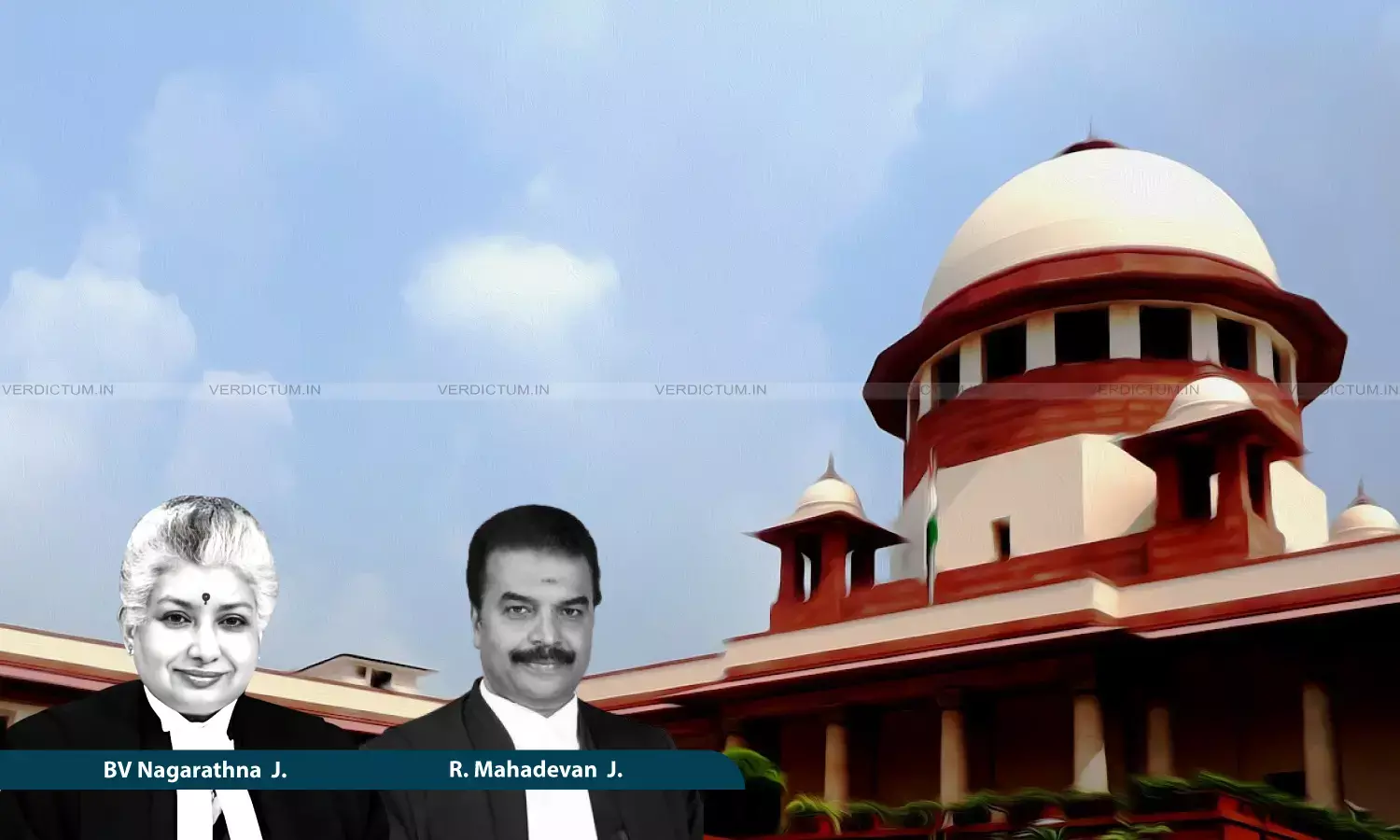
Justice B.V. Nagarathna, Justice R. Mahadevan, Supreme Court
The Supreme Court has held that a person who did not take part in an auction and is a stranger to it cannot enter the fray by making a higher bid at a later stage.
The Court said such a late offer does not confer any locus or right on that party to seek the bid in its favour.
The Court set aside an order of the Division Bench of the Madhya Pradesh High Court which had remanded an application filed by a non-participant offering Rs 42.25 crore for the property of a company in liquidation, and had restrained the Official Liquidator from executing the sale deed in favour of the highest bidder.
The Bench of Justice B.V. Nagarathna and Justice R. Mahadevan observed, “Merely because a person who has not participated in an auction proceedings and is a stranger thereto seeks to enter the fray by making a higher bid at a later stage would not confer any locus or right on such a party to seek conferment of the bid in his favour.”
Senior Advocate Shashank Garg appeared for the Appellant, while Senior Advocates S Niranjan Reddy and Shekhar Sharma appeared for the Respondents.
Brief Facts
Respondent No.1, M/s Bharat Commerce and Industries Limited, underwent liquidation. An e-auction was then conducted for plots in Rajpura, Punjab. The appellant, M/s Kalindi Associates, emerged as the highest bidder with an offer of Rs 31 crore, against a reserve price of Rs 29 crore.
After the auction concluded, M/s Maa Sharda Oils, a third party who was a stranger to the entire auction process, submitted a higher offer of Rs 35 crore. The High Court rejected that offer but directed the Official Liquidator to inquire whether the appellant would be willing to revise its bid to Rs 35 crore, which the appellant agreed to do.
Respondent No.2, also a non-participant in the auction, then filed an interlocutory application seeking to take part in the auction process, contending that it was willing to offer Rs 42.25 crore. The Single Judge rejected the application and accepted the appellant’s enhanced bid of Rs 35 crore.
In a company appeal by Respondent No.2, the Division Bench allowed the appeal. Relying on certain precedents holding that higher offers by a third party could be considered even after a sale certificate had been issued, it remanded the application to the Single Judge for fresh consideration.
It also directed the Official Liquidator to refrain from executing the sale deed in favour of the appellant in the meantime. The appellant’s review petition was dismissed on the ground that the order, being merely one of remand, did not call for interference. Aggrieved, the appellant approached the Supreme Court.
Observations/Findings of the Court
The Court noted that it was admitted that Respondent No.2 had not participated in the auction, and that the appellant was the highest bidder whose bid of Rs 31 crore was accepted against a reserve price of Rs 29 crore, later enhanced to Rs 35 crore.
Holding that the Division Bench was not right in remanding the matter, the Court observed, “Respondent No.2 is a stranger and not a person aggrieved by the auction which took place on the said date in which the appellant was declared to be the highest bidder. That being the position of respondent No.2, he could not have intervened in the liquidation proceedings by filing an application namely, I.A. No.170/2026. It was highly speculative and without any locus standi on the part of the said respondent to have filed the said application at all.”
The Court said the Company Judge had rightly declined to entertain the prayer of Respondent No.2, and that the Division Bench had failed to notice that Respondent No.2 had no locus whatsoever to file the application.
The Court relied on Jasbhai Motibhai Desai v. Roshan Kumar, Haji Bashir Ahmed [1976], which classifies applicants as a “person aggrieved”, a “stranger”, or a busybody or meddlesome interloper, and lays down the tests for locus standi.
It also relied on Golden Food Products India v. State of U.P. [2026] and Eva Agro Feeds (P) Ltd. v. Punjab National Bank [2023]. Under those decisions, an auction cannot be set aside in favour of a third party who did not participate in it and made no offer, unless there is material irregularity, illegality, fraud or collusion. The decisions further hold that repeated interference would frustrate the sanctity of a public auction, and that a mere expectation of a higher price is no good ground to cancel an otherwise valid auction.
Accordingly, the Court set aside the impugned order of the Division Bench, dismissed the application filed by Respondent No.2, and allowed the appeals.
Taking note of the submission, acknowledged by counsel for the Official Liquidator, that the appellant had already deposited Rs 35 crore, the Court directed the Official Liquidator to hand over possession of the subject land to the appellant immediately after all legal formalities, including registration of the sale deed, are completed.
Cause Title: M/s Kalindi Associates v. M/s Bharat Commerce and Industries Limited & Ors. [SLP (C) Nos. 18907-18908/2026]
Appearances:
Appellant: Sr. Adv. Shashank Garg, AOR Devvrat, Adv. Shivam Sachdeva, Adv. Himansh Yadav, Adv. Abhinav Malhotra, Adv. Divyansha, Adv. Vinod Kumar Jaiswal
Respondents: Sr. Adv. S Niranjan Reddy, Sr. Adv. Shekhar Sharma, AOR Mrinmayee Sahu, AOR Ankit Chaturvedi, AOR Sneha Sanjay Botwe, Adv. Jitin Chaturvedi, Adv. Amruta Padhi, Adv. Shubham Agarwal, Adv. Gaargi Singh, Adv. Tarjana Rai, Adv. Tripti Jain, Adv. Prakhar Karpe, Adv. Vineet Shrivastawa, Adv. Shubhankar Sharma