

Supreme Court Stays Madras High Court Ruling Constituting Board Of Management For Chidambaram Nataraja Temple From Podhu Dikshitars
The Podhu Dikshitars argued that the High Court could not sit in appeal over its own 1951 judgment recognising their right to administer the temple.

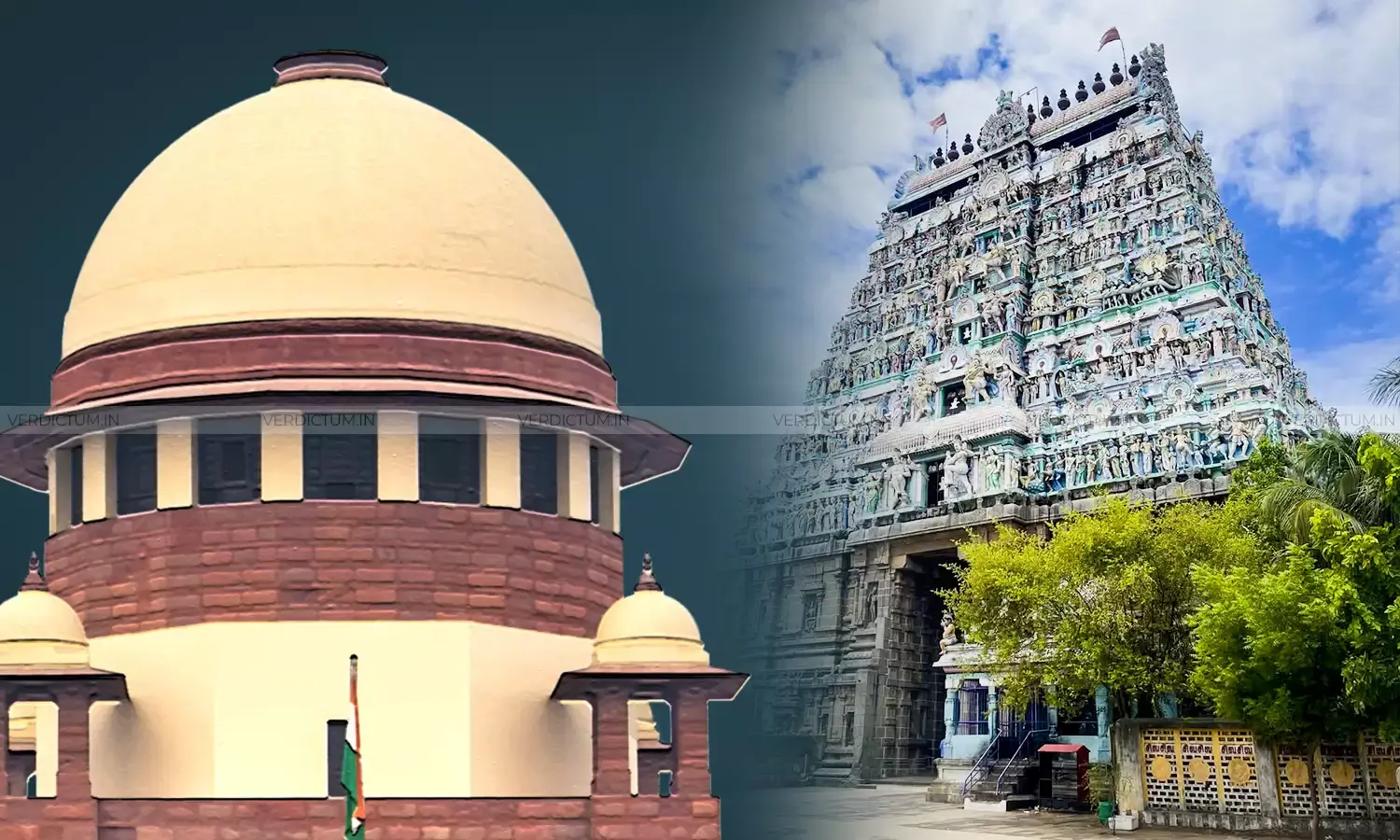
The Supreme Court has stayed the judgment of the Madras High Court, which had constituted a Board of Management to take over the administration of the Sri Sabanayagar (Lord Nataraja) Temple at Chidambaram.
The Court issued notice on the Special Leave Petitions filed by the Podhu Dikshitars and others, and stayed the impugned judgment.
The High Court, while upholding G.O. (Ms.) No. 115 dated 17 May 2022, which permitted devotees to have darshan by climbing atop the Kanagasabai, had found maladministration in the upkeep of the heritage structure and in the accounting of temple properties. It had directed the Board to take over the administration “till the ill is cured”.
The Bench of Justice Aravind Kumar and Justice Vipul M. Pancholi ordered, "Issue notice. Counsels accepts notice. Having heard the learned advocates appearing for the parties, we are of the considered view that the impugned judgment deserves to be stayed, accordingly, it stands stayed."
Senior Advocates CS Vaidyanathan, Guru Krishna Kumar, K Parameshwar and J Sai Deepak appeared for the Petitioners, while Senior Advocates Shekhar Naphade and Jaideep Gupta appeared for the State
Vaidyanathan submitted that the right of the Dikshitars to administer the temple had already been determined by the High Court in 1951 and had attained finality, as the then State of Madras had withdrawn its appeal before the Supreme Court. He contended that the State authorities, acting under the Tamil Nadu Hindu Religious and Charitable Endowments Act, 1959, could not pass any order denying those rights.
He pointed out that, although the 1959 Act was enacted after the pronouncement of that judgment, nothing in the Act took away the rights declared by the Court in favour of the Dikshitars with respect to the administration of the temple.
He further submitted that it was not permissible for the High Court to assume jurisdiction to sit in appeal over its own earlier judgment of 1951, which had attained finality. According to him, the High Court also erred in holding that the earlier judgment would not operate as res judicata.
He argued that, even if the temple had neither been established nor owned by the Dikshitars, and no such claim had ever been made, the earlier judgment had recognised them as a religious denomination, or a section thereof, entitled to administer the temple, which they had done for several centuries. Re-examination of that question, he submitted, could not arise.
Naphade, for the Respondents, submitted that the complaint was that devotees were not being allowed to enter the Kanagasabhai, and that money was being taken from them, and only those who paid were permitted entry. He submitted that photographs to that effect were annexed to the judgment. He stated that this was one aspect of the matter, and that the other two were the destruction of the heritage structure and the failure to maintain accounts.
Counsel for the Respondents denied the assertion that the Petitioners had no time to respond to the report of the Heritage Commission.
He then referred to the judgment and the Commission's report, which recorded that the brick wall between the ancient stone pillars of the passage leading to the Nataraja sanctum had been removed and rooms constructed in cut stone, thereby altering the historic spatial character and visual continuity of the mandapam passage. He submitted that these were representative instances of damage to the temple structure.
Accordingly, the Court stayed the impugned judgment.
Writ petitions were filed before the High Court in respect of the constitutional validity of the Government Order permitting devotees to have darshan of Sri Sabanayagar by climbing atop the Kanagasabai Mandapam in the Sri Sabanayagar (Nataraja) Temple, at Chidambaram Town and Taluk, Tamil Nadu.
The High Court had framed three issues: (a) whether the Government Order was a colourable exercise of executive power overriding the Dikshitars’ rights under Article 26; (b) whether the heritage structure was damaged under their management; and (c) whether the Temple’s properties were properly accounted for and audited.
On issue (a), the High Court had held that the Government Order regulated only the mode of public darshan and did not interfere with the Dikshitars’ religious ceremonies. Rights under Articles 25 and 26 were subject to public order, morality and health. The public’s right to worship in a public temple had to co-exist with the denominational right, and the right to administer did not include a right to maladminister.
On issue (b), the report of the Tamil Nadu Heritage Commission recorded numerous unauthorised constructions and alterations. These included concrete mandapams, rooms built between ancient pillars, and paint over inscriptions and murals. The Dikshitars admitted the constructions but objected to the involvement of the HR&CE Department. The High Court answered the issue in the affirmative.
On issue (c), the High Court had found that the Dikshitars produced only unaudited rough ledgers in a sealed cover. It found that the HR&CE Department and the Special Tahsildar had also failed in their duty to protect Temple lands, and that the two sides had blamed each other. The Court answered the issue in the negative.
Holding that judicial interference was warranted to cure maladministration, the Court constituted a Board of Management of two retired Judges, a retired IAS officer, and the Secretary of the Podhu Dikshitars and the Secretary to Government, HR&CE Department, as ex-officio members.
The Board was to ensure fair public darshan at the Kanagasabai without violating custom. It was also to remove unauthorised constructions in consultation with the Heritage Commission, retrieve encroached properties, augment income, maintain accounts, and take an inventory of valuables. The daily rituals and festivals remained the exclusive prerogative of the Podhu Dikshitars, and donations were to be received through a single-window e-payment system.
Cause Title: TR Ramesh v. The State of Tamil Nadu & Ors. [SLP(C) No. 39005/2026]