

Breaking: Supreme Court Stays Investigation In CMRL-Exalogic Case Against Former Kerala CM Pinarayi Vijayan & Family
The Court permitted the petitioners to pursue the appeal before the High Court Division Bench.

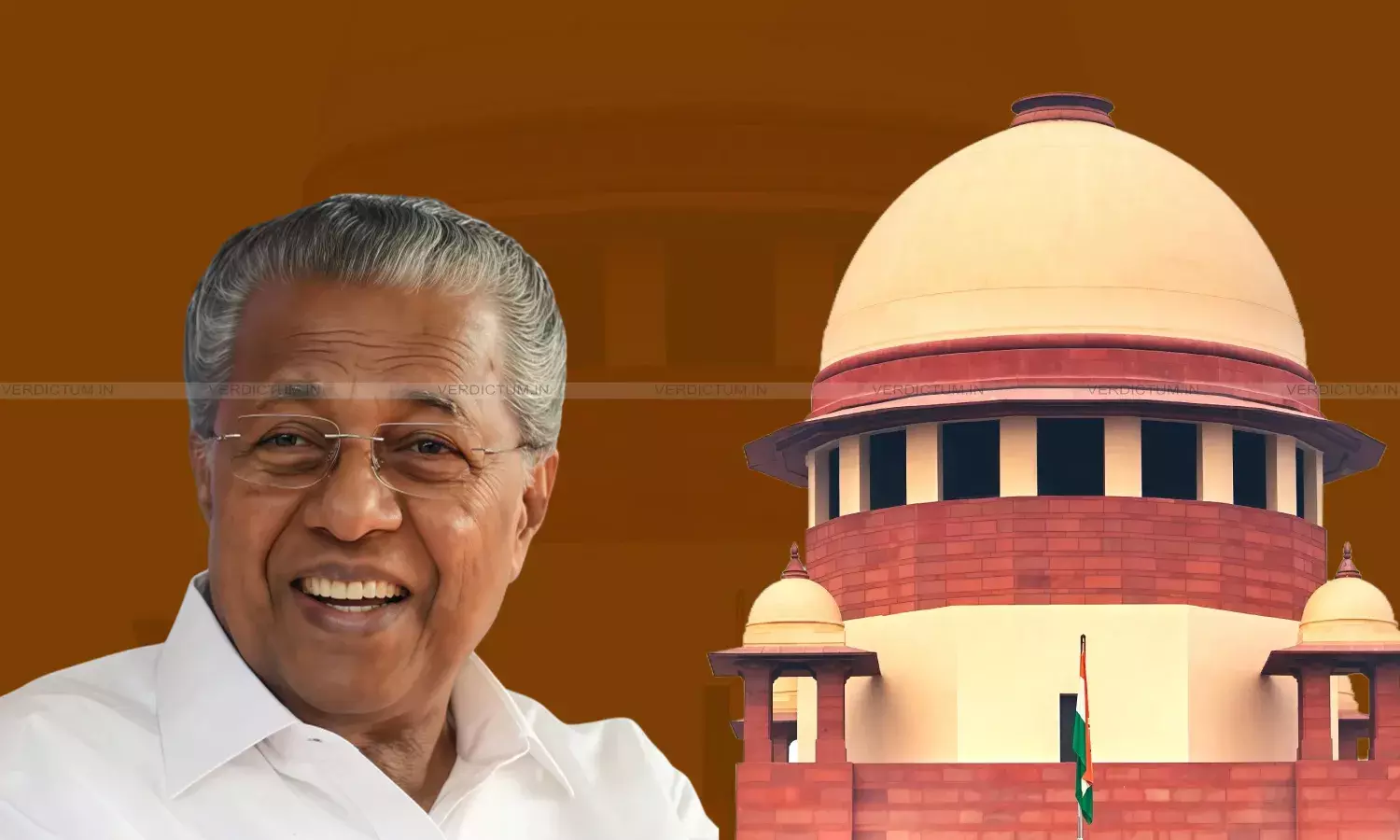
The Supreme Court has stayed the investigation into the First Information Report (FIR) registered against former Kerala Chief Minister Pinarayi Vijayan and his family members for a period of one week in the alleged CMRL-Exalogic bribery case.
The Kerala High Court had ordered registration of an FIR, based on the ED report on the alleged bribery case.
The Court said that they were entitled to file an appeal before the Division Bench of the Kerala High Court challenging the Single Bench's direction to register an FIR. The Court, accordingly, set aside the Division Bench's order which refused leave to file an appeal. The Court has now permitted the petitioners to pursue the appeal before the Division Bench.
The Vacation Bench of Justice Joymalya Bagchi and Justice V Mohana ordered, "That apart, we are also minded to observe that the Single Judge has not only directed registration of an FIR, which is the mandate of the law and the mandate in Vijay Madanlal Choudhary, but also the commencement of investigation. Commencement of investigation and taking the same to its logical conclusion under the Prevention of Corruption Act would require due compliance of other statutory requirements under the special law, which may necessitate special law (cites C. Charanjeet Singh, paragraph 51C). These circumstances and facts clearly make out a prima facie case of locus for the petitioners to seek leave to appeal against the impugned judgment. Accordingly, we set aside the impugned order and permit the petitioners to pursue the appeal before the Division Bench."
Senior Advocates Sidharth Luthra and N Hariharan appeared for the Petitioners, while Advocate Zoheb Hussain appeared for the ED
The Court ordered, "We make it clear that our observations are limited to the issue at hand, that is, the locus of the petitioners to prefer the appeal, and not an expression of opinion on merits. We give liberty to the petitioners to pursue the appeal as well as seek interim relief in accordance with law. To enable the petitioners to do so, we direct that the investigation in the impugned first information report shall remain stayed for a week."
It was contended that the State was duty-bound to register an FIR; that as per Vijay Madanlal Choudhary, the State was obliged to register an FIR as per communication sent to them under Section 66(2) of the PMLA by the ED. Petitioners, being accused persons, do not have a right of hearing at the time of registration of such FIR.
"We are unable to agree to such contention advanced before us. This is not a case where the State had registered a first information report on its own; on the contrary, the registration of the FIR and commencement of investigation thereon was pursuant to a judicial order passed by the Constitutional Court. While passing such order, the Single Judge had inter alia observed that the materials in the communication by the ED disclose a cognizable offence. Such fact would disclose a cognizable offence, and therefore, it was obligatory for the State to register an FIR. If the petitioners are not permitted to assail such finding of fact in the appellate proceeding, the same shall stare at their face in an independent proceeding assailing the first information report as per law", the Court observed.
The Court said that the scheme of the BNSS has undergone a change from what was envisaged under the Code of Criminal Procedure. Under the erstwhile Code, Section 156(3) did not require the participation of a public servant or his superior in the process of taking a decision to issue a direction for the registration of an FIR. However, under Section 175(4) of the BNSS, such a requirement has been incorporated.
"We have referred to Section 175(4) of the BNSS not with reference to the merits of the case before us, but to elucidate the expansive jurisdiction envisaged in the new code with regard to a potential accused prior to the registration of an FIR and nothing more", the Court added.
The High Court had allowed a plea by Advocate K M Shajahan, who contended that the police should register an FIR rather than conduct a preliminary inquiry on the allegations contained in the report of the Enforcement Directorate (ED).
The materials having transpired in the course of ED investigation, during the PMLA investigation under the PMLA Act, ED issued a communication under Section 66(2) to the State Government for sharing information for necessary action as per law. In response thereto, the Director General of Police constituted a nine-member SIT (Special Investigation Team) to conduct a preliminary enquiry. The first respondent, being dissatisfied with such dilatory tactics to avoid registration of FIR and commencement of investigation against the former public servants and others, approached the High Court.
The ED had claimed in court that an FIR could be registered against Vijayan, his daughter Veena T and her husband P A Mohamed Riyas based on the report it had submitted to the state police. The ED had claimed that its report could be treated as a preliminary inquiry report and that an FIR could be registered based on it.
The contention was opposed by the state government, which claimed that the report submitted by the agency was not sufficient to register an FIR and that a preliminary inquiry was required. The Congress-led UDF government in Keralam recently ordered a police inquiry based on the ED's letter to the State Police Chief seeking a probe against Vijayan, Veena and Riyas.
The ED had sought registration of a case based on "evidence" gathered during its probe and searches conducted under the Prevention of Money Laundering Act. The agency had alleged that Cochin Minerals and Rutile Limited (CMRL) made fraudulent payments of Rs 2.78 crore to Veena's now-defunct company Exalogic Solutions under the guise of "IT consultancy services."
Accordingly, the appeal was disposed of.
Cause Title: Pinarayi Vijayan v. K M Shajahan and Ors. [SLP (Crl.) 20437/2026]