

Supreme Court Asks States To Segregate UAPA & NDPS Trials From Regular Courts, Union To Provide 1 Crore To States For Special Exclusive Courts
The Court directed States to establish dedicated courts for these cases and warned against burdening District Judges with these sensitive matters.

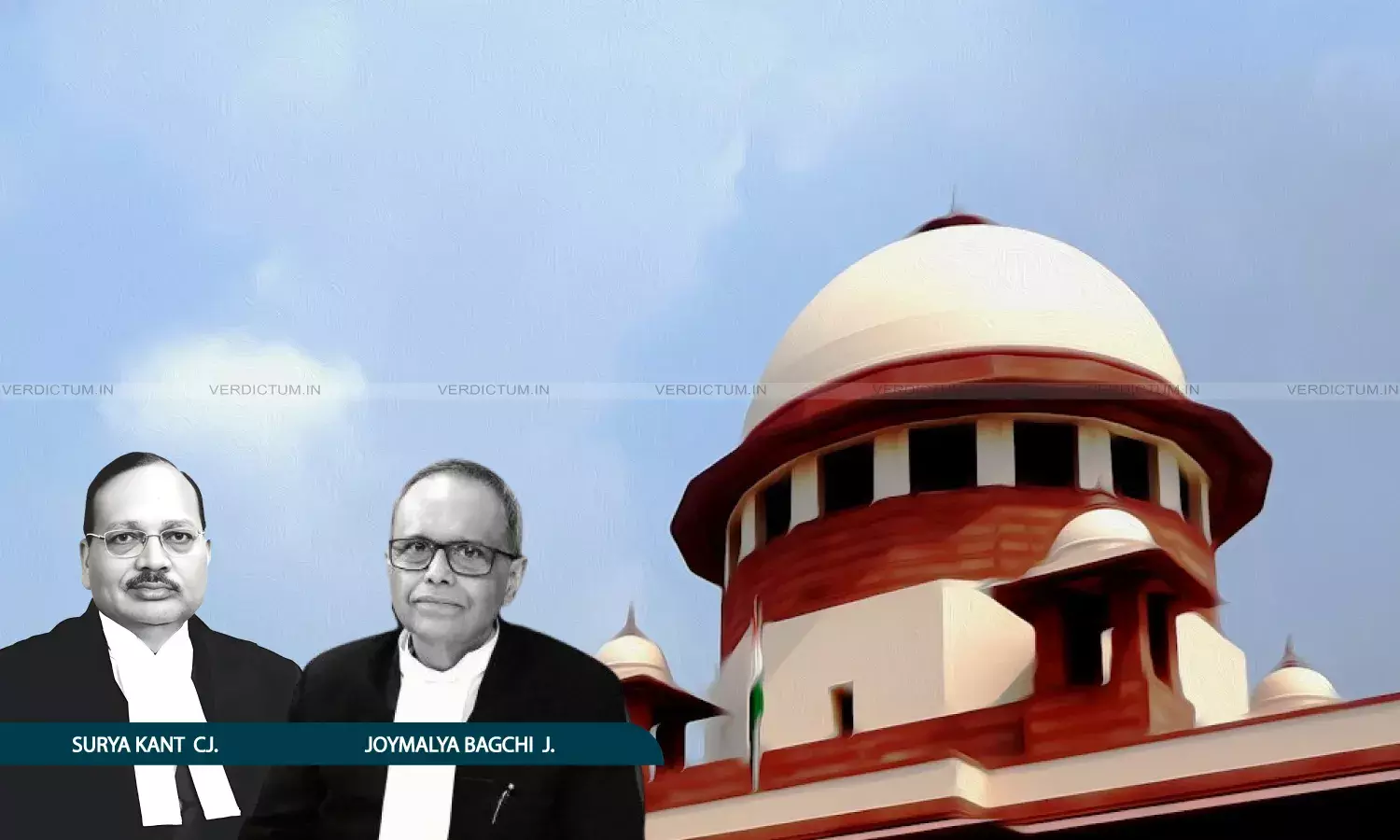
The Supreme Court has asked the State Governments, in consultation with respective High Courts, to determine how many exclusive, dedicated courts are required state-wise.
The Court emphasized that "exclusivity" is the only way to ensure trials conclude within a one-year timeline. The Bench noted that in high-stakes legislation like UAPA, where bail is restricted by statutory interdicts, the right to a speedy trial becomes the only safeguard for the accused's liberty.
To implement this, the Union Government will provide ₹1 crore in annual recurring funds and ₹1 crore for infrastructure per court. Furthermore, the Court directed High Courts to increase their Higher Judicial Services cadre strength to ensure that these exclusive benches are presided over by seasoned officers with at least five years of sessions trial experience.
Advocate Generals have been given a deadline to submit comprehensive data on pending cases to determine the exact number of exclusive courts and Special Public Prosecutors required for each state.
The Bench of Chief Justice Surya Kant and Justice Joymalya Bagchi ordered, "This matter concerns the establishment of exclusive special courts for the trial of UAPA cases by the National Investigation Agency or by the State Police, as also for the trial of NDPS cases by different State and Central agencies...Referring to the order dated 10th February 2026, it was brought to our notice that the Office Memorandum dated 07-01-2026 was reproduced in extension in our order of 24th March 2026. In terms of the said Office Memorandum, the Union of India has agreed to reimburse non-recurring expenditure of ₹1 crore to all State Governments, provided that the cost of land or construction for the establishment of such special exclusive courts is borne by the State Government. The Union of India has also agreed to provide a sum of ₹1 crore as annual recurring expenditure for the establishment of such courts, along with the requisite staff."
ASG Aishwarya Singh Bhati appeared for the Union Government along with other Advocate Generals representing several States.
The Court emphasized that these courts must be truly exclusive, meaning no other matters—such as family law or civil appeals—should be assigned to them. The Chief Justice proposed a benchmark of one dedicated court for every 10 to 15 cases to ensure that trials, which often involve hundreds of witnesses, could be concluded within a strict one-year timeline. The Court also noted that the criteria for Annual Confidential Reports (ACR) of the presiding officers would be modified to reflect the specialized nature of their work.
The Court ordered, "In the above-stated order, it was also pointed out that there are 17 states where more than 10 trials under UAPA conducted by the NIA are pending. In addition to the trials under UAPA being conducted by State Police, it is appropriate to request the Advocates General to identify: 1. How many separate exclusive NIA/UAPA courts are required for conducting trials, whether the trial is conducted by NIA or State Police. 2. The appointment of dedicated Public Prosecutors for each such court. 3. The provision of requisite infrastructure for the establishment of such exclusive courts...We have briefly heard the counsels on these issues. We have impressed upon them to secure complete details of trials pending under: 1. UAPA, whether conducted by NIA or State Police. 2. The NDPS Act, whether such trials are conducted by State Police or the Narcotics Control Bureau, etc."
Regarding infrastructure and manpower, the Court directed that these special courts should be located within or adjacent to existing court complexes to avoid inconvenience to members of the Bar. It was further decided that the cadre strength of the Higher Judicial Services should be temporarily increased to provide experienced judicial officers, preferably those with at least five years of experience in conducting sessions trials.
"Upon receipt of this information, a uniform yardstick can be evolved in order to determine how many exclusive courts to deal with UAPA and NDPS cases are required to be established in each state. It goes without saying that to give effect to the Office Memorandum dated 07-01-2026, it would be necessary for the respective states to abide by the requirements. Under the infrastructure for the establishment of these exclusive courts, they shall also have to appoint a Special Public Prosecutor for each court (for state cases). Similarly, the Union of India shall appoint a Special Public Prosecutor for cases conducted by the NIA", the Court said.
It was also ordered, "The State Governments, in consultation with High Courts, will also be required to make additions to the cadre strength of the respective Higher Judicial Services to the extent of the requirement for the establishment of exclusive courts. The courts shall be presided over by judicial officers preferably having experience of five years in conducting sessions trials..."
It added, "One more issue that has cropped up is whether the Central Government will provide financial assistance of ₹1 crore in recurring expenditure even for those special courts where cases under UAPA or NDPS Acts are being conducted by state agencies. The memorandum does not expressly clarify this. The Union of India shall provide financial assistance for conducting all trials under UAPA and NDPS Acts within the timeline of one year, as earlier indicated by this Court, notwithstanding the fact that such trial is being conducted by Central agencies or the State."
CJI Surya Kant said, "So, two things will be your responsibility. One, to immediately give one courtroom and the requisite infrastructure. Second will be for that High Court also—and that will be our next stage—additional posts to be created. Say, in your state if you require 10 courts, in another state you require, and in the third you require. So, to that extent, there will be a temporary addition for the time being in your Higher Judicial Service cadre. It will not be extra; it will be part of the total cadre strength, because here we need to have very trained and experienced judicial officers to conduct these trials. You cannot give a "raw hand" to those selected and then appointed...So, they will have to be very experienced, having a fairly good experience of conducting trials."
Counsel for Jharkhand said, "In Jharkhand, we have one exclusive court—not within the same court campus—an exclusive court for NIA. In 2024, it is functioning a lot."
CJI said, "Very good. Is it exclusively doing NIA?"
Counsel replied, "Exclusively. It is notified by the Central Government under Section 11 of the NIA Act. From 2024, we have only 27 NIA cases."
Justice Bagchi said, "The Central Government does it through the NIA. Is 27 the entire number of NIA cases, or is it only NIA cases?"
Counsel replied, "Only those NIA cases and only those UAPA cases which the NIA has taken up."
Justice Bagchi then said, "That is exactly our apprehension. That is where the problem is created. I mean, you are also in a difficult situation, you understand. What are the number of undertrials in your 790 cases? Our main concern is not the Central Government or the State Government; it is the impact of these legislations where the right to undertrial bail is limited because of statutory interdicts. We need to have a situation where there is a fast-pacing of these courts. If you have a Central Government NIA court and you have 13 or 27 cases..."
CJI Kant remarked, "Suppose you use that court for a police murder trial also on that day. A few family court appeals also. Civil appeals also. This and that also. For the two matters of NIA or your UAPA matters, in the morning the lawyer will seek an adjournment. He will grant the adjournment and remain busy with the other matters. That is not going to solve the purpose. That is the reason. All of you today need not respond immediately. You see, we wanted to sensitize you about this problem with your cases. You are the best persons now to tell us how many cases of UAPA or similar statutes exist. What we are suggesting is that you please furnish us with complete data of the cases. We were able to get the details as far as NIA is concerned because, for NIA courts, we are leaving it to the High Courts through the Registrar Generals to furnish the data. But since you are the Chief Prosecutors, you are also aware of it."
"You furnish the data. Based upon that, we need to determine how many exclusive, dedicated courts are required state-wise, and this figure will vary from state to state. Jharkhand has its own unique problems; they might be facing many more UAPA cases than other states", he added.
The Court emphasized that the core of this judicial reform was the strict enforcement of the word "exclusively." The Bench observed that for these special courts to function effectively, they must not be assigned any extraneous matters, such as civil or family law cases, which often lead to frequent adjournments in high-priority trials.
The Court specifically critiqued the practice in states like Jharkhand, where UAPA cases were assigned to Principal District Judges. The Bench noted that these judges are heavily burdened with administrative responsibilities and case assignments, making it impossible for them to conduct the day-to-day trials required for sensitive matters. Consequently, the Court directed that this policy be changed to ensure that presiding officers can focus solely on the evidence before them.
The Bench directed all Advocate Generals to furnish comprehensive, category-wise data regarding pending UAPA and NDPS cases in their respective states. This data was required to determine the exact number of additional courts needed and to facilitate the appointment of dedicated Special Public Prosecutors. The matter was scheduled for further hearing in May 2026 to review the progress made by the states and the High Courts.
Accordingly, the matter is now listed for a further date.
Cause Title: In Re: Creation of Special Exclusive Courts [SMW(Crl) No. 1/2026]