

States Or Districts Where Yamuna Water Quality Deteriorates Will Be Held Accountable: Supreme Court
The Court said that the Yamuna River must be protected as a single shared resource, not as separate State-wise stretches.

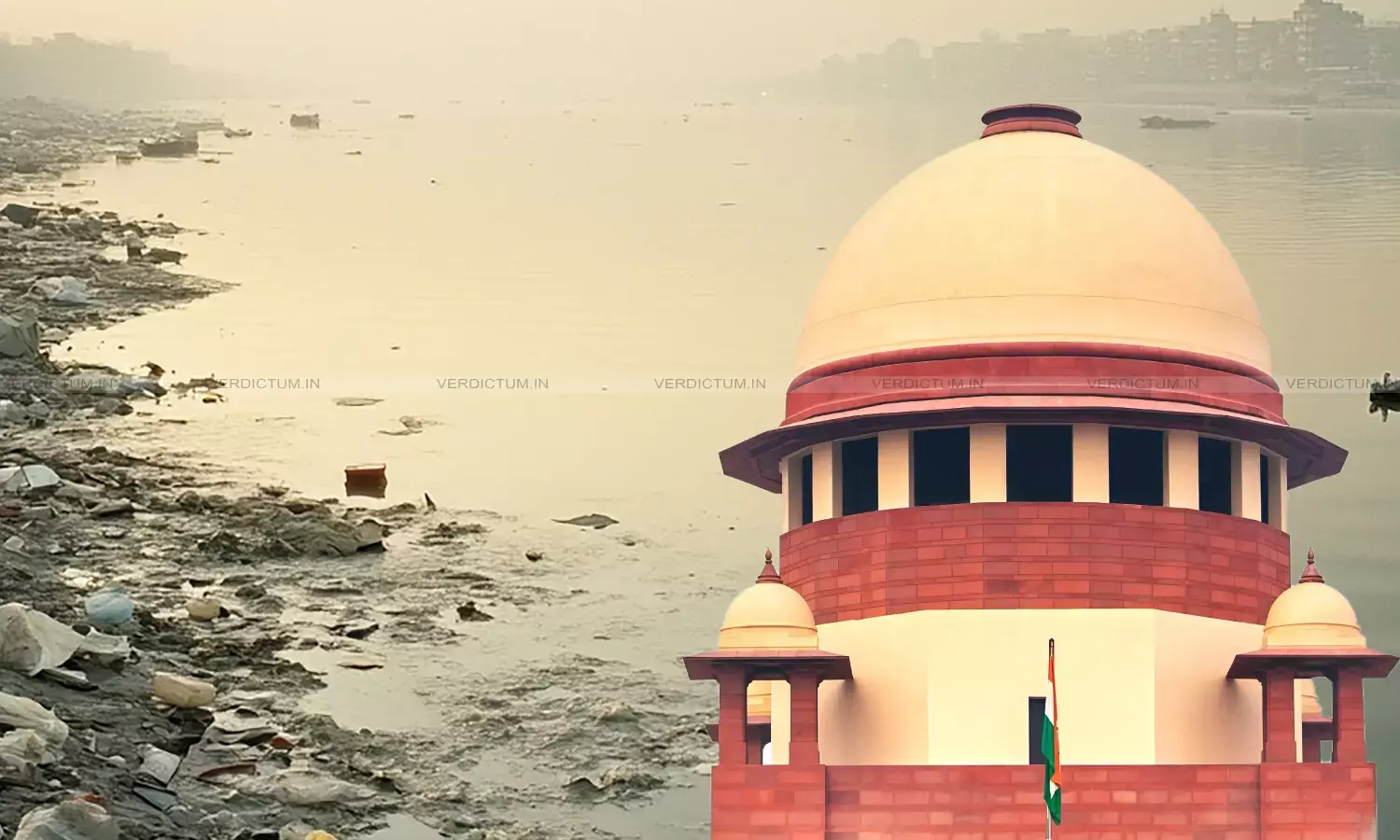
The Supreme Court has directed that if the water quality of the Yamuna deteriorates on any parameter while flowing through or exiting a State, Union Territory or district, that State, UT or district shall be held accountable and penalised, with the fine to be deposited with the Registry of the Court.
The Court said it proposed to lay down a broad test and levy fines on States and UTs that fail in their duty to check pollution of the Yamuna, “whether through inefficiency or for lack of the political will to take hard decisions.” It said this approach would put an end to the defence of “passing the buck”.
The Court also issued directions on real-time monitoring of Sewage Treatment Plants (STPs) and Common Effluent Treatment Plants (CETPs). It observed that Zone ‘O’ under the Delhi Master Plan 2047 should be protected as a ‘Green’ Zone and extended along the river, if feasible.
The Bench of Justice Manoj Misra and Justice Manmohan observed, “If the water quality deteriorates on any parameter while flowing through, or exiting a State/Union Territory or a District therein, then that State/Union Territory or District within the State/Union Territory shall be held accountable and penalised. The said compensation/ fine shall be deposited with the Registry of this Court. The Central Pollution Control Board to suggest formula for computation of fine/compensation. The States/Union Territories shall be at liberty to recover such fines, after holding an inquiry, from the polluter as well as officials who were remiss in performing their duties.”
Additional Solicitors General S.V. Raju, Anil Kaushik and Aishwarya Bhati appeared in the matter, along with Senior Additional Advocate General Lokesh Sinhal.
Brief Facts
Previously, the Court had noted that encroachment on the Yamuna riverbed, toxic effluents from illegal industries and untreated sewage had reduced the river “to little more than a sewage channel.” It had constituted a Committee headed by the Union Home Secretary, comprising the Chief Secretaries of the States and UTs through which the Yamuna flows, to prepare a comprehensive Yamuna Action Plan.
The Committee submitted the Plan, and the Court received a detailed presentation of it on October 07, 2026. Among other things, the Plan proposes 125 new STPs, the upgrading of 20 existing STPs, the interception of 520 drains discharging about 9,666.81 MLD of wastewater into the Yamuna and its tributaries, 12 new CETPs, 23 biogas plants and the restoration of 270 water bodies.
Observations/Findings of the Court
The Court found the Plan to be a significant step forward, as it identifies domestic sewage as the single largest source of pollution in the river. However, it pointed out contradictions in the draft. The Plan does not propose removal of encroachments on water bodies and wetlands along Zone ‘O’ on the ground that they are free of encroachments, yet an annexure prepared by the NCT of Delhi marks all 35 water bodies and wetlands in Zone ‘O’ as encroached. Similarly, the Plan states that 28 of Delhi’s 37 STPs meet the CPCB standards, while the CPCB’s own report states that none meets all the prescribed standards.
The Court observed that “everything that is wrong with civic administration in the towns, cities and villages situated along the banks of the river is reflected in the poor health of the river and in the 520 (five hundred twenty) drains”, which is why pollution in the Yamuna has only increased despite huge sums being spent on cleaning it.
On unauthorised settlements, the Court observed, “unless illegal and unauthorised colonies, JJ clusters on the drains as well as on the river bed are removed after rehabilitating their occupants, their sewage will continue to pollute the river at the source.”
On Zone ‘O’, the Court said no permanent structure, except green parks and essential public infrastructure, should be allowed in future, and that existing structures should be removed in accordance with law after allotting alternative accommodation to occupants who are entitled to it. It remarked, “After all, the river Yamuna must have space to meander and change its course, if it so chooses.”
Invoking the doctrine of Common but Differentiated Responsibilities (CBDR), set out in Principle 7 of the Rio Declaration, 1992, the Court observed, “The principle should not be understood as permission to simply divide the river into separate State-wise segments, with each State answerable only for the water within its own borders and indifferent to what happens once it crosses into the next State.”
It added that each State’s obligation can be calibrated to its contribution and capacity, “For instance, by requiring that the quality of the river water leaving a State cannot be worse than the quality at which it entered.”
Relying on the River Ganga (Rejuvenation, Protection and Management) Authorities Order, 2016, under which the Ganga is to be managed as a single system, the Court held that the principle extends with equal force to the Yamuna, being one of the Ganga’s principal tributaries.
Acknowledging that it is “neither a city planner nor an expert body”, the Court said it would give administrators the power and flexibility to do their jobs while holding them accountable if they fail to achieve results.
Accordingly, the Court issued directions, including:
1. The CPCB shall place before the Court the water quality, including BOD, COD, fecal coliform and TSS, at the points where the Yamuna and major drains enter and exit each State, UT and district.
2. The CPCB shall investigate and report on any pollution incident, such as fish deaths, white foam, algal bloom or spikes in pollution levels, along with its cause and the remedial measures needed.
3. Every STP, CETP and Government-commissioned biogas plant shall install tamper-proof smart energy meters within one month. STPs and CETPs shall also install inflow and outflow meters with continuous sensors, and all readings shall be uploaded live, plant-wise, on the CPCB and State Pollution Control Board websites.
4. Any break in the data feed exceeding 24 hours shall be presumed to be non-operation of the plant, unless the operator proves otherwise.
5. The CPCB shall cause unannounced quarterly sampling of every STP of 5 MLD or more and every CETP through IITs, NITs or accredited laboratories, and recover environmental compensation from the operator for each day of non-compliance.
6. Urban local bodies shall register all septage tankers and install GPS tracking in each.
7. Police and District Magistrates shall provide magisterial and armed police assistance to CPCB inspection teams on requisition. The Chief Secretaries and the concerned Central Ministries shall each nominate a Nodal Officer not below the rank of Special Secretary within two weeks.
8. The officer in charge of each plant and major drain shall be named on the portal and shall file a monthly compliance affidavit before the Court.
The matter was accordingly listed for a further date.
Cause Title: New Okhla Industrial Development Authority v. State of Uttar Pradesh & Ors. [Civil Appeal Nos. 8547-8548/2022]
Appearances:
Appellants: Additional Solicitors General S.V. Raju and Anil Kaushik, AOR Sandeepan Pathak, AOR Rajinder Singh and other Advocates.
Respondents: Additional Solicitor General Aishwarya Bhati, Senior Additional Advocate General Lokesh Sinhal, along with Advocates-on-Record and Advocates for various respondents.