Distribution Licence Cannot Continue In Perpetuity; Deemed Licensee Gets No Fresh 25-Year Term From Electricity Act Commencement: Supreme Court
The Court permitted the company’s licence to continue until June 9, 2029, as an interim measure while examining the Electricity (Amendment) Rules, 2023, after hearing the Union Government.
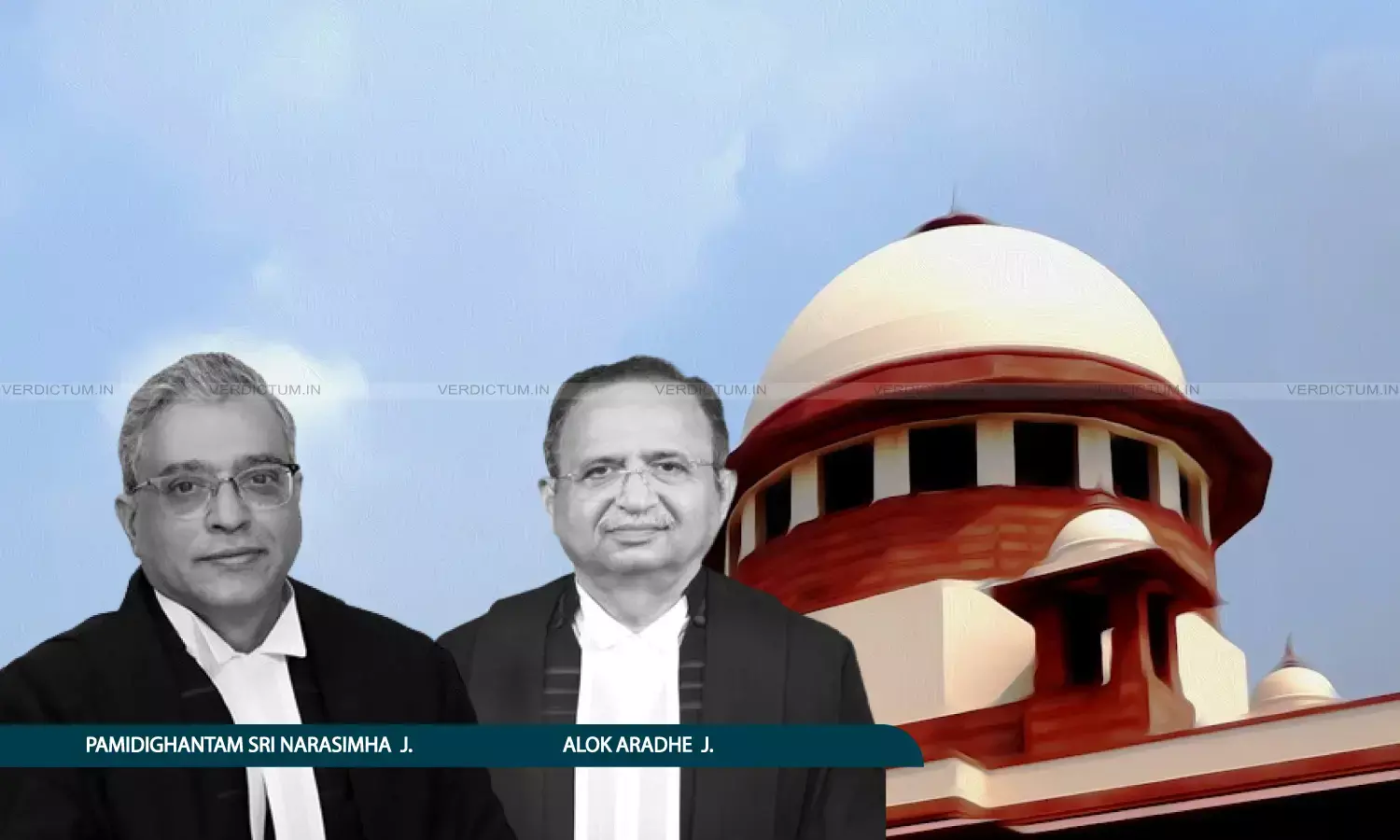
Justice Pamidighantam Sri Narasimha and Justice Alok Aradhe, Supreme Court
The Supreme Court has held that an electricity distribution licence cannot continue perpetually until revoked. It further held that a deemed licensee is not entitled to a fresh 25-year term from the commencement of the Electricity Act, 2003, upon the expiry of the licence’s original tenure.
The Court was hearing appeals filed by the State of Uttar Pradesh and an electricity consumer against a decision of the Appellate Tribunal for Electricity. The Tribunal had held that Noida Power Company Limited’s original licence was followed by a one-year transitional period after the 2003 Act came into force and a fresh 25-year term thereafter, extending its licence until June 9, 2029.
A Bench of Justice Pamidighantam Sri Narasimha and Justice Alok Aradhe observed: “Sections 15(8) of the 2003 Act, which provides that, ‘a licence shall continue to be in force for a period of twenty-five years unless such licence is revoked’, cannot be interpreted to mean that a licence once granted shall continue in perpetuity till revoked. Neither the plain text, the context, nor the intendment of the legislation permits such an interpretation. Equally, there is no scope for holding that upon the expiry of the original period of the licence under the 2003 Act, a deemed licensee shall be entitled to a fresh term of 25 years from the date of the commencement of the Act.”
Background
Noida Power Company Limited obtained an electricity distribution licence under the Electricity Act, 1910, for 30 years with effect from August 30, 1993. Its original term was due to expire on August 30, 2023. The Electricity Act, 2003, came into force during the subsistence of that licence.
The Uttar Pradesh Electricity Regulatory Commission subsequently passed several tariff orders recognising the 2023 expiry date. When the company submitted its business plan for the financial years 2020-21 to 2024-25, the Commission approved it only until the licence’s expiry and restrained the company from entering into medium-term or long-term power-purchase agreements extending beyond that date.
The company challenged that order before the Appellate Tribunal for Electricity. While the appeal was pending, the Commission invited expressions of interest for granting a fresh distribution licence for the area served by the company. The Tribunal stayed further action on that process.
The Tribunal eventually rejected the company’s claim that its deemed licence continued perpetually until revoked. However, it held that the company received a one-year transitional period from the commencement of the 2003 Act, followed by a fresh 25-year term under Section 15(8) of the Act. On that interpretation, the licence would remain valid until June 9, 2029.
Court’s Observation
Deemed Licence Retains Original Tenure
The Court explained that the first proviso to Section 14 of the Electricity Act, 2003, treats a licence subsisting under the repealed law as a deemed licence only for the period stipulated in the original licence, clearance or approval. The provisions of the former law continue for one year, or for an earlier period fixed by the appropriate commission at the licensee’s request, after which the 2003 Act governs the business.
The Court held that the 2003 Act contains no express provision extending or renewing a subsisting licence. Once either a deemed licence or a licence granted under the 2003 Act expires, a fresh licence must be obtained through the procedure prescribed in Sections 14, 15 and 16 of the Act.
The Court observed: “Except in cases where the Appropriate Government transmits, distributes or trades in electricity or in respect of the Damodar Valley Corporation, every other licence that expires, whether a deemed licence or a licence under the 2003 Act, is required to abide by the procedure contemplated under Part IV of the 2003 Act.”
Periodic Licensing Protects Competition And Consumers
The Court explained that the 25-year tenure enables the appropriate commission to reassess a utility’s performance before deciding whether to grant a fresh licence. Such scrutiny advances the development of the electricity sector and protects consumer interests.
It further said that allowing a perpetual licence or a virtual monopoly in a licensed area would be inconsistent with the regulated development of the energy sector. When the original term expires, competing applicants may be considered so that the commission can select the most eligible licensee.
The Court observed: “Private enterprise’s performance capabilities evolve and strengthen in an atmosphere of healthy competition. This is evident from the preambular objective of the 2003 Act, which reads, ‘The Act…generally for taking measures conducive to development of electricity industry, promoting competition therein…’”
2023 Rules Require Further Examination
The Court then considered Rules 4A, 4B and 4C inserted through the Electricity (Amendment) Rules, 2023. Rule 4B states that a deemed licence under specified provisos to Section 14 of the Electricity Act, 2003, remains valid for 25 years from the commencement of the Act, while Rule 4C provides for deemed renewal unless the licence is revoked.
The Court said that the Union Government’s understanding reflected in those Rules did not align with its interpretation of the parent Act. However, the Rules had not been directly challenged, and the Union Government had not been heard on their validity. The Court therefore refrained from deciding their legality at this stage.
The Court clarified that interpreting legislation is the judiciary’s exclusive function. Subordinate legislation may assist in construing an ambiguous parent enactment, but it cannot control the statute’s meaning or displace an interpretation supported by its text, scheme and purpose.
The Court observed: “Subordinate legislation, by itself, does not determine or control the meaning of the primary statute. It can only be an aid to supplement or corroborate a meaning that a constitutional court would have found on the basis of other interpretative criteria.”
Conclusion
The Court allowed the appeals in part and set aside the Appellate Tribunal for Electricity’s decision. It directed that the Union Government, through the Ministry of Power, be impleaded and served with the appeals so that it could assist the Court on the 2023 Rules.
Since the Rules came into force before the original licence expired and remain operative, the Court permitted Noida Power Company Limited’s licence to continue until June 9, 2029, as an interim measure. It directed that the appeals be listed on December 14, 2026.
Cause Title: State of Uttar Pradesh v. Noida Power Company Limited and Another, connected matters (Neutral Citation: 2026 INSC 1286)