

Sanction To Prosecute Public Servant Can’t Rest On Political Dictate: Supreme Court
The Apex Court dismissed the State’s challenge to a High Court order quashing the sanction for prosecution in a corruption case, holding that where the sanctioning authority itself had serious doubts about the demand, the sanction could not be granted on the same material after reconsideration.
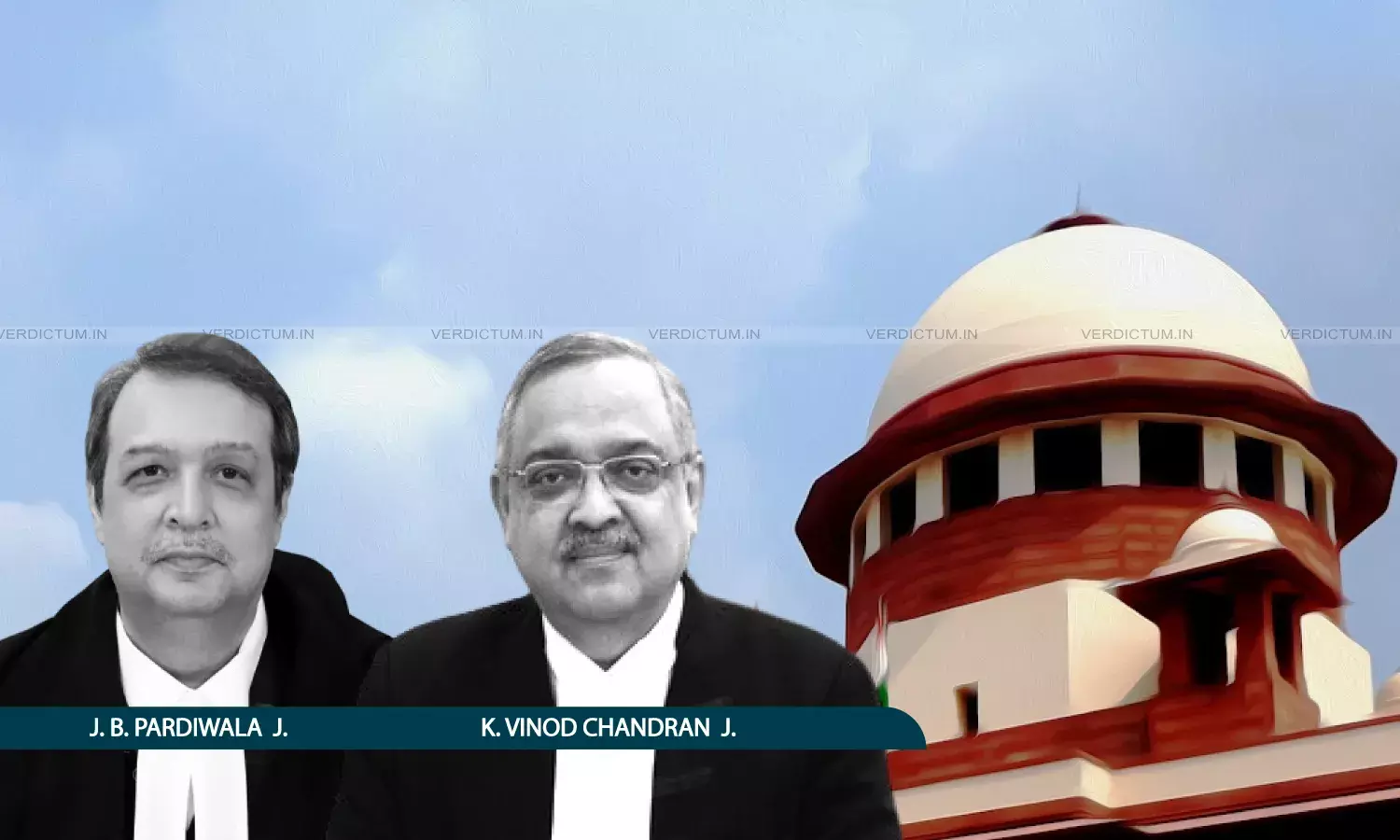
Justice J. B. Pardiwala, Justice K. Vinod Chandran, Supreme Court
The Supreme Court has held that a sanction to prosecute a public servant under the Prevention of Corruption Act cannot rest on a political dictate, while imposing costs in a bribery case where reconsideration of an earlier refusal to grant a sanction was prompted by the Rajasthan Chief Minister’s Office, despite no fresh material.
The Court was hearing the State of Rajasthan’s special leave petition against a Rajasthan High Court order quashing the sanction for prosecution granted against a public servant in a bribery case under the Prevention of Corruption Act, 1988.
A Bench of Justice J.B. Pardiwala and Justice K. Vinod Chandran, at the outset, remarked: “The decision-making process under Section 19 of the Prevention of Corruption Act, 1988 cannot resemble the dilemma in ‘Hamlet’s Soliloquy’: ‘to be or not to be’, though expressed in a different context. If there is ambivalence, it could be presumed that extraneous considerations weighed and here is a case where political dictate is blatantly displayed.”
The Bench further observed: “We cannot but observe that the petitioner has been dragged unnecessarily to the High Court by the review, prompted by the office of the CM. The State at least should have rested content, when the highest Constitutional Court within its boundaries, interfered with a patently illegal and blatantly tainted order of sanction.”
Advocate Nidhi Jaswal appeared for the State, while Senior Advocate Siddharth Dave appeared for the public servant.
Background
The case arose from allegations that a public servant had demanded money in connection with a patient’s knee surgery. The prosecution's case was that a trap was laid and money was recovered from a locked drawer at the officer’s official residence.
The State’s own Department of Personnel initially found serious doubt in the allegations. It noted that the phone transcript did not clearly establish receipt of a bribe, that the amount discussed appeared linked to the cost of steel plates for surgery, and that the alleged recovery from a locked drawer after breaking it open was suspicious.
The Chief Secretary initially declined sanction. However, the matter was later sent back for reconsideration from the office of the Chief Minister without any fresh material. The Department of Personnel again maintained that a sanction was not warranted, but a sanction was ultimately granted.
The High Court set aside the sanction, after which the State approached the Supreme Court.
Court’s Observations
At the outset, the Supreme Court sharply criticised the decision-making process under Section 19 of the Prevention of Corruption Act. The Court noted that the sanction was first declined and later granted without any new material.
The Court referred to the internal recommendations which had found that the demand of bribe was not clearly established and that the recovery itself raised suspicion.
The Court noted: “It was categorically found that a review reveals no explicit demand having been made and the recovery of the bribe from the drawer after breaking it open clearly raises a suspicion regarding the alleged receipt and recovery of bribe money.”
The Court further remarked: “If the administrative authority itself expresses a doubt and suspicion regarding the demand of bribe, the trap laid and the recovery of the money there is no question of a sanction being granted, since it is a very reasonable and valid doubt.”
The Court also recorded that the surgery had already been completed on the previous day, making the alleged receipt of a bribe on the next day suspicious.
Upon examining the facts of the matter, the Court stated: “In the present case even on preponderance of possibilities, there arise a case of victimization; which we notice only to emphasize that, in considering a sanction for prosecution the standard should be of a possibility of bringing home the guilt of the delinquent, beyond reasonable doubt, a tad higher than mere preponderance of probabilities but surely not to the extent of finding concrete proof beyond reasonable doubt, which is the function of the jurisdictional court.”
The Supreme Court relied on Mansukhlal Vithaldas Chauhan v. State of Gujarat (1997), State of Punjab v. Mohd. Iqbal Bhatti (2009), State of H.P. v. Nishant Sareen (2010), and Gopikant Choudhary v. State of Bihar (2000).
The Court underscored that a sanction is meant to protect innocent public servants from frivolous prosecution, not to shield the guilty. Referring to the law on reconsideration, the Court held that a mere change of opinion on the same material cannot justify review of an earlier refusal to sanction prosecution.
The Court observed: “A mere change of opinion per se on the same materials cannot be a ground for review or reconsideration of an earlier order, refusing to grant sanction, … A caveat was also made that, on the basis of fresh materials collected by the investigating agency, there could be a review of refusal to sanction, when there is a proper application of mind on the fresh materials which were not available at the earlier instance”.
The Court found that the reconsideration was prompted by the Chief Minister’s office despite the absence of new material.
The Bench stated: “The facts in the instant case also bring us to the very same conclusion. The impugned order specifically notices Mansukhlal Vithaldas Chauhan which cautioned the sanctioning authority from acting under any pressure or external force swaying its decision one way or the other.”
The Court accordingly concluded: “We find absolutely no reason to interfere with the impugned order, and we deprecate such instances bringing out interference leading to unnecessary harassment of public officers discharging public duties; which is sought to be avoided by Section 19 of the Prevention of Corruption Act.”
Conclusion
The Supreme Court dismissed the State’s special leave petition and directed Rajasthan to pay costs of ₹50,000 each before the High Court and the Supreme Court within two months.
The petition and pending applications were accordingly disposed of.
Cause Title: State of Rajasthan & Others v. Dev Kant Meena (2026 INSC 752)
Appearances
Petitioners: Advocate Nidhi Jaswal, with Saurabh Rajpal (AOR)
Respondent: Senior Advocate Siddharth Dave, with Namit Saxena (AOR), Advocates Awnish Maithani, Shruti Singh and Yusuf Tariq
