

Assault Or Intimidation Of Doctors On Duty Cannot Be Tolerated: Supreme Court Cancels Bail Of Corporator, Three Co-Accused
The Bench held that the fear caused among the victim doctors, including their decision to tender resignations, was directly relevant to assessing intimidation and entitlement to bail.
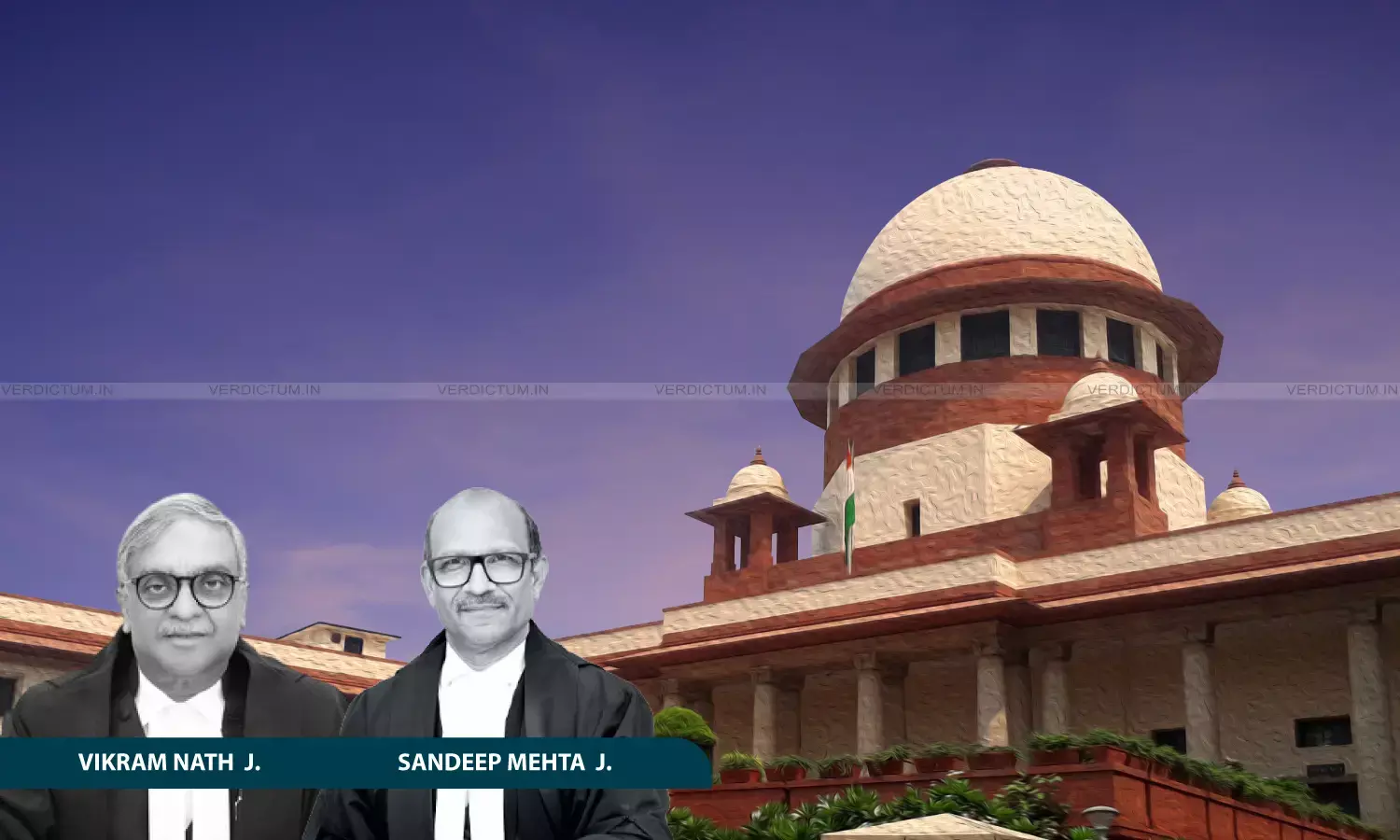
Justice Vikram Nath, Justice Sandeep Mehta, Supreme Court
The Supreme Court has held that any attempt to intimidate or assault medical professionals while they discharge duties in the interest of public health cannot be tolerated, particularly when the alleged conduct is attributed to a person holding elected office.
The Court cancelled the bail granted to a municipal Corporator and three co-accused in a case concerning the alleged assault and intimidation of doctors at a municipal hospital. It found that the High Court had failed to adequately consider the accused’s antecedents, alleged influence and the incident’s effect upon the medical fraternity.
The Court was hearing the State of Maharashtra’s appeal against a Bombay High Court order restoring the Magistrate’s orders granting bail to the accused, subject to conditions, in suo motu proceedings arising from the alleged hospital incident.
A Bench of Justice Vikram Nath and Justice Sandeep Mehta observed: “Any attempt to intimate or assault medical professionals, while discharging duties entrusted to them in the interest of public health, cannot be tolerated.”
The Bench further observed: “The material on record indicates that the incident had caused such fear and apprehension amongst the victim doctors that they were constrained to tender their resignations. This circumstance was not merely incidental to the individual allegations; it was directly relevant to the apprehension of intimidation and the ability of medical professionals to discharge their duties without fear or insecurity. The effect of the prejudicial conduct of the accused upon the functioning of the healthcare institution and the confidence of medical professionals, therefore, warranted due consideration while exercising discretion in the matter of bail.”
Shrirang B. Varma, Advocate, appeared for the State. Siddharth Dave, Senior Advocate, represented the first accused, while Shubham Saigal, Advocate, appeared for the other accused.
Background
The prosecution alleged that an elected Corporator led three other accused in assaulting and verbally abusing three doctors, including a woman doctor, who were on duty in the labour ward of a municipal hospital. The incident allegedly arose from a dispute concerning the shifting of a pregnant patient in labour. The Corporator was also accused of threatening the informant-doctor, resulting in delayed reporting of the incident.
The Magistrate granted bail to the Corporator and subsequently released the remaining accused on parity. Following public concern over the incident, the Bombay High Court initiated suo motu proceedings, stayed the bail orders and directed the Corporator to surrender. It also transferred the investigation to a Deputy Commissioner of Police and directed that the victim doctors’ resignations not be accepted.
The High Court later restored the bail orders subject to conditions requiring the accused to remain outside Maharashtra until commencement of the trial, report regularly to a police station in Goa, surrender their passports and refrain from contacting witnesses. It also directed that the matter be tried by a Special Judge on a fast-track basis.
The State argued that the High Court’s later order was inconsistent with its earlier prima facie conclusion that the Magistrate’s bail orders suffered from serious infirmities. It contended that the High Court had overlooked the gravity of the allegations, the Corporator’s antecedents, the apprehension of witness intimidation and the limited custody of approximately 27 days.
The informant submitted that the alleged threats extended to him had not received due consideration. The Indian Medical Association highlighted the fear caused among doctors and hospital staff, the victim doctors’ withdrawal from duty, the statutory consequences applicable to misconduct by a municipal councillor and a subsequent incident involving alleged assault upon hospital staff.
The accused disputed the allegations as false and exaggerated by media attention. They submitted that the injuries were simple, the alleged offences carried a maximum sentence of five years and the proposed examination of 64 witnesses would prolong the trial. The Corporator also submitted that he had been acquitted or discharged in 16 of the 17-18 cases cited as his antecedents.
Court’s Observations
Violence Against Doctors Affects Delivery Of Medical Care
The Court observed that the relationship between doctors and patients is founded upon trust and concerns human life, dignity and the alleviation of suffering. It noted that doctors, particularly during emergencies, must make immediate decisions and exercise independent professional judgment with composure.
The Bench held that a secure working environment is not a personal privilege of medical professionals but a safeguard serving the larger public interest. It nevertheless clarified that doctors remain accountable and that patients may question treatment, complain of negligence and pursue remedies available in law.
The Court stated: “A grievance, however genuine, does not confer a licence to resort to violence. To permit such conduct would not merely imperil the individual doctor. It would undermine the very conditions in which medical professionals are required to make decisions upon which the life and health of patients may depend.”
The Court observed that fear or insecurity within a healthcare institution may impair the safe and effective delivery of medical care beyond the individual doctors directly affected by the incident.
The Bench explained: “Those entrusted with protecting the health of others cannot themselves be placed in a position where they are compelled to discharge their professional responsibilities under fear, intimidation or apprehension.”
Elected Representatives Cannot Use Public Office To Intimidate
The Court observed that electoral power remains subject to the discipline of law. It expressed concern over elected representatives treating a democratic mandate as a source of personal authority to command, intimidate or enforce their will.
The Bench stated: “An elected representative is entrusted with the responsibility of serving the public and strengthening the institutions through which grievances are addressed, and justice is administered. He/She cannot supplant those institutions by assuming the role of the police, the administrator or the Court.”
The Court held that an elected representative bears a heightened responsibility to uphold the law and reinforce public confidence in institutions. It observed that alleged violence against medical professionals by a person holding elected office was particularly grave because it endangered healthcare workers and undermined the responsibilities attached to public office.
The Bench further observed: “The authority derived from the electoral mandate cannot be permitted to become a substitute for the authority of law. No person, howsoever high the office held, can claim supremacy over the discipline of law.”
The Court added that public authority derives its legitimacy from remaining within the bounds of law and serving the nation, rather than from the ability to command others.
High Court Gave No Cogent Reason For Reversing Its Prima Facie View
The Court found that the Bombay High Court’s two orders adopted irreconcilable approaches to considerations central to the bail decision. Its earlier order had stayed the Magistrate’s bail orders after prima facie considering the nature of the allegations and the alleged assault upon doctors discharging their duties.
The Bench noted that the later order restored bail principally because the accused had furnished residential details outside Maharashtra, undergone a period of custody, and because the investigation and forensic analysis had substantially progressed. It found no intervening circumstance explaining why the considerations underlying the earlier order had ceased to operate.
The Court observed: “The mere passage of time in custody, progress in investigation or the anticipated completion of forensic analysis, without anything further, does not explain how the circumstances which had earlier weighed with the High Court had ceased to operate or had otherwise lost their significance.”
The Bench held that once the High Court had found sufficient prima facie grounds to stay the bail orders and direct the Corporator’s surrender, any subsequent departure required cogent and discernible reasons. It found that the impugned order lacked such an assessment.
Antecedents, Influence And Intimidation Were Material To Bail
The Court observed that criminal antecedents are material to the exercise of bail discretion, particularly where they may indicate repeated criminal involvement, possible interference with justice or intimidation of witnesses.
The Bench relied upon Ash Mohammad v. Shiv Raj Singh and Another (2012), which required courts to consider the totality of circumstances and an accused’s antecedents alongside the period of custody and individual liberty.
The Court stated: “In the case of habitual offenders, such antecedents constitute a material circumstance which cannot be disregarded while exercising judicial discretion in the matter of bail.”
The Court acknowledged that the Corporator had obtained acquittal or discharge in 16 criminal proceedings. It nevertheless observed that the nature of the allegations and the surrounding circumstances remained relevant, particularly when material witnesses were required to testify against him.
The Bench also expressed concern that the Corporator had remained admitted to a hospital throughout his police and judicial custody and sought discharge immediately after issuance of the release order. It found that this conduct raised concern about whether the influence attached to his position had been used to circumvent effective custody.
The Court held that the bail granted to the three co-accused was substantially based upon parity with the Corporator. Once the basis of his bail was found unsustainable, the remaining accused could not claim an independent entitlement to bail solely on parity.
Preventive Detention And Witness Protection
The Court directed the State Government to independently examine, in accordance with law, whether the applicable preventive-detention provisions were attracted. It clarified that the competent authority must assess the issue on its merits and satisfy the governing statutory requirements.
The Bench stated: “The competent authority shall independently examine the matter on its own merits, having due regard to the statutory requirements governing preventive detention and the material circumstances bearing upon the necessity for such action, so as to instil a sense of security and confidence amongst the medical fraternity and to ensure that medical professionals are able to discharge their duties without fear or apprehension.”
The Court further directed the Trial Court to ensure adequate protection for all material witnesses throughout the trial. Referring to Section 9 of the Maharashtra Witness Protection and Security Act, 2017, and Mahender Chawla and Others v. Union of India and Others (2019), it directed the Trial Court to remain vigilant against threats, intimidation or coercion and order suitable protection wherever necessary.
The Bench clarified that its observations did not sanction negligence or dereliction of duty by medical professionals. It stated that any such conduct must be addressed under the applicable law and guidelines.
Conclusion
The Supreme Court allowed the State’s appeal and set aside the Bombay High Court’s order insofar as it restored bail to the four accused. Their bail was cancelled, and they were directed to surrender before the Trial Court by October 5, 2026. In case of failure, the Trial Court was permitted to cancel their bail bonds and secure their custody.
The Court clarified that the accused could renew their bail applications before the appropriate forum if there was a material change in circumstances.
The remaining directions issued by the High Court were preserved, except its direction requiring completion of the trial within three months of framing charges. The Supreme Court directed the Special Fast Track Court to endeavour to conclude the trial within six months from presentation of its order.
The prosecution was directed to assess its witness list and, wherever legally permissible, dispense with witnesses whose evidence was not essential, without compromising the fairness of the trial.
Cause Title: State of Maharashtra v. Ramesh Sukrya Mhatre & Ors. (Neutral Citation: 2026 INSC 1075)
Appearances
Appellant: Shrirang B. Varma, Siddharth Dharmadhikari and Harshavardhan V. Ghadge, Advocates; Aaditya Aniruddha Pande, Advocate-on-Record
Respondents: Siddharth Dave, Senior Advocate; Chirag J. Shah, Utsav Trivedi, Sameer Nangare, Anudatt Dubey, Shubh Jain and Nayan Dham, Advocates; M/s TAS Law, Advocate-on-Record; Shubham Saigal, Advocate-on-Record; Siddharth Jain, Shruti Priya Mishra, Bhavika Mehta and Ishani Kaushik, Advocates; Rajeev Kumar Panday, Ayush Gupta, Saumya Saraswat, Astha Agrawal, Shailendra Kumar, Vikas Bansal, K.K. Sinha and Abhinay Ravindra Adsul, Advocates; Vivek Singh, Advocate-on-Record; Prabhas Bajaj, Advocate-on-Record; Priyanshu Tyagi, Harsh Chauhan, Rithvik Mathur, Rishabh Yadav and Priyanka Bhatt, Advocates; Sandeep Sudhakar Deshmukh, Advocate-on-Record; Nishant Sharma, Ankur Savadikar and Kartik Sharma, Advocates
