

Acquittal Strengthens Presumption Of Innocence, Shouldn't Be Interfered With Merely Because Another View Is Possible: Supreme Court
The Supreme Court was considering an appeal of the State in a murder case.

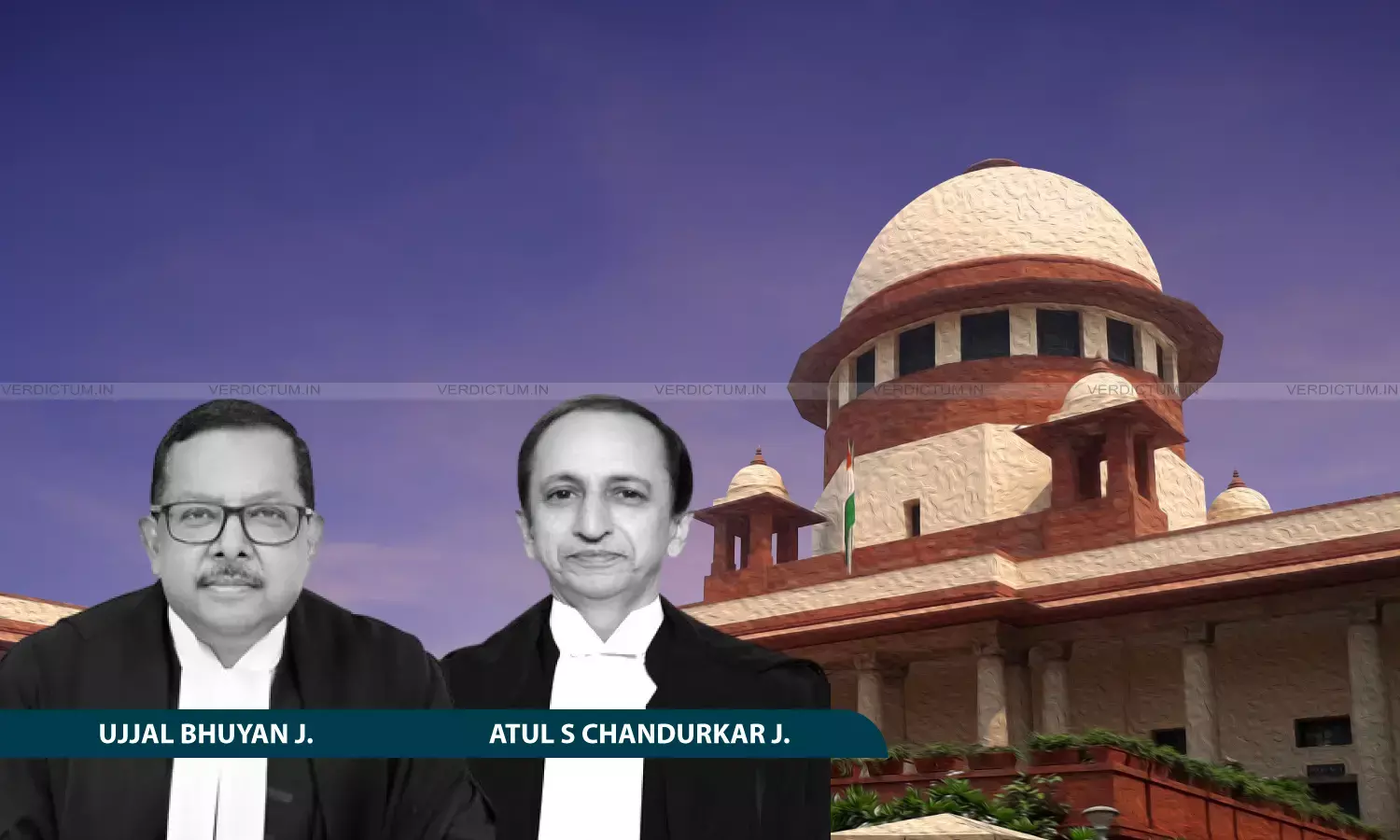
While dismissing an appeal filed by the State in a murder case, the Supreme Court has held that an order of acquittal adds strength to the presumption of innocence and interference may not be warranted merely because another view of the matter is possible.
The Apex Court was considering an appeal where the State claimed that, merely on the ground that there were minor inconsistencies and contradictions in the depositions of eyewitnesses, the respondent was acquitted.
Delving into the law relating to the scope for interference in an appeal against an order of acquittal, the Division Bench of Justice Ujjal Bhuyan and Justice Atul S. Chandurkar stated, “The scope for interference by the Court in an appeal challenging an order of acquittal is circumscribed by the aspect as to whether the findings recorded in the judgment of acquittal are perverse or based on material that is not available on record resulting in a conclusion that is whole untenable. However, if the appellate Court on a re-appreciation of evidence has granted the benefit of doubt to the accused or has found the evidence on record insufficient to maintain the conviction, then merely because another view of the matter is possible, interference may not be warranted. An order of acquittal rather adds strength to the presumption of innocence.”
Factual Background
The respondent-Moti Ram along with one Man Singh faced trial for the offence punishable under Section 302 read with Section 34 of the Indian Penal Code, 1860 on the allegation that they had committed the murder of one Beli Ram in 2012. According to the case of the prosecution, Bir Singh had invited two deities at his house and when some persons were singing songs, Man Singh came there and warned those singing religious songs to stop the same. The second accused had an altercation with Beli Ram, a devotee. It was alleged that Beli Ram was dragged out of the room. The first accused, who was carrying a knife in his hand, stabbed him in his chest. As a result, Beli Ram fell down and later succumbed to his injuries.
The Sessions Court convicted them and sentenced them to suffer life imprisonment for the offence punishable under Section 302 read with Section 34. The respondent alone challenged his conviction by preferring an appeal before the Himachal Pradesh High Court. The High Court allowed the appeal and acquitted the respondent of the offence with which he was charged. Aggrieved thereby, the State of Himachal Pradesh preferred the appeal challenging his acquittal.
Reasoning
On a perusal of the evidence of the witnesses, the Bench noted that the second accused, Man Singh was the aggregator and the first accused Moti Ram, was not found to have given any threat to anyone. It was further noticed that even though about 10-15 persons had assembled at the place of the incident, none had come forward to stop the scuffle between the accused persons and Beli Ram.
The Bench found that the High Court was of the view that there was a doubt as to whether the knife was the same as the one that was stated to be recovered from the spot, as no fingerprint was found on the knife nor any attempt was made to locate any fingerprints on it. The Bench held that the view taken by the High Court was a possible view which was supported by the material on record and there was no perversity in the appreciation of evidence by the High Court, though the evidence led by the prosecution did raise a doubt about the complicity of the first accused.
Holding that the High Court was justified in acquitting the first accused of the offence with which he was charged, the Apex Court refused to exercise its jurisdiction under Article 136 of the Constitution and dismissed the appeal.
Cause Title: State of Himachal Pradesh v. Moti Ram (Neutral Citation: 2026 INSC 1012)