

Supreme Court Upholds "No Interest" Clause On Security Deposits In Mining Contracts; Interest Payable Only If State Retains Amount Beyond Contractual Refund Period
The Court said that public policy cannot be invoked to invalidate a mutually agreed commercial term accepted by parties with full knowledge.

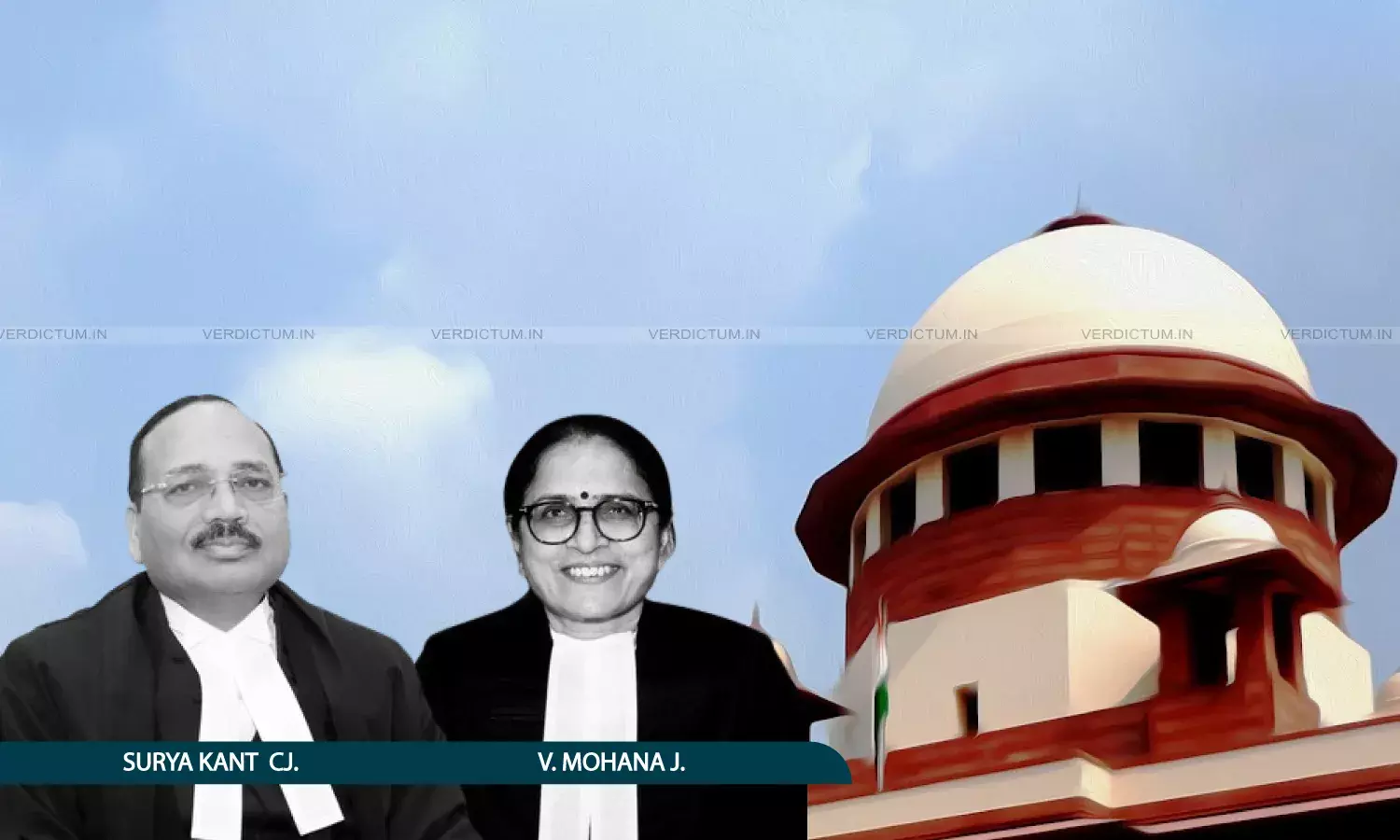
The Supreme Court has upheld the validity of a contractual clause providing that a contractor's security deposit shall not carry interest, holding that writ courts cannot rewrite commercial contracts or invalidate mutually agreed terms merely because one party later considers them onerous.
However, the Court clarified that where the contract also requires the State to refund the security deposit within a specified period after termination, interest becomes payable if the amount is retained beyond that period.
The Bench partly allowed appeals filed by the State of Haryana against a Punjab and Haryana High Court judgment that had declared Clause 19 of Form-L under the Punjab Minor Minerals Concession Rules, 1964 to be unsustainable and directed payment of 9% interest on the contractor's security deposit from the date of its deposit.
A Bench comprising Chief Justice of India Surya Kant and Justice V. Mohana observed, “The High Court fell into error in declaring Clause 19 as unsustainable in law and against public policy. The public policy cannot be pressed into service to set at naught the commercial contract which expressly denies interest on security deposit. Such a stipulation is neither immoral nor unlawful nor can it be classified as unsustainable in the legal sense...Once parties have voluntarily accepted a contract they cannot turn around and assail the same as oppressive after major part of the contract period has gotten over. The reasoning of the High Court that when State charges interest on belated instalment they should pay interest on the security does not stand scrutiny… To reason otherwise and without interpreting the contract as agreed but to add new terms which were not admittedly written therein amounts to rewriting the contract which a Writ Court is not entitled to do…”.
“…The stipulations in Clause 2 and in Clause 19 operate in different fields and they serve different purposes. While Clause 2 provides for…the contractor’s default on the timely payment which is a consequence of the contractor’s own breach, the security deposit in Clause 19 is a performance guarantee held by the State and the parties have clearly agreed that it would carry no interest…”, it noted further
Akshay Amritanshu, AOR appeared for the appellant and Lalita Kaushik, AOR appeared for the respondent.
The dispute arose out of a mining contract awarded to M/s Jai Durgaa Finvest Pvt. Ltd. for extraction of sand from the Bega Murthal Sand Zone. Under the agreement, the contractor deposited a security amount of ₹37 lakh. The contract was terminated on March 9, 2000 after the contractor defaulted in payment of instalments, following which the security deposit was forfeited and later adjusted towards outstanding dues.
The contractor challenged Clause 19 of the agreement, which provided that the security deposit would not carry any interest and would be refunded within three months from the expiry or earlier determination of the contract. The High Court had held the clause to be contrary to public policy and awarded interest from the date of deposit.
Setting aside that finding, the Bench observed that, “…Once the contract is determined then it is the obligation upon the State to refund the security deposit within the period prescribed in the agreement…If the State retains the security deposit beyond three months the Respondent-contractor is entitled for interest which is very clear from a proper reading of Clause 19. While the Clause 19 states that there is no interest from the date of deposit while securing it, once it is determined, the amount cannot be withheld by the State beyond three months as provided in the clause itself”, it noted further.
Rejecting the High Court's reasoning that the State could not charge interest for delayed payments while denying interest on the security deposit, the Court held that the two provisions served distinct purposes. While the clause imposing 24% interest compensated the State for the contractor's default in timely payment, the security deposit functioned as a performance guarantee, and the parties had expressly agreed that it would remain interest-free.
However, the Bench held that Clause 19 had to be read in its entirety, as it observed, “The two limbs of the Clause 19 have to be read together, and they are interdependent. While the first portion states that “it shall not carry any interest” and second portion of the same clause reads that “shall be refunded to the contractor within three months from the date of expiry or sooner determination of the contract.” The correct interpretation of this Clause would mean the Respondent’s deposit will earn no interest and it will be returned to the Respondent within three months of the contract coming to an end or within three months of the termination of the contract…”.
Accordingly, the Court held that although no interest was payable on the security deposit until three months after termination of the contract, the contractor became entitled to simple interest at 9% per annum from June 9, 2000, three months after the contract was terminated, until the date the security amount was adjusted against outstanding dues or refunded.
Cause Title: State Of Haryana & Ors. v. M/S. Jai Durgaa Finvest P. Ltd. (Neutral Citation: 2026 INSC 678)
Appearances:
Appellants: Akshay Amritanshu, AOR, Sarthak Srivastava, Advocate.
Respondents: Lalita Kaushik, AOR.