Do Secured Creditors Under SARFAESI Have Priority Over MPID Depositors? Supreme Court Refers Issue To Three-Judge Bench
The two-Judge Bench expressed the view that secured debts should receive priority, but sought an authoritative ruling from a larger Bench.
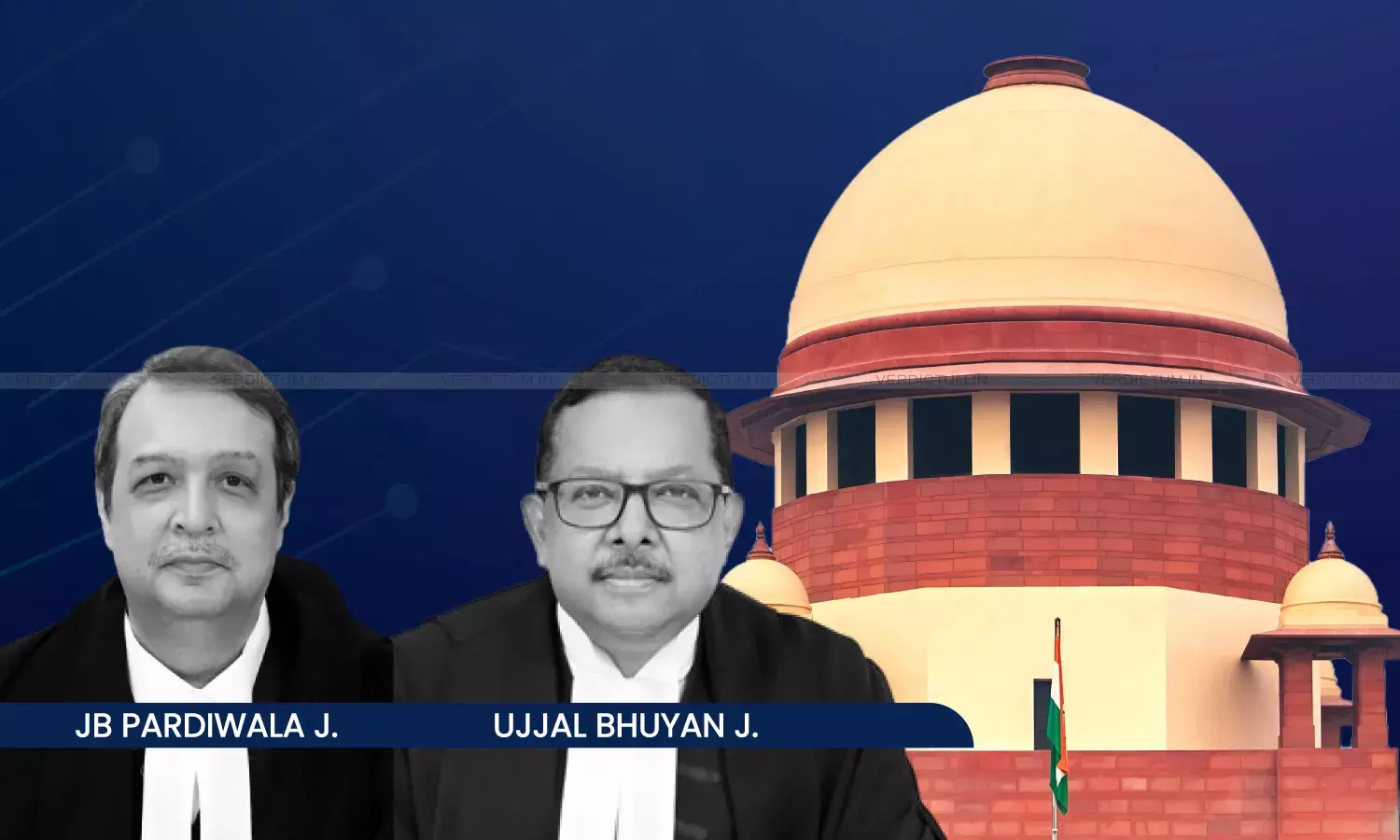
The Supreme Court has referred to a three-Judge Bench the questions of whether deposits recoverable under the Maharashtra Protection of Interest of Depositors (in Financial Establishments) Act, 1999, fall within “all other debts” under Section 26E of the SARFAESI Act; whether SARFAESI recoveries should receive priority; and whether Parliament is the dominant legislative power over the recovery of dues as an essential part of banking.
The Court was hearing State Bank of India's appeal against a Bombay High Court judgment affirming the MPID Designated Court's refusal to permit the bank to appropriate ₹3.5 crore from the proceeds of mortgaged properties sold under the SARFAESI Act. The amount, retained in a fixed deposit, had grown to approximately ₹5.51 crore.
A Bench of Justice J.B. Pardiwala and Justice Ujjal Bhuyan observed: “In view of what has been pointed out hereinabove, we are of the opinion that, for a comprehensive consideration and an authoritative pronouncement after taking into account all aspects, including those dealt with hereinabove, the matter needs to be placed before Hon’ble the Chief Justice of India to constitute an appropriate three-Judge Bench.”
The Bench further observed: “The three-Judge Bench constituted may address itself to the following questions: (i) Whether the “deposits” sought to be recovered under the MPID Act would fall within the ambit of the expression “all other debts” appearing in Section 26E of the SARFAESI Act? (ii) Whether the harmonious construction of the statutory schemes of the SARFAESI Act and the MPID Act indicates that the “recovery of dues” under the former should be given priority over the latter? (iii) Whether it is the Parliament which is the dominant power insofar as the aspect of “recovery of dues” is concerned because the same is essential to the activity of banking which falls within the legislative field of the Union under Entry 45 of List I to the Schedule VII? In other words, whether the SARFAESI Act is the dominant legislation and, as such, would prevail over the MPID Act?”
Senior Advocate Rajiv Shakhder appeared for the appellant bank. Senior Advocate Shayam Mehta appeared for the State of Maharashtra.
Background
The bank extended credit facilities to a company whose promoters mortgaged two properties as security. After the loan account was classified as a non-performing asset, the bank invoked the SARFAESI Act to enforce its security interest.
Maharashtra subsequently initiated proceedings alleging that the company had duped depositors and seized the mortgaged properties under the MPID Act. With permission from the Designated Court, the bank auctioned the properties and received ₹19.43 crore, including delayed-payment interest. The bank was permitted to appropriate ₹15.93 crore, while ₹3.5 crore was retained in a fixed deposit.
The State later attached the properties under the MPID Act. It received claims from 92 depositors aggregating to ₹4 crore and began disbursing money from the fixed-deposit corpus, which had increased to ₹5.51 crore.
The bank sought permission to appropriate the retained principal towards the outstanding loan. The Designated Court rejected the application by relying on National Spot Exchange Limited v. Union of India (2025), which it understood as giving MPID recoveries precedence over SARFAESI claims. The Bombay High Court affirmed that decision and directed transfer of the retained amount and accrued interest to the MPID Competent Authority.
Before the Supreme Court, the bank argued that SARFAESI was a later and dominant parliamentary enactment governing secured assets. Maharashtra maintained that the MPID Act validly protected defrauded depositors, did not trench upon Parliament's banking field and contained its own overriding provisions.
Court's Observations
Simultaneous Recoveries Created A Statutory Conflict
The Bench examined the purposes and recovery mechanisms of both enactments. It found that the MPID Act was intended to protect persons defrauded by financial establishments, while the SARFAESI Act enabled secured creditors to enforce security interests and recover banking dues without ordinary court intervention.
The Court observed: “While both the SARFAESI Act and MPID Act have been legislated competently by the Parliament and the State legislature respectively, yet the incidental overlap as regards ‘recovery’ mechanisms presents a conflict when the two statutes are sought to be implemented simultaneously.”
The Bench held that attachment and vesting under the MPID Act did not extinguish a pre-existing security interest, which continued to run with the property. It identified the central unresolved question as whether secured creditors or MPID depositors should receive priority over the proceeds.
MPID Deposits May Fall Within “All Other Debts”
The Bench examined Section 26E of the SARFAESI Act, which gives secured debts priority over “all other debts” and specified government dues. It reasoned that restricting “all other debts” to banking debts would impermissibly narrow the provision, particularly when it expressly gives secured creditors priority even over non-banking government dues.
The Bench disagreed with NSEL to the extent that it excluded MPID deposits from the expression “all other debts”. It clarified that it agreed that Section 26E priority arose only after registration of the security interest under Section 26D, but considered the interpretation of MPID deposits to require larger-Bench clarification.
The Court observed: “Therefore, with all humility at our command, we disagree with the observation in NSEL (supra) that Section 26E of the SARFAESI Act is inapplicable insofar as the ‘recovery of the deposits’ under the MPID Act is concerned, as the same cannot be said to be ‘debts’ which are covered under Section 26E.”
Bench Favoured SARFAESI Priority But Sought Authoritative Ruling
The Bench expressed the view that harmonious construction favoured secured-debt recovery. It relied on the later enactment of the SARFAESI Act, the priority conferred by Section 26E and the absence of an express first charge for MPID depositors. It also considered speedy recovery by banks material because banks hold public money.
On legislative dominance, the Court observed: “The SARFAESI Act is the dominant legislation insofar as the aspect of ‘recovery of dues’ is concerned. We have said so because ‘recovery of dues’ is essential to the activity of banking, which falls in the legislative field of the Parliament under Entry 45 of List I to the Schedule VII of the Constitution.”
The Bench nevertheless referred these conclusions for authoritative determination because they departed from aspects of the coordinate-Bench decision in NSEL.
Parliament Asked To Clarify Section 26E
The Court noted that the SARFAESI Act did not clarify the competing priorities of secured creditors and MPID beneficiaries, despite being enacted after the State legislation. It said this statutory vacuum had generated repeated litigation.
The Court observed: “Although our final conclusion has been to refer the issue to a larger bench yet we consider it apposite to suggest to the Parliament to bring about an appropriate amendment to Section 26E of the SARFAESI Act whereby an explanation of the expression “all other debts” may be provided authoritatively.”
It urged the Department of Financial Services under the Ministry of Finance to consider the suggestion and initiate the necessary amendment.
Conclusion
The Registry was directed to place the matter before the Chief Justice of India for constituting an appropriate three-Judge Bench. Pending the final resolution, Maharashtra was restrained from transferring, utilising, appropriating or disbursing ₹5,51,59,816. Copies of the judgment were directed to be forwarded to the Principal Secretary, Ministry of Finance, and the Attorney General for India.
Cause Title: State Bank of India v. State of Maharashtra and Others (Neutral Citation: 2026 INSC 1279)