

Default Occurs At A Singular Point In Time: Supreme Court Holds Claim U/S 9 IBC Time-Barred Despite Subsisting EPC Contract
While quashing claim against Power Project, the Bench noted that default occurs when non-payment crystallizes, subsisting contract doesn't extend limitation.

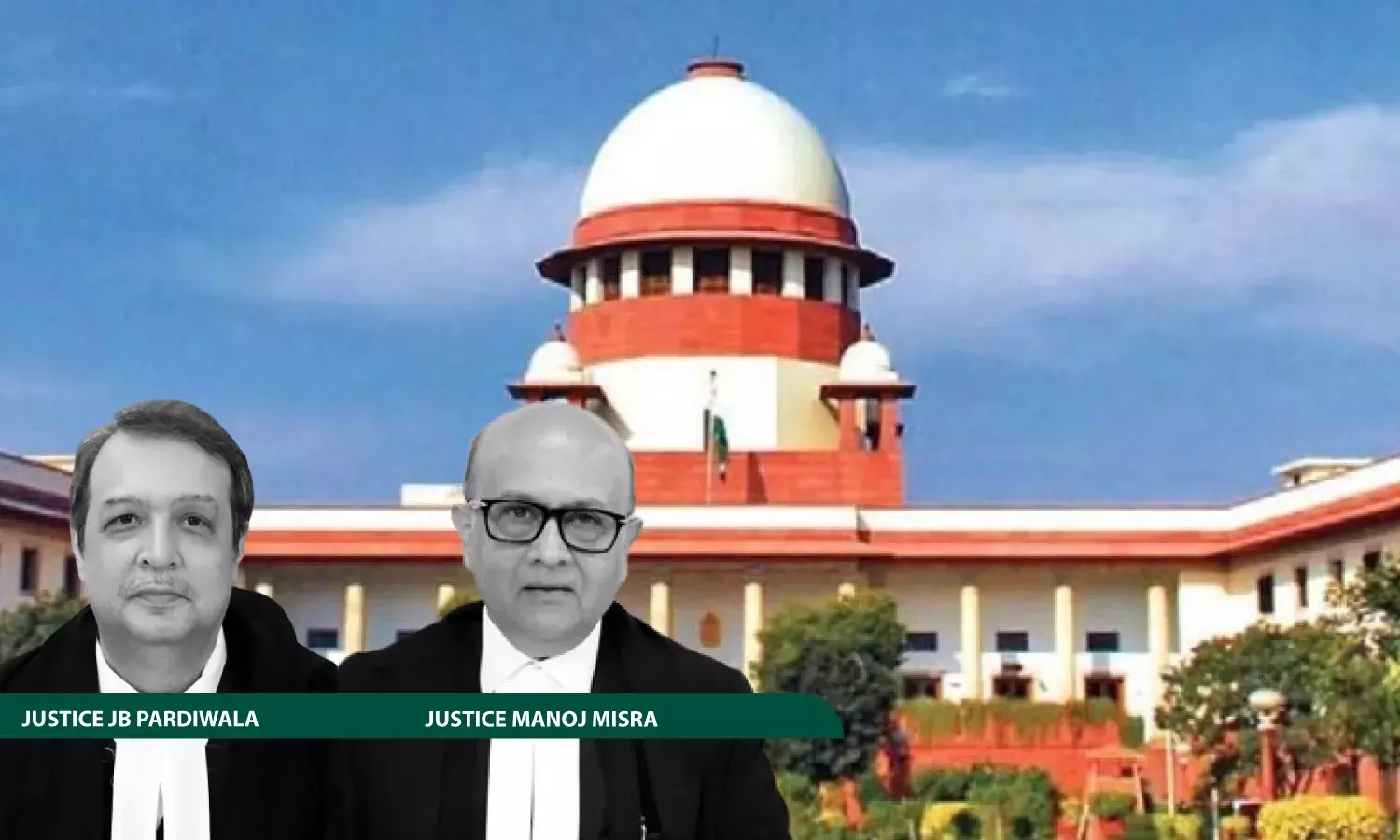
Justice J.B. Pardiwala, Justice Manoj Misra, Supreme Court
The Supreme Court has held that default under Section 3(12) IBC occurs at the singular point in time when payment becomes due and is not made, and that while an unpaid debt may cause continuing financial harm, it does not constitute a continuing legal injury capable of resetting the limitation clock under Article 137 of the Limitation Act, 1963.
Setting aside the concurrent orders of the NCLT and NCLAT, the Court quashed Corporate Insolvency Resolution Process (CIRP) proceedings initiated under Section 9 IBC by an EPC contractor against a power project developer over dues dating back to 2011–2012. Clarifying the scope of operational debt, the Bench ruled that while contractual milestone dues qualify as operational debt, unadjudicated claims such as idling, suspension, or demobilization charges constitute unliquidated damages and cannot be recovered through insolvency proceedings without prior judicial determination.
A Bench of Justice J.B. Pardiwala and Justice Manoj Misra observed, “The ‘default’ envisaged under Section 3(12) of the IBC occurs on nonpayment of debt when whole or any part/instalment of the debt becomes due and payable but is not paid by the debtor. Thus, Section 3(12) grounds the occurrence of default at a singular point in time. The mere subsistence of the EPC contract will not give continuing cause of action in respect of the defaulted amount”.
“…under the IBC, the Adjudicating Authority cannot treat all invoices for payment in aggregate and consider the date on which the first invoice came to be issued as the starting point for limitation in respect of the entire set of invoices for which the claim was filed”, the Court noted further.
The Respondent, Sravanthi Infratech Pvt. Ltd., was awarded an EPC contract worth ₹827 crore by the Appellant for setting up a 225 MW gas-based power station in Andhra Pradesh, to be completed in 14 months. Despite the Respondent achieving the first three payment milestones under the agreed schedule, the Appellant paid only ₹50.15 crore against a cumulative ₹165.4 crore due, prompting the Respondent to suspend works in July 2011 and eventually demobilise the site.
The Appellant's own communication to the Central Electricity Authority in January 2012 acknowledged the work done, and Billing Break-Up statements submitted by the Respondent were acknowledged without dispute in early 2012. The Respondent issued legal notices in 2014 and 2015 demanding payment, none of which received any response, before finally issuing a statutory demand notice under Section 8 of the IBC in July 2018 for over ₹1,292 crore, and filing a Section 9 application in October 2018 after continued non-response.
The NCLT, Amravati Bench admitted the Section 9 application on December 13, 2019, holding that the claim constituted operational debt, that the EPC contract continued to subsist since neither party had terminated it, that there was no pre-existing dispute given the Appellant's failure to respond to the demand notice, and that the application was not time-barred since the contract had not been terminated or frustrated. The NCLAT dismissed the Appellant's appeal by judgment dated February 1, 2021, affirming these findings in their entirety.
On subsistence of the contract, the Court held that termination required affirmative action under Clause 14 of the EPC agreement, which neither party took, and that the doctrine of frustration under Section 56 of the Contract Act could not apply since the suspension of works arose from the Appellant's own breach, a "self-induced frustration", relying on Boothalinga Agencies v. V.T.C. Poriaswami Nadar.
On the nature of the claim, the Court held that contractual milestone dues qualify as operational debt under Section 5(21) of the IBC, whereas suspension, idling, and demobilization charges are unliquidated damages that cannot constitute operational debt without prior judicial adjudication. On pre-existing dispute, applying Mobilox Innovations, the Bench held that the appellant's total silence across multiple legal notices for over seven years indicated its defense was an afterthought rather than a genuine prior dispute.
However, on limitation, the Court ruled decisively against the respondent. It held that the debt crystallized upon acknowledgment in 2012, and subsequent unanswered legal notices in 2014 and 2015 could not reset the limitation clock without a written acknowledgment under Section 18 of the Limitation Act. Rejecting the argument that a subsisting contract offers a continuing cause of action, the Court emphasized that an unpaid debt causes continuous damage, not continuing legal injury. Reaffirming Next Education and Babulal Vardharji Gurjar, the Bench reiterated that each invoice carries an independent limitation period and the IBC cannot be used to give a new lease of life to time-barred claims.
The Court allowed the appeal, set aside the judgments of both the NCLAT and the NCLT admitting the Section 9 application, while granting the Respondent liberty to approach the appropriate dispute resolution forum provided under the EPC contract, namely arbitration, to pursue its claims on merits.
Cause Title: Srinivasa Reddy Velagala v. Sravanthi Infratech Pvt. Ltd. (Neutral Citation: 2026 INSC 835)
Appearances:
Appellant: Shyam Divan, Senior Advocate.
Respondent: Nitin Bhardwaj, Advocate.