

Eradicate Perception That Only Sanitary Workers Must Handle Waste: Supreme Court Calls For Public Participation For SWM Rules Compliance
The Court mandated strict penalties against illegal dumping and integrated waste management into school curricula while invoking Mahatma Gandhi’s philosophy of collective physical labour.

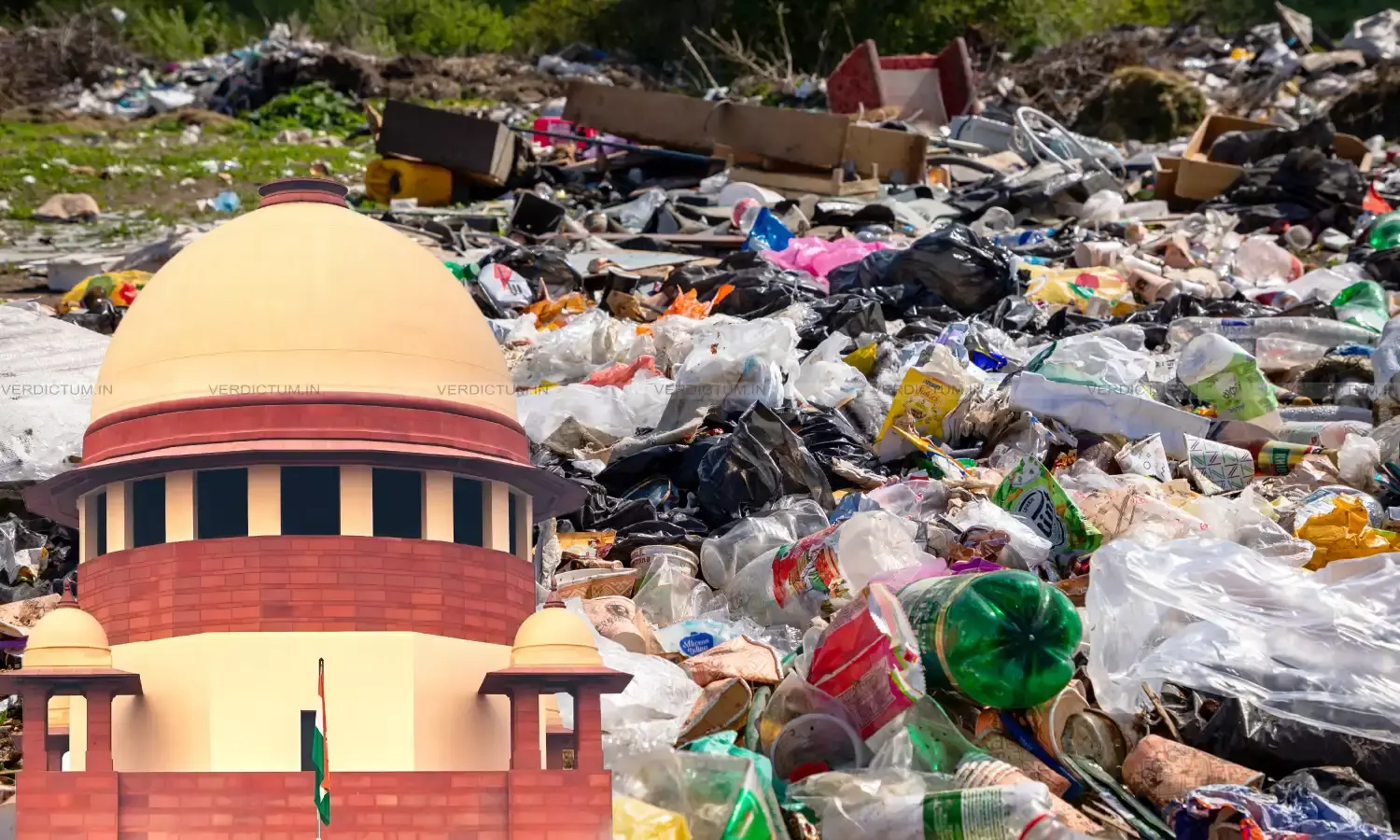
The Supreme Court constituted a Supreme Court-empowered Monitoring Committee (SCMC) to ensure the strict, pan-India enforcement of the Solid Waste Management (SWM) Rules, 2026.
The Court ordered that the Supreme Court-empowered Monitoring Committee (SCMC) would be chaired by the senior-most Secretary and would comprise the Secretaries of the Ministry of Housing and Urban Affairs, Ministry of Environment, Forest and Climate Change, Department of Drinking Water and Sanitation, Ministry of Panchayati Raj, Ministry of Rural Development, and the Member Secretary of the Central Pollution Control Board (CPCB) as the Member-Secretary Convenor.
The Committee was entrusted with the responsibility of supervising pan-India performance, monitoring progress, and issuing necessary directives to enforce the SWM Rules, 2026.
Previously, the Court issued nationwide directions to ensure strict enforcement of the Solid Waste Management Rules, 2026, declaring that failure to implement the Rules will no longer be treated as a mere administrative lapse. The Court emphasised that achieving a “waste-free India” requires immediate structural and institutional preparedness before the Rules come into force on 01-04-2026.
The Bench of Justice Pankaj Mithal and Justice SVN Bhatti observed, "The singularity of obligation and compliance under the SWM Rules, 2026, is that every human being and their activities result in pollution, yet all contributors expect a minuscule percentage of sanitary workers to handle it. This perception shall be eradicated, and it shall be the responsibility of all contributors for Waste Management. As a test case, the District Collectors can specifically engage with households and educational institutions. Let the students be the guides and mentors in their respective households, and the Special Cells in each district educate them in this regard. The Constitution can operate in its full vigour only when there is participation and compliance from all."
AOR Vanshaja Shukla appeared for the Petitioner, while ASG Aishwarya Bhati appeared for the Union.
The Court observed, "Everyone contributes to the betterment of our environment. We recognise that for the current law to be effective and meaningful, the true power lies with local body officers, foot soldiers, and all direct and indirect contributors of Solid Waste, regardless of their level of contribution through their living and activities."
The Court issued a continuing mandamus to ensure continuity and consistency in the execution of waste management policies. It directed that the current leadership of the officers of the Swachh Bharat Mission should not be disturbed or transferred until their superannuation, except on exceptional grounds of non-performance.
The Court observed that while the power to enforce the rules vested with local body officers and foot soldiers, accountability for achieving targeted results would be fixed at appropriate levels to make the entire process answerable to the Court.
The Bench issued specific directions to the District Collectors across the country to identify unauthorized sources of solid waste transport and illegal dumping. The Collectors were mandated to initiate strict penal actions against offending vehicles and their operators. Furthermore, the Court directed the District Collectors to create a dedicated page on their official websites to track issues and progress, allow citizens to upload photographs of waste accumulation, and granted them functional autonomy to deploy innovative administrative and technical tools.
The Court observed that the non-finalization of a dedicated Solid Waste Management curriculum constituted a major lapse in engaging the younger generation. It ordered the design of an educational curriculum aimed at fostering civic responsibility. Additionally, the Court strictly prohibited States and Union Territories from exceeding the committed timelines for the disposal of legacy waste, directing them to deploy scientific and technological methods to obliterate such waste under the pain of accountability proceedings.
The SCMC issued directions to all zones of the Indian Railways regarding their statutory obligations under the SWM Rules, 2026, and directed that their formal reply be placed before the Court in the subsequent report. Noting that prior order copies had not been translated, the Court directed the immediate translation of its orders into local regional languages and ordered the circulation of soft copies along with the executive affidavit to ensure absolute transparency.
Invoking the philosophy of Mahatma Gandhi, the Court emphasized that environmental preservation is a collective responsibility and rejected the perception that waste handling is the sole duty of sanitary workers. The District Collectors were directed to secure public participation through democratic processes involving corporators and panchayat members. The Court specifically ordered the engagement of households and educational institutions, directing that students be groomed as guides and mentors through special district cells.
It said, "The Father of our Nation, Mahatma Gandhi, firmly believed that sustenance, individual or institutional, is the rightful reward of those who have genuinely labored. His famous quote, "[h]e who eats without performing physical labor eats stolen food. God created man to work for his food; no one has a right to a meal who does not put in physical labor," underscores this belief."
While emphasizing that the law must nudge citizens into compliance without compromising on statutory fidelity, the Court deferred active criminal prosecution in the hope of fostering collaborative and economic approaches to waste management.
It added, "No State/Union Territory is permitted to exceed the timelines committed to before the SCMC for the disposal of legacy waste. The present contribution of all entities shall conform to the requirements of the Solid Waste Management Rules, 2026, and deviations shall invite accountability proceedings. Steps are taken to obliterate legacy waste using all available scientific and technological methods."
To closely monitor compliance, the Court laid down a strict Case Management Schedule, directing the SCMC to submit an Interim Report on August 6, 2026, followed by a Short-Term Report in November, a Medium-Term Report in January, and an Annual Report on April 10, 2027. The matter was accordingly ordered to be listed on August 6, 2026.
Cause Title: Bhopal Municipal Corporation v. Dr Subhash C. Pandey & Ors[Civil Appeal No. 6174 of 2023]
Appearances:
Appellant: Advocate on Record Vanshaja Shukla, Advocate Gunjan Chowksey, Advocate Ankeeta Appanna, Advocate Siddhant Yadav.
Respondents: Additional Solicitor General Aishwarya Bhati, Additional Advocate General Shiv Mangal Sharma, Advocate on Record Sudarshan Lamba, Advocate on Record Gurmeet Singh Makker, Advocate on Record Arpit Gupta, Advocate on Record Raghavendra Pratap Singh, Advocate on Record Pashupathi Nath Razdan, Advocate on Record Salvador Santosh Rebello, Advocate on Record Saurabh Balwani, Advocate on Record Vikramaditya Singh, Advocate on Record Pragati Neekhra, Advocate on Record Deepanwita Priyanka, Advocate on Record Siddhant Sharma, Advocate on Record Kumar Mihir, Advocate on Record Saurabh Rajpal, Advocate on Record Abhishek Atrey, Advocate on Record C. K. Sasi, Advocate on Record Avijit Mani Tripathi, Advocate on Record Aaditya Aniruddha Pande, Advocate on Record Sameer Abhyankar, Advocate on Record Surjendu Sankar Das and others.