

"Tax-Fee Distinction May Have Blurred, But Continues To Remain": Supreme Court Upholds NMMC’s Power To Levy Property Tax In MIDC Area
The Bench clarified that quid pro quo remains essential to a fee and service charge cannot be treated as tax.

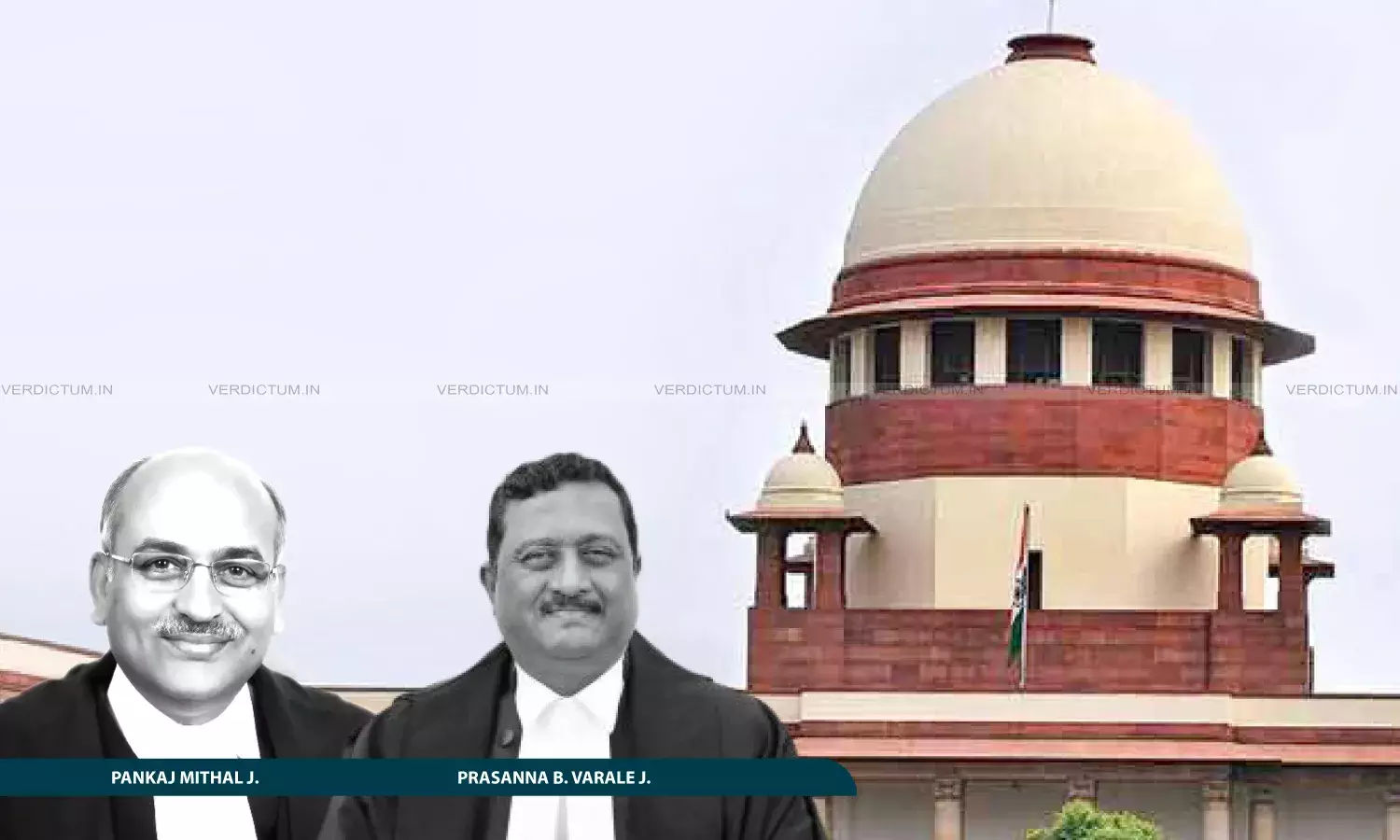
Justice Pankaj Mithal, Justice Prasanna B. Varale, Supreme Court
The Supreme Court has held that although the traditional distinction between a tax and a fee has narrowed over time, it has not disappeared in law, and MIDC’s service charges for civic amenities cannot be equated with municipal taxation. Deciding a long-running dispute between the Maharashtra Industrial Development Corporation and the Navi Mumbai Municipal Corporation, the Court ruled that MIDC’s levy of charges for roads, drainage, water supply and related amenities does not bar the Corporation from imposing property tax under the municipal law.
At the same time, the Court held that the exemption under the Maharashtra Regional and Town Planning Act, 1966 extends to industrial units on MIDC land so long as MIDC itself continues to provide civic amenities, and ceases once those responsibilities are transferred to the municipal corporation.
The Bench affirmed that the TTC industrial area falls within the territorial limits of the Navi Mumbai Municipal Corporation (NMMC) and rejected the contention that land vested with MIDC stood excluded from municipal jurisdiction. The Court held that the State notification constituting NMMC covered the entire area of the notified villages, including TTC MIDC, and that vesting of land with MIDC for industrial development did not remove it from NMMC’s municipal boundaries.
A Bench of Justice Pankaj Mithal and Justice Prasanna B. Varale rejected the argument that MIDC’s recovery of service charges barred municipal taxation, and observed, “…despite the distinction between ‘tax’ and ‘fee’ having been blurred to some extent but still it has not been completely done away with and the distinction, though very fine, continues to remain. The tax is a compulsory extraction for the collection of revenue whereas fee is in the nature of a charge for the services rendered. The element of quid pro quo is an essential characteristic of a fee or a charge. Therefore, so long as the said element ex facie exists, the levy of fee or charges cannot be equated with tax”.
Senior Advocates Arvind Datar, Gopal Sankaranarayanan appeared for the appellants and Senior Advocates C. U. Singh, Vinay Navare appeared for the respondents.
The dispute arose after the Navi Mumbai Municipal Corporation asserted its power to levy and recover property tax from industrial units situated in the TTC industrial area developed by MIDC.
The appellants challenged the levy, contending that MIDC was already providing roads, electricity, drainage, sewage and other civic facilities in the area and recovering service charges for the same, and therefore the municipal corporation lacked authority to impose property tax. They also claimed exemption under Clause 7(1) of the First Schedule to the MRTP Act.
On the question of taxation, the Bench held that the statutory power to levy property tax vested exclusively in the municipal corporation under Sections 127 and 128A of the Maharashtra Municipal Corporations Act. MIDC, by contrast, was empowered only to levy fees and service charges under Sections 15 and 17 of the MID Act for specific amenities provided by it. The Court held that such charges retained the character of fees backed by quid pro quo and could not be equated with taxes.
“The combine reading of both the aforesaid statutes i.e., the MMC Act and the MID Act, it is clear enough that the power to impose and collect property tax which include certain other kind of taxes vests with the NMMC whereas the power to levy fee and charges for providing amenities is conferred upon the MIDC. It is also evident that the fee or service charges in respect of the amenities does not fall within the ambit of property tax as defined under Section 127 read with Section 128A of the MMC Act and are independent and separate from the property tax. They are not even in the nature of tax as the element of quid pro quo exist with regard to levy of such fee and service charges vis-a-vis the unit/plot holders and the MIDC”, the Bench observed.
"...however, as the MIDC was providing the infrastructure facilities and amenities and was realizing fee/ service charges, the MIDC including all its unit/ plot holders were exempt from payment of tax under Clause 7(1) of First Schedule of MRTP Act, till the time those facilities were handed over to the NMMC whereupon it is within the sole domain of the NMMC to realise property tax without any exemption”, the Bench further observed.
The Bench, however, accepted the appellants’ contention on the scope of Clause 7(1) of the First Schedule to the MRTP Act. It held that where MIDC, as the Special Planning Authority, itself provides civic amenities which would ordinarily be provided by the local authority, exemption from taxes including property tax extends not only to MIDC but also to industrial units and plot holders occupying land vested in MIDC. The Court held that limiting the exemption only to MIDC would defeat the statutory object and render the provision ineffective.
At the same time, the Court clarified that the exemption was conditional and not perpetual. Referring to the agreement executed between MIDC and NMMC on December 01, 2005 for transfer of roads, street lighting, drainage and related civic infrastructure, the Bench held that once MIDC ceased to provide those amenities and NMMC assumed responsibility for their maintenance and development, the statutory exemption under Clause 7(1) came to an end for the transferred areas. From that point onward, NMMC became entitled to levy and recover property tax in accordance with law.
Accordingly, the appeals were partly allowed.
Cause Title: Small Scale Enterpreneurs Association & Ors. v. The State Of Maharashtra & Ors. (Neutral Citation: 2026 INSC 570)
Appearances:
Appellants: Arvind Datar, Gopal Sankaranarayanan, Senior Advocates and Amol Chitale, Advocate.
Respondents: C. U. Singh and Vinay Navare, Senior Advocates.
Click here to read/download the Judgment