Knowledge Of Second Marriage Insufficient To Fasten Liability U/S 494 IPC On Husband’s Family; Participation Must Be Shown: Supreme Court
The Court held that liability under Section 494 IPC cannot be extended to relatives of the husband in the absence of evidence showing active participation, facilitation, or overt acts in the second marriage.
The Supreme Court has held that mere knowledge of a second marriage is insufficient to attract liability under Section 494 of the Indian Penal Code, 1860, against the husband’s relatives and that the complainant must prima facie establish overt acts or participation by the accused in the solemnisation of such marriage.
The Court further held that general and omnibus allegations against relatives of the husband, without specific material, cannot sustain prosecution under Sections 498A and 494 IPC.
The Court was hearing an appeal challenging the refusal of the Kerala High Court to quash criminal proceedings arising out of an FIR registered under Sections 494 and 498A, read with Section 34 IPC, against the relatives of the husband.
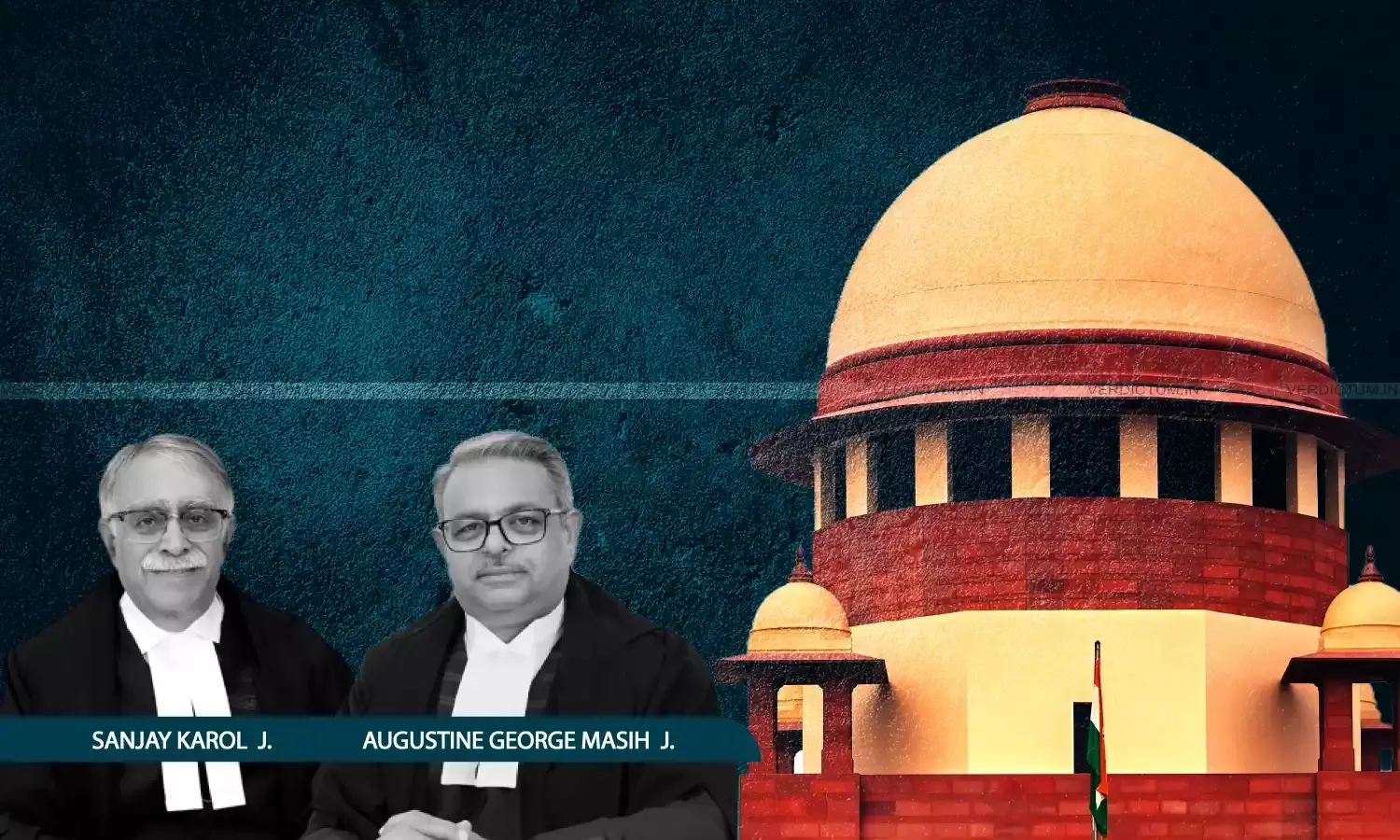
A Bench comprising Justice Sanjay Karol and Justice Augustine George Masih observed: “While it has been alleged that the accused-appellants were aware of the second marriage, mere knowledge that an act is being or has been committed by another person does not, by itself, establish the requisite common intention”.
“Even proceeding on the basis that the accused-appellants were aware of the second marriage, there is no allegation, let alone any material, to suggest that they actively participated in, facilitated, or encouraged the solemnisation of that marriage”, the Bench added.
Advocate Abhilash MR appeared for the appellants; Advocate Nishe Rajen Shonker appeared for the respondents.
Background
The complainant married the accused husband in 2007 and alleged that she was subjected to continuous dowry harassment and physical and mental cruelty during the subsistence of the marriage. She further alleged that her husband contracted a second marriage in 2013 without disclosing the subsisting marriage.
An FIR was registered in 2016 under Sections 494 and 498A of the IPC against the husband and his family members, including his father-in-law, mother-in-law, and sister-in-law. Upon completion of the investigation, a charge sheet was filed, and charges were framed.
The accused-appellants approached the High Court under Section 482 CrPC seeking quashing of proceedings, contending that the allegations against them were vague and did not disclose any specific role. The High Court declined to interfere, holding that the matter required trial, leading to the present appeal.
Court’s Observation
The Court first reiterated the settled principles governing the exercise of inherent powers under Section 482 CrPC, referring to State of Haryana v. Bhajan Lal (1992), observing that such powers are to be exercised to prevent abuse of process of law or to secure the ends of justice. It noted that proceedings can be quashed where allegations, even if taken at face value, do not disclose the commission of an offence.
Applying these principles, the Court examined whether the allegations in the FIR and material on record disclosed offences under Sections 498A and 494 IPC against the accused-appellants, distinct from the husband.
With respect to Section 498A IPC, the Court found that the gravamen of the complaint was directed primarily against the husband, with specific allegations of cruelty, physical assault, and dowry demands attributed to him.
In contrast, the allegations against the accused-appellants were largely general in nature, consisting of claims that they were present during certain incidents or encouraged the conduct of the husband. The Court noted that no specific acts of cruelty, demand, or harassment were attributed to them on identifiable occasions.
Relying on Dara Lakshmi Narayana v. State of Telangana (2025), the Court cautioned against implicating family members based on vague and omnibus allegations, observing that “mere reference to the names of family members… without specific allegations indicating their active involvement should be nipped in the bud.” It held that such generalised accusations cannot form the basis for criminal prosecution.
On examining the role of each accused, the Court noted that the father-in-law and mother-in-law were alleged to have been present during certain incidents and to have received amounts, but no specific overt acts of cruelty were attributed to them.
Similarly, the sister-in-law was alleged only to have received money for the purchase of a flat, without any material showing coercion or participation in acts of cruelty. The Court held that such allegations, in the absence of specific acts, do not satisfy the ingredients of Section 498A IPC.
Turning to the offence under Section 494 IPC, the Court relied on S. Nitheen v. State of Kerala (2024) and reiterated that “in order to bring home the said charge, the complainant is required to prima facie prove the overt act or omission of the accused persons in the second marriage ceremony”, while adding that the prosecution had “failed to provide any cogent evidence to establish such overt act or intention on part of the accused-appellants”.
The Court further held that the High Court had erred in relying upon inferential knowledge to sustain the proceedings and held that “such inferential knowledge, without more, is insufficient to satisfy the threshold established in S. Nitheen (supra), which requires evidence of an overt act or omission”.
Conclusion
The Supreme Court held that the allegations against the accused-appellants did not disclose the commission of offences under Sections 498A and 494 IPC and that continuation of proceedings would amount to abuse of process of law.
Accordingly, the appeal was allowed, the impugned judgment of the High Court was set aside, and the criminal proceedings were quashed.
Cause Title: Sivaraman Nair & Ors. v. State of Kerala & Anr. (Neutral Citation: 2026 INSC 412)
Appearances
Appellants: Advocates Abhilash M.R., Manjari Singh, Sandra Jaison, Ann Melvin, Rajkumar; M/s M.R. Law Associates, AOR
Respondents: Nishe Rajen Shonker, AOR; Advocates Anu K. Joy, Alim Anvar, Devika A.L., Santhosh K; Renjith B. Marar; Lakshmi N. Kaimal, AOR & Ors.