

"Enjoyment Survey" Cannot Determine Entitlement To Compensation Under Land Acquisition Act: Supreme Court Sets Aside Lok Adalat Awards
The Court also held that rival claimants to compensation cannot be treated as a representative class sharing common interest under Order I Rule 8 CPC.

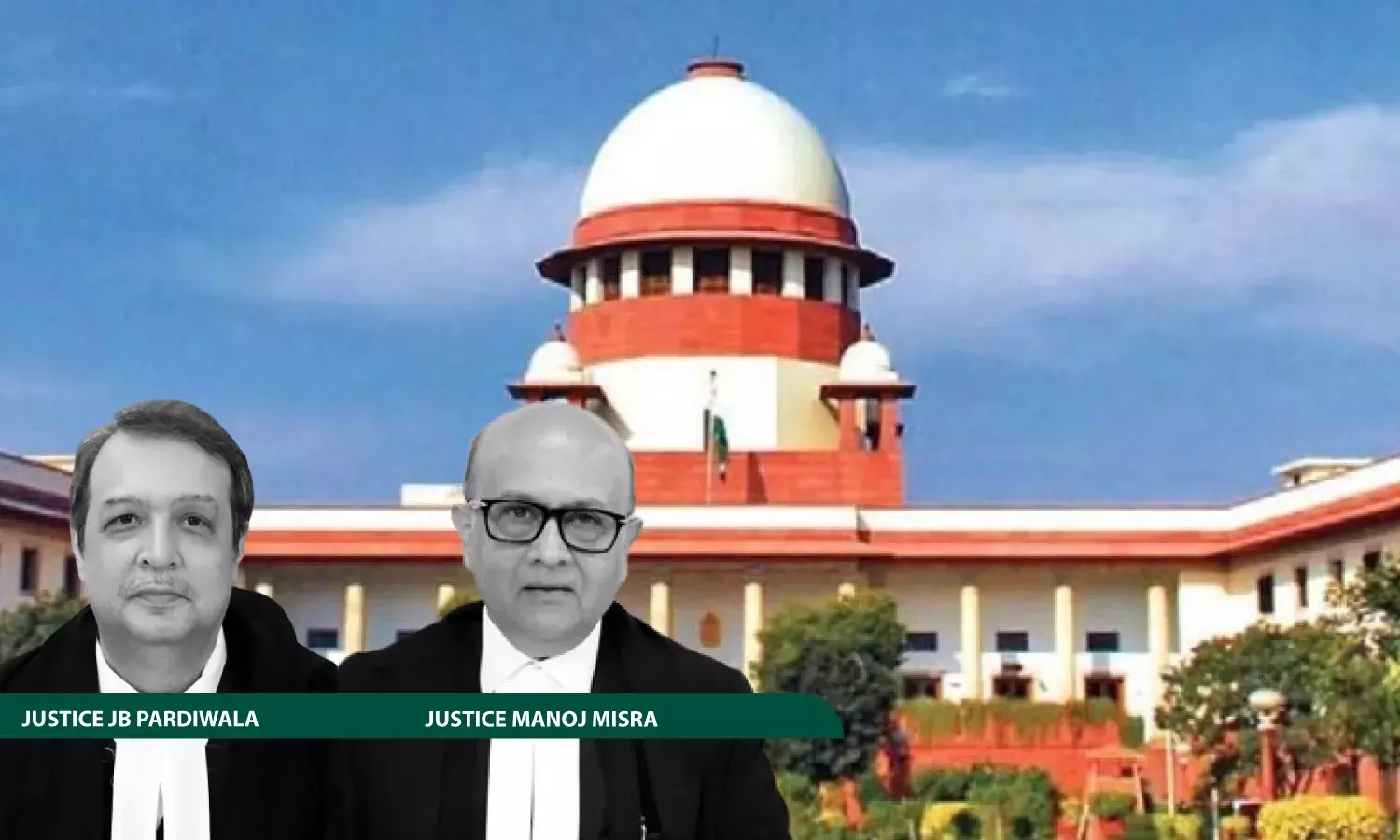
Justice J.B. Pardiwala, Justice Manoj Misra, Supreme Court
The Supreme Court has held that an "enjoyment survey", a survey capturing only the physical occupation of acquired land, cannot, by itself, determine legal entitlement to compensation under the Land Acquisition Act, 1894, and has set aside Lok Adalat awards passed on that basis in a decades-old land acquisition dispute in Khammam, Telangana. The Court remitted the matter for a fresh, de novo hearing before the Principal District Judge.
The Court further held that where claimants hold rival and adverse claims to the same compensation, they cannot be treated as a class sharing a common interest for the purposes of Order I Rule 8 of the Code of Civil Procedure, 1908, since such a proceeding presupposes a community of interest rather than a dispute between the very persons said to be "represented".
A Division Bench comprising Justice J.B. Pardiwala and Justice Manoj Misra observed, “An enjoyment survey captures nothing more than the fact of physical occupation on the land at the time it is conducted. It does not purport to examine the legal title, right, or interest by virtue of which such occupation is held. In such circumstances, the findings of such survey cannot be treated as conclusive of entitlement to compensation”.
Advocate Gaichangpou Gangmei appeared for the appellants and Advocate P. Parmeswaran appeared for the respondent.
The dispute arose from the acquisition of over 489 acres in Kommepalli village for mining operations by Singareni Collieries Company Ltd. After the Land Acquisition Officer's award was challenged, the parties negotiated enhanced compensation before the High Court Legal Services Committee, and a coordination meeting directed an "enjoyment survey" of the land to facilitate resolution of title disputes through Lok Adalat. Sixteen Lok Adalat awards were subsequently passed on March 29, 2016.
The appellants, disputing title-holders who were not made parties to, or signatories of, the settlement, challenged these awards, contending that the Land Acquisition Officer had erred in passing awards without ascertaining who was actually entitled to compensation.
The Principal District Judge, Khammam, in a letter to the High Court, acknowledged that the awards had been passed without recording any terms of compromise among the disputing claimants and that the Coordination Meeting's direction for an enjoyment survey had been misunderstood. Despite this, the High Court dismissed the appellants' writ petition, holding that the awards reflected consent of the parties and could be treated as a settlement analogous to a representative suit under Order I Rule 8 of the CPC.
Examining Sections 29, 30 and 31 of the Land Acquisition Act, the Supreme Court held that a valid agreement on apportionment under Section 29 requires the concurrence of all interested persons, and a partial settlement excluding some claimants cannot qualify. The Court found that the enjoyment survey, which records only physical possession and not legal title, had no statutory basis to serve as the foundation for determining entitlement to compensation, relying on Telangana High Court precedents rejecting the practice in analogous acquisition proceedings.
“It must be kept in mind that when the Government acquires property, public funds are disbursed as compensation. It must be paid to the person entitled and determined as per law, and not merely to any claimant who cares to appear at the first instance, or who is the most vocal or visible before the authorities. It is needless to mention that physical possession may be held under any number of capacities, and such a survey is incapable of distinguishing between these. We cannot permit it to determine as to who is entitled to receive compensation”, the Bench noted.
The Court also held the High Court's characterisation of the awards as a class-action-like settlement under Order I Rule 8 to be erroneous, since the claimants held adverse interests against one another rather than a shared grievance against a common party.
Accordingly, the Court set aside the High Court's judgment and directed the Principal District Judge, Khammam, to conduct a fresh hearing of the apportionment reference, uninfluenced by any prior observations, within six months.
Cause Title: Singapogu Babu Rao & Ors. v. Special Deputy Collector (Land Acquisition) & Ors. (Neutral Citation: 2026 INSC 888)
Appearances:
Appellants: Gaichangpou Gangmei, Advocate.
Respondent: P. Parmeswaran, Siddhartha Sinha, Advocates.