

Overlap Of Disputes With Mother Agreement Cannot Be Ground To Refuse Reference U/S 11 A&C Act At Threshold: Supreme Court
The Court appointed former Bombay High Court Chief Justice as sole arbitrator in joint venture and MoU disputes despite Seoul arbitration clause in licence agreement; non-signatory subsidiary issue left to arbitrator.

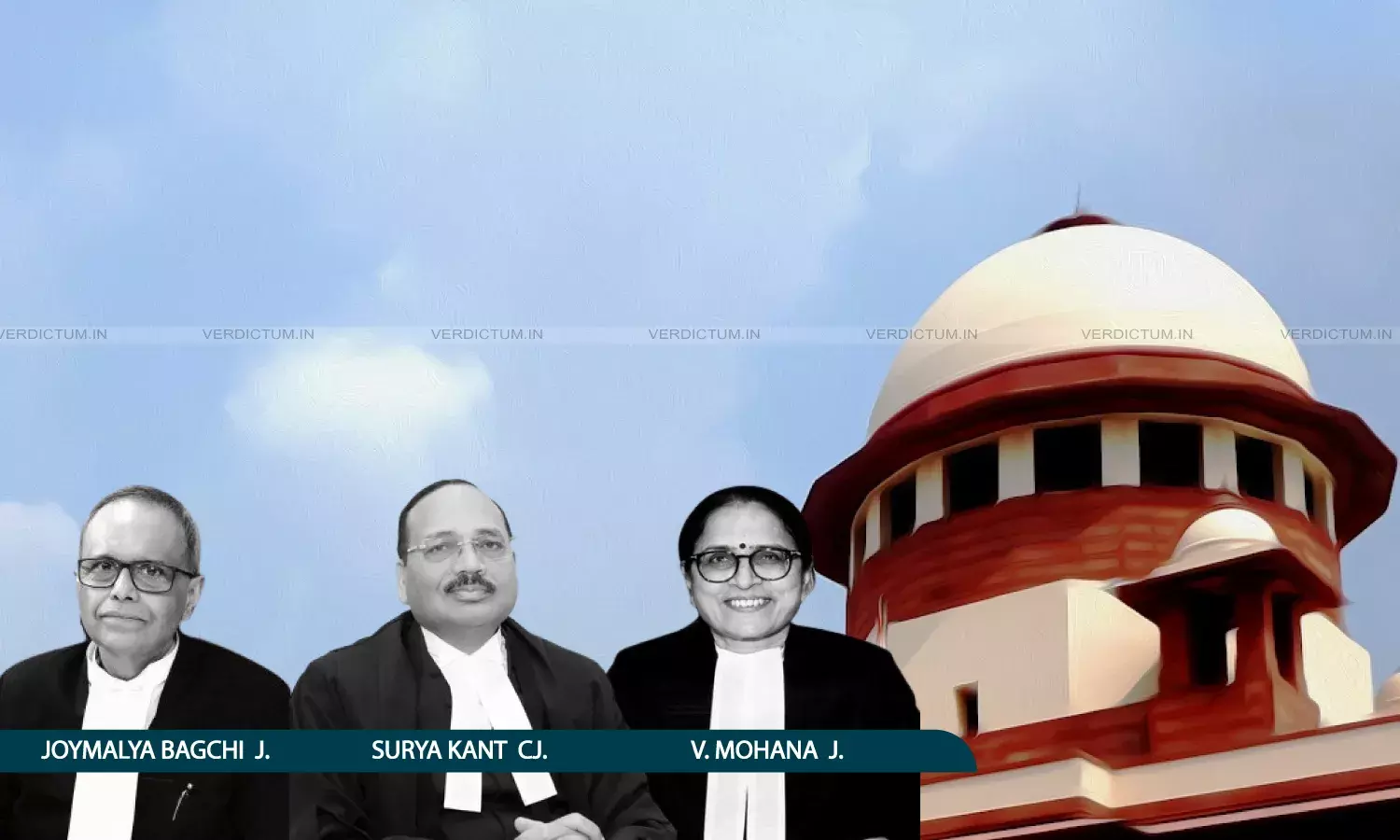
CJI Surya Kant, Justice Joymalya Bagchi, Justice V. Mohana, Supreme Court
The Supreme Court has held that an overlap between disputes under a joint venture agreement and MoU and claims under a separate licence agreement is a matter for the arbitrator. It cannot be a ground to refuse a reference at the threshold under Section 11 of the Arbitration and Conciliation Act, 1996.
The Court held that the three agreements prima facie operate in different fields, so the Mumbai-seated arbitration clauses in the joint venture agreement and MoU govern disputes under them, not the Seoul clause in the Licence Agreement. It left open whether the non-signatory subsidiary is bound, and appointed Justice Ramesh Deokinandan Dhanuka, former Chief Justice of the Bombay High Court, as sole arbitrator.
A Bench of Chief Justice Surya Kant, Justice Joymalya Bagchi and Justice V. Mohana observed, “…argument that the disputes pertaining to the JVA and MoU cannot be adjudicated in isolation and overlap with claims under the License Agreement in respect whereof his clients have already raised a dispute for arbitration in Korea, would fall within the jurisdiction of the arbitrator visà-vis the scope and ambit of disputes amenable to arbitration under the JVA/MoU, and cannot constitute a ground to refuse a reference at the threshold… Thus, the License Agreement, JVA and MoU 13 prima facie operate in different fields and the disputes arising exclusively under the JVA and MoU are amenable to the dispute resolution clauses engrafted therein and not the clause in the License Agreement”.
Senior Advocate C.U. Singh appeared for the petitioners and Senior Advocate Sudhanshu Choudhari appeared for the respondents.
“Admittedly, the existence of the agreements is not in dispute. What is contended is that the JVA and MoU spring from the mother agreement, namely License Agreement, and have no independent existence. As such, the dispute resolution clause, namely Clause 12.1 of the mother agreement, envisaging arbitration in Korea would override the dispute resolution clauses in the subsidiary agreements”, it noted further.
Shubham Equipment Private Limited (SEPL), a Thane-based tank-cleaning company, and Korea's Rothwell Water Company Limited (RWCL) signed a Licence Agreement on January 30, 2019, providing for arbitration in Seoul under Korean law. A Joint Venture Agreement of October 01, 2021 created Rothwell Water (India) Private Limited, with arbitration in Mumbai under Article 43. A Memorandum of Understanding of February 01, 2023 had SEPL render liaison and logistics services for RWCL, with a sole arbitrator seated in Mumbai.
In October 2024, SEPL terminated the joint venture agreement. It alleged that RWCL had incorporated Rothwell Business International Private Limited (RBIPL) in breach of the non-compete clause. It claimed Rs 20 crore for business loss and Rs 4.24 crore under the MoU.
SEPL served arbitration notices in November 2024 and filed two Section 11 petitions. RWCL did not deny that disputes had arisen. It argued that no amicable settlement had been attempted, that the Licence Agreement was the mother agreement and its Seoul clause prevailed, and that RBIPL, a non-signatory, was not bound. RWCL also invoked arbitration in Korea on August 08, 2025. The Court first referred the parties to mediation, which failed.
On merits, the Court noted that under Section 11(6-A) its inquiry is confined to the prima facie existence of an arbitration agreement, which was admitted. It found that Article 25 of the joint venture agreement and Clause 10.8 of the MoU each supersede prior agreements on their subject matter. On RBIPL, it held the question contentious, given that RBIPL is a wholly owned subsidiary of a signatory and allegedly incorporated in derogation of the joint venture agreement, and left it to the arbitrator.
Cause Title: Shubham Equipment Private Limited & Anr. v. Rothwell Water Company Limited & Ors. (Neutral Citation: 2026 INSC 1098).
Appearances:
Petitioners: C.U. Singh, Senior Advocate.
Respondent: Sudhanshu Choudhari, Senior Advocate.