Supreme Court Disapproves Practice Of Writing Lengthy, Merits-Laden Orders In Temporary Injunction Applications
The Court restored an interim injunction in a family estate dispute, holding that interlocutory orders under Order XXXIX CPC must preserve the subject matter of trial and not decide questions that properly await evidence.
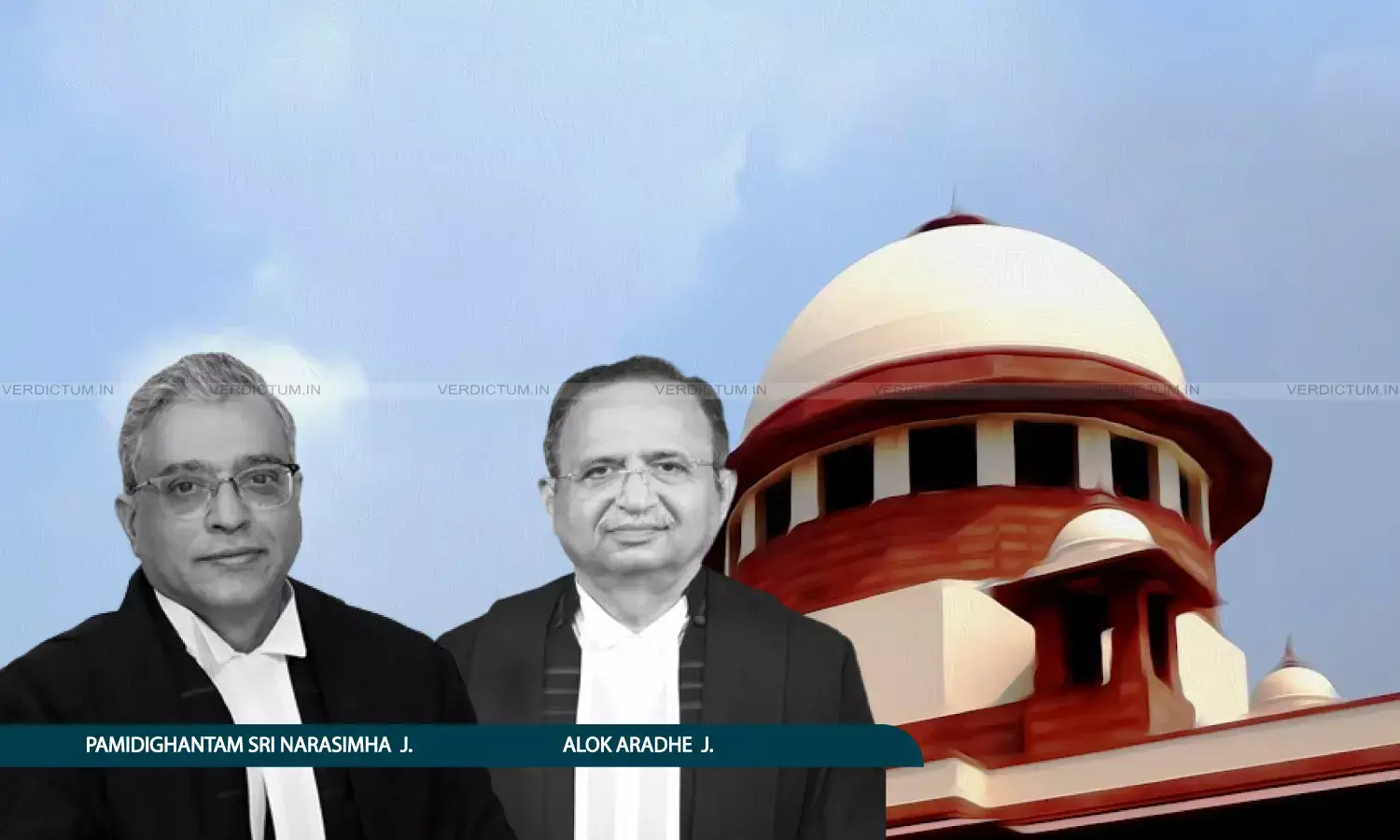
Justice Pamidighantam Sri Narasimha and Justice Alok Aradhe, Supreme Court
The Supreme Court has held that courts deciding applications for temporary injunction under Order XXXIX CPC, and appellate courts reviewing such orders, must confine themselves to the three settled requirements of prima facie case, balance of convenience and irreparable injury, without entering into a merits-laden examination of documents.
The Court was hearing appeals arising from a Delhi High Court Division Bench judgment dated March 20, 2026, which had set aside a Single Judge’s order dated July 29, 2022 granting interim injunction in favour of the original plaintiff in a family estate dispute involving shares, LLP interests, companies and immovable properties.
A Bench of Justice Pamidighantam Sri Narasimha and Justice Alok Aradhe observed: “Before parting with these appeals, we consider it necessary to record our disquiet at a recurring feature of orders passed under Order XXXIX of the Code, and of appellate orders reviewing them, that reach this Court. Such orders are, with increasing frequency, running into pages of close analysis of the rival documents, weighing the probable outcome of issues of title, undue influence or fraud, and expressing views, in substance, on which party is likely to succeed at trial. Orders become lengthy for a single reason: the court passing them has, whether consciously or not, entered upon the final merits of the controversy and conducted what is, in substance, a mini-trial upon affidavits and documents that properly await the leading of evidence.”
The Bench further added: “We accordingly do not approve the practice of writing lengthy, merits-laden orders, whether at the interlocutory stage or in appeal from it, on applications for temporary injunction, and emphasise that courts confine such orders to recording, with reasons, their findings on the three settled conditions of prima facie case, balance of convenience and irreparable injury, without embarking upon an examination of the final merits or the probable outcome of the issues that properly arise for trial.”
Senior Advocates Kapil Sibal and S. Niranjan Reddy appeared for the appellants, while Senior Advocates Mukul Rohatgi and Nakul Dewan appeared for the respondents.
Background
The dispute arose from the estate of a testator who had established several companies, partnerships and trusts during his lifetime. According to the original plaintiff, the testator had executed a Will dated March 26, 2004 governing succession to his shares in the family assets. Competing claims were raised that he had executed a later Will dated October 4, 2008, or had died intestate.
After the testator’s death, one branch of the family began residing with the original plaintiff. Between December 2018 and June 2019, the original plaintiff executed several gift deeds and LLP transfer agreements transferring shares and capital interests in family entities. The judgment records that a farmhouse at Rajokri was sold for ₹4.72 crore, and that further amounts of ₹50 crore were obtained by way of loans and advances, which were allegedly used to acquire flats, a factory, and vehicles.
The original plaintiff later instituted CS(OS) No. 589 of 2021, alleging that certain defendants had taken advantage of her old age and procured transfers of shareholding and LLP interests by illegal and fraudulent means. She sought declarations, permanent and mandatory injunctions, restoration of shareholding and LLP interests, and restraint against alienation of subject properties. She also filed an application under Order XXXIX Rules 1 and 2 CPC seeking interim injunction.
A Single Judge of the Delhi High Court granted interim protection on July 29, 2022, restraining creation of third-party rights in properties owned by defendant companies and LLPs, and restraining certain defendants from alienating specified properties. The Division Bench later set aside that order in appeals under Order XLIII Rule 1(r) CPC. The legal representatives of the original plaintiff and other family members approached the Supreme Court.
Court’s Observations
The Supreme Court said that a temporary injunction is statutory in form but equitable in substance. Referring to Section 36 of the Specific Relief Act, 1963, Section 37(1), Order XXXIX Rule 1(a) CPC and Section 94(c) CPC, it held that interim injunctive relief is meant to prevent the ends of justice from being defeated.
The Court explained that an interlocutory injunction decides nothing finally and serves as a holding operation so that the trial does not become a barren exercise.
The Court observed: “The single most important proposition governing these appeals is that an interlocutory injunction decides nothing; it is a holding operation, so that the trial, when it comes, is not a barren exercise.”
Applying this principle, the Court held that the shareholding, LLP interests and immovable properties in question constituted the subject matter of the suit. If defendant Nos. 4 and 9 were left free to alienate or encumber the family companies, LLPs or properties acquired with their proceeds, any eventual decree in the plaintiff’s favour could be rendered an empty formality.
The Court held that Order XXXIX CPC does not permit either the court of first instance or an appellate court to resolve conflicts of evidence on affidavit, decide difficult questions of law, or examine the ultimate probative value of documents.
The Court observed: “This is not what Order XXXIX requires, nor what the law permits - whether of the court of first instance or of an appellate court reviewing it. Lord Diplock’s caution, that the interlocutory stage is not the occasion to resolve conflicts of evidence on affidavit or to decide difficult questions of law calling for mature consideration, has been consistently accepted in India. This Court, emphasised the court’s reluctance to decide difficult questions of law or fact at the interlocutory stage. The scope of examination on an application under Order XXXIX – and, equally, of an appeal against an order made on such an application – is confined to the limited and threshold question whether the plaintiff has shown a serious dispute meriting investigation at trial; it does not extend to an examination of the final effect, probative value or ultimate merits of the documents annexed to the pleadings, which is the trial court's task, to be undertaken after evidence and not before.”
The Court held that the prima facie threshold is modest and does not require proof of title. What is required is that the claim should not be frivolous or vexatious, and should disclose a serious question requiring trial.
The Court noted: “A prima facie case does not mean a case proved to the hilt but a case which can be said to be established if the evidence which is led in support of the same were believed.”
Referring to Dalpat Kumar v. Prahlad Singh (1992), Gujarat Bottling Co. Ltd. v. Coca Cola Co. (1995), and other precedents, the Court held that the nature of the original plaintiff’s interest under the Will dated March 26, 2004, the effect of the subsequently propounded Will dated October 4, 2008, and the plea of undue influence were substantial questions for trial.
It held that the Division Bench’s insistence on a “clear prima facie nexus”, detailed reading of the Will, and examination of the effect of Section 89 of the Companies Act, 2013 required the kind of close merits-based enquiry impermissible at the interlocutory stage.
The Court said the balance of convenience was not equally poised. The injunction did not restrain any independent business activity of defendant Nos. 4 and 9, but restrained further alienation of shareholding, LLP interests and properties whose provenance itself was under challenge.
The Court observed that defendant Nos. 4 and 9 would lose nothing substantial by being restrained from alienating assets to which their title was in dispute, while the appellants could irrecoverably lose control over family companies representing a substantial part of the testator’s estate if third-party rights were created.
On irreparable injury, the Court held that loss of controlling shareholding in family companies, or creation of third-party rights in properties allegedly acquired from disputed transfers, would not be mere financial loss capable of compensation through damages.
The Court observed: “No decree for money could restore to the appellants the specific shareholding and properties in question, once alienated to third parties during the pendency of the suit.”
The plea that some properties were self-acquired was held to be a matter for trial. For interim protection, the Court accepted that properties allegedly purchased through proceeds of disputed transfers had to be preserved until the matter was decided on evidence.
The Supreme Court reiterated the standard in Wander Ltd. v. Antox India P. Ltd. (1990), holding that an appellate court ordinarily does not substitute its discretion for that of the court of first instance unless the order is arbitrary, capricious, perverse or contrary to settled principles.
The Court found that the Single Judge’s order was anchored in the three conditions governing interim injunctions and could not be treated as arbitrary or perverse.
The Court observed: “The Division Bench’s substitution of its own appreciation of the Will, of the parties’ conduct, and of the applicability of statutory provisions bearing on the final merits, for the exercise of discretion by the learned Single Judge, was not warranted on the standard it had itself correctly recited, and constitutes precisely the kind of interference that Wander Ltd. & Anr. (supra) forbids.”
The Court also found that the Division Bench entered into matters that should have been left for trial, including construction of clauses of the Will, delay, admissions in another suit, application of Section 89 of the Companies Act, 2013, and the alleged nexus between acquisitions and proceeds.
The Court held: “Measured against this standard, the judgments of the learned Single Judge as well as the Division Bench bear the marks of a mini-trial. Having correctly stated the limited standard of appellate interference laid down in Wander Ltd. & Anr. (supra) that interference is warranted only where the discretion below has been exercised arbitrarily, capriciously, perversely, or contrary to settled principles of law regulating the grant or refusal of temporary injunctions. The Division Bench proceeded, over twelve detailed findings, to construe individual clauses of the Will dated 26.03.2004, to weigh the effect of delay and of admissions said to have been made in a separate suit, to apply Section 89 of the Companies Act, 2013 to the facts, and to assess whether a “clear prima facie nexus” had been demonstrated between specific acquisitions and specific proceeds. Each of these is a matter of substance properly reserved for trial; none of them is a matter upon which an appellate court, confined to asking whether the Single Judge’s discretion was perversely or arbitrarily exercised, may substitute its own appreciation of the evidence.”
Conclusion
The Supreme Court allowed the appeals, set aside the Delhi High Court Division Bench judgment, and restored the Single Judge’s interim injunction order.
It clarified that its order was based only on a prima facie appraisal of a serious dispute requiring trial and would not be treated as an expression of opinion on the Will, intestacy, Section 14 of the Hindu Succession Act, 1956, Section 89 of the Companies Act, 2013, undue influence, fraud or self-acquisition. It also directed that the Division Bench’s merits observations would stand effaced and would not influence the trial court.
The appellants were directed to remain bound by their undertaking as to damages. The Single Judge was requested to dispose of CS(OS) No. 589 of 2021 as expeditiously as possible, preferably within eight months. No order as to costs was passed.
Cause Title: Shruti Manav Sharma & Anr. v. Sunanina Singh & Ors. (Neutral Citation: 2026 INSC 843)
Appearances
Appellants: Senior Advocates Kapil Sibal and S. Niranjan Reddy, with Mohit Paul, AOR, and Advocates Anunaya Mehta, Rangoli Seth, Anandita Tayal, Vidhan Malik, Ashutosh Chugh and Rohit
Respondents: Senior Advocates Mukul Rohatgi and Nakul Dewan, with Advocates Nikhil Singhvi, Shraddha Deshmukh, Soham Krishan Luthra, Mansi Gupta, Yogit Kamat, Naman Joshi, Guneet Singh Sidhu, Hardik Singh, Rahul, Ritika Vohra, Dheeraj P. Deo, B.S. Jakhar, Vikram Singh Jakhar, Bhawna Jakhar, Neeraj Jakhar and Rusheet Saluja; M/s SARC Legal, AOR; Rishabh Kapur, AOR