

Error Of Law Evident From The Record Is Open To Correction By High Court By Invoking Certiorari Jurisdiction: Supreme Court
The Supreme Court was considering the appeals challenging the interference caused by the Delhi High Court in setting aside the order passed by an Arbitrator.

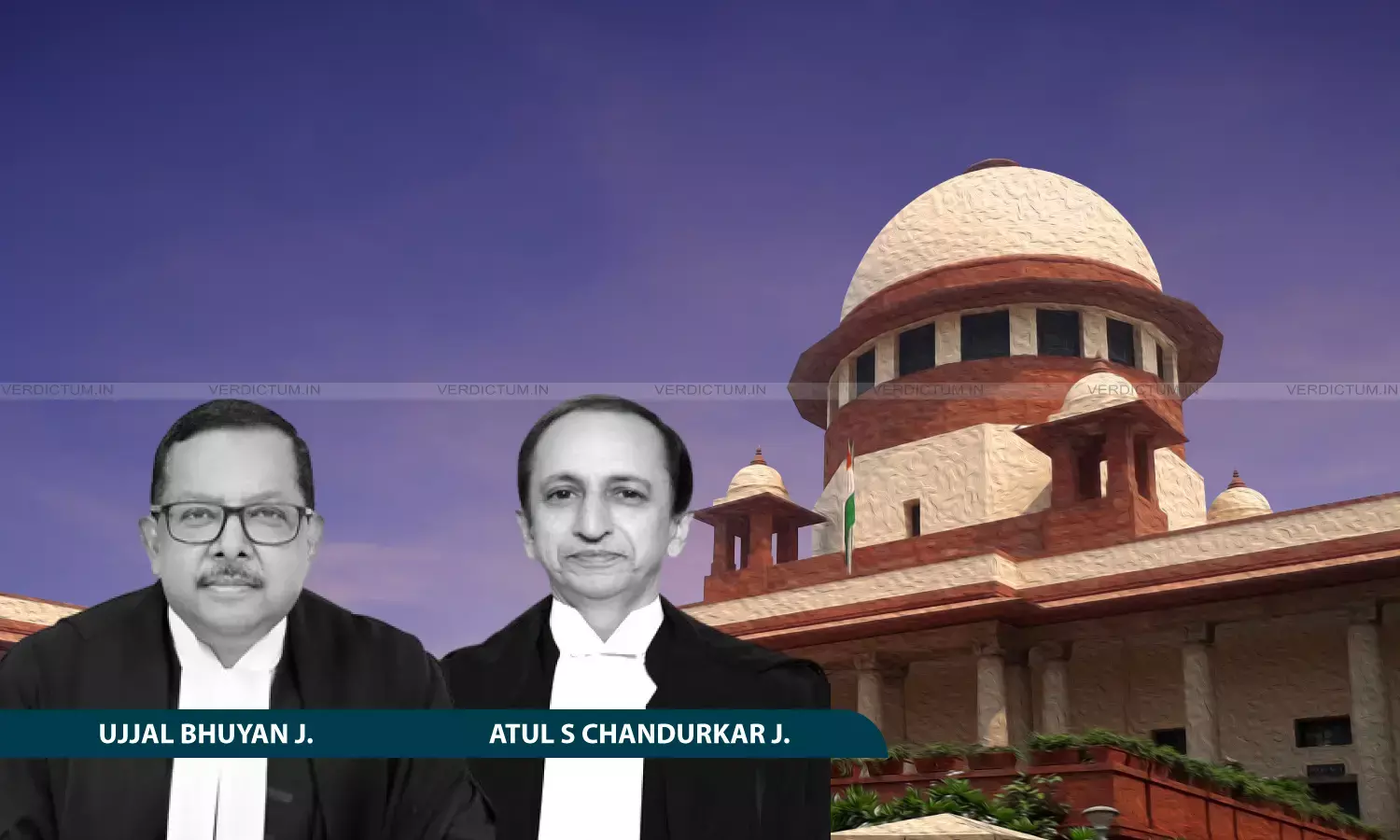
The Supreme Court has upheld an order of the Delhi High Court setting aside the order passed by an Arbitrator and observed that though the scope for interference in exercise of certiorari jurisdiction would be limited, an error of law is open to correction by the High Court.
The Apex Court was considering the appeals challenging the interference caused by the Delhi High Court in setting aside the order passed by the Arbitrator under Section 61 of the Delhi Cooperative Societies Act, 1972 as affirmed in appeal under Section 76 by the Delhi Co-operative Tribunal.
The Division Bench of Justice Ujjal Bhuyan and Justice Atul S. Chandurkar held, “From the aforesaid decisions, it is evident that though the scope for interference in exercise of certiorari jurisdiction would be limited, an error of law evident from the record is open to correction by the High Court. If a finding is recorded without there being any evidence on record or a finding is recorded without any supporting document, whatsoever, a case for interference would be made out since such finding would amount to an error of law.”
Senior Advocate Jitendra Mohan Sharma represented the Appellant while Senior Advocate Ashim Vachher represented the Respondent.
Factual Background
One S.N. Sharma claimed to be a member of M/s Burmah Shell Co-operative Housing Society, the first respondent, and entitled to allotment of a plot. Complaining of illegal deprivation in the matter of allotment of a plot, the claimant filed a dispute before the Joint Registrar, Co-operative Societies, Delhi, which was referred to an Arbitrator. The Society questioned the appointment of the Arbitrator by filing a civil suit. Despite a restraint order, the Arbitrator passed an ex parte award. The Arbitrator upheld the claim of the claimant for allotment of a plot. The said proceedings reached the Apex Court at the instance of the legal heir of the original claimant in another case, Prakash Narain Sharma vs. Burmah Shell Co-op. Housing Society Ltd (2002). The Apex Court set aside the ex parte award and directed continuation of the arbitration proceedings from the stage at which the Society was set ex parte. The original Arbitrator having expired, he was replaced by another Arbitrator, the Registrar, Co-operative Societies, Delhi (second respondent).
After remand, the Registrar concluded the arbitration proceedings and passed an award holding that the original claimant was a member of the Society. The legal heir of the original claimant, Prakash Narain Sharma, was held entitled to allotment of a plot. The arbitrator directed the Managing Committee of the Society to give a plot to the legal heir of the original claimant on making full payment towards the cost of the land. The said order of the Arbitrator was challenged by the Society by preferring an appeal under Section 76. The Tribunal upheld the Registrar’s order.
The Society preferred a writ petition under Articles 226 and 227 of the Constitution before the Delhi High Court. The High Court held that the original claimant was not entitled to allotment of any plot since he had not been admitted as a member of the Society. The orders passed by the Registrar and the Presiding Officer of the Tribunal were set aside. The writ petition preferred by the Society was allowed. Aggrieved thereby, the legal heirs of the original claimant approached the Apex Court.
Reasoning
The Bench noted that the Registrar as well as the Tribunal glossed over relevant documentary material on record. The High Court in the impugned judgment had indicated the same, which, according to the Bench, was the correct position as per the records of the case. These documents included the resignation of the original claimant and its acceptance as recorded in the Minutes of the Managing Committee Meeting held in 1951 followed by transfer of the share of the original claimant to another member on August 18, 1951, the rejection of the original claimant’s application for membership as per the Minutes of the Managing Committee Meeting dated November 5, 1952 and the rejection of the request of the original claimant to permit him to pay the deposit for a plot of land as late as on November 4, 1979.
As per the Bench, the Arbitrator failed to consider these documents that were available on record, which would have resulted in a finding that the original claimant was not a member of the Society. “Instead, it proceeded on the assumption that the original claimant continued to be a member during his lifetime”, it stated while holding that there was perversity in the finding of the Registrar.
The Bench further noted that the Tribunal in its cryptic order consisting of six paragraphs affirmed this finding. “In our view, the High Court was fully justified in causing interference with these orders by observing that if the relevant documents had been taken into consideration, the same would have resulted in a decision in favour of the Society. We, therefore, hold that no fault can be found with the exercise of certiorari jurisdiction by the High Court”, it held.
Taking note of the fact that the claim of the original claimant was rightly disregarded as there were four prior claimants seeking allotment of a plot, the Bench held that the High Court took into account equitable considerations while interfering in exercise of certiorari jurisdiction. Thus, finding no reason to interfere with the impugned judgment of the High Court, the Bench dismissed the Civil Appeals.
Cause Title: Shri Prakash Narain Sharma v. M/S. Burmah Shell Co-operative Housing Society (Neutral Citation: 2026 INSC 927)
Appearance
Appellant: Senior Advocate Jitendra Mohan Sharma, AOR T. V. Ratnam, Advocate Rajendra Prasad Maurya
Respondent: Senior Advocate Ashim Vachher, AOR Shantanu Kumar, Advocates Sudhir Kumar Sharma, Vinayak Uniyal, AOR Prashant Kumar